
Kuesalin: dance, devotion, and cultural vitality
The arrival in Italy of a Nahua ceremonial dance costume from indigenous Mexico
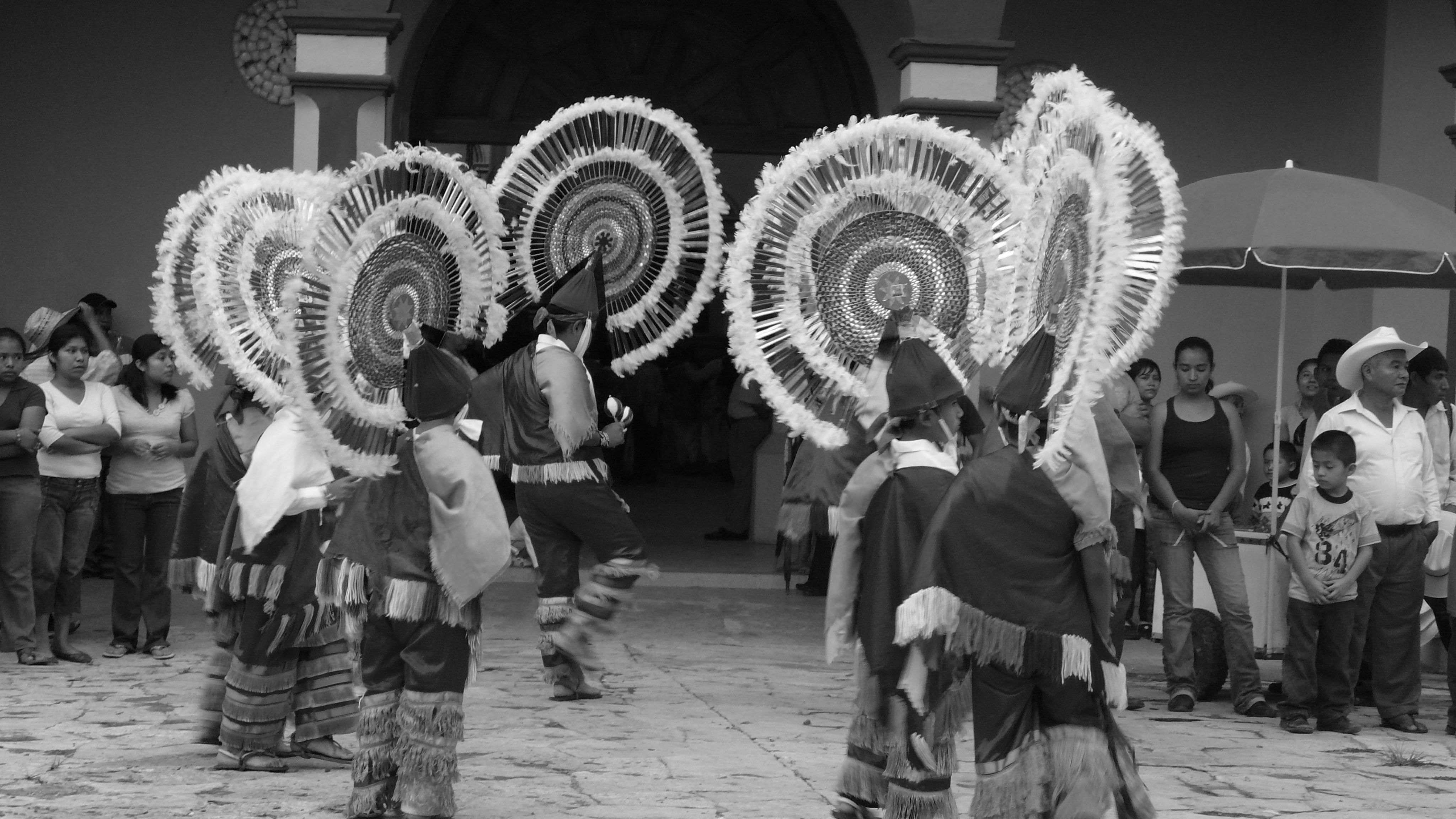

For over 50 years (since 1973), Italian ethnologists at Sapienza University of Rome have been studying the culture and social practices of numerous indigenous groups in Mexico.
They represent more than a tenth of the country’s population; speak more than 50 indigenous languages (in addition to Spanish); they are the custodians of cultural traditions that are as ancient and diverse as they are vibrant - combining many aspects of pre-Hispanic American civilizations with the contributions of the culture and religion of the Spanish conquerors and the constant innovations produced by their members.


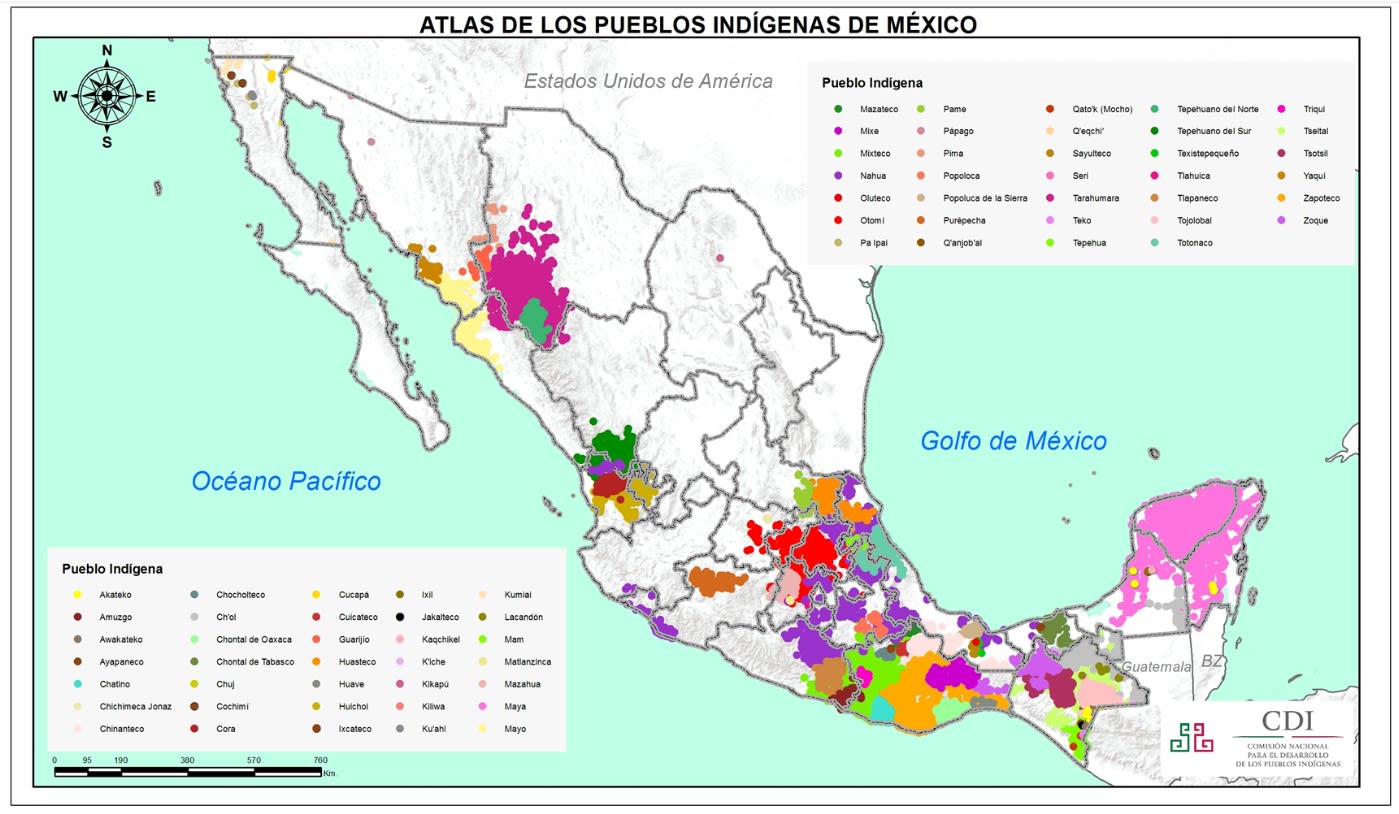
Map showing the distribution of the main indigenous languages of Mexico (Atlas de los pueblos indígenas de México, CDI)
Map showing the distribution of the main indigenous languages of Mexico (Atlas de los pueblos indígenas de México, CDI)

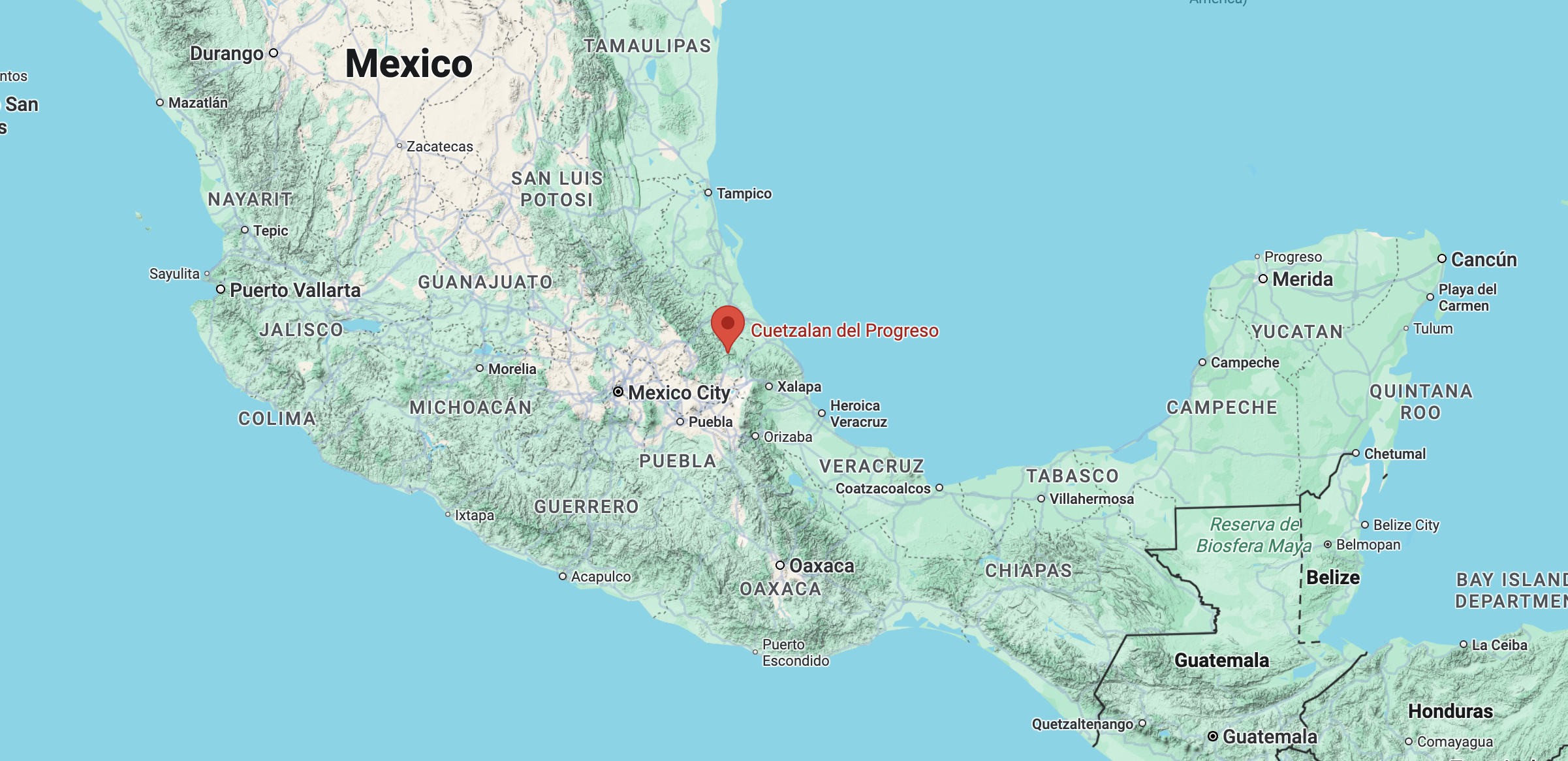
Map of the Sierra Norte de Puebla, showing the location of Cuetzalan
Map of the Sierra Norte de Puebla, showing the location of Cuetzalan

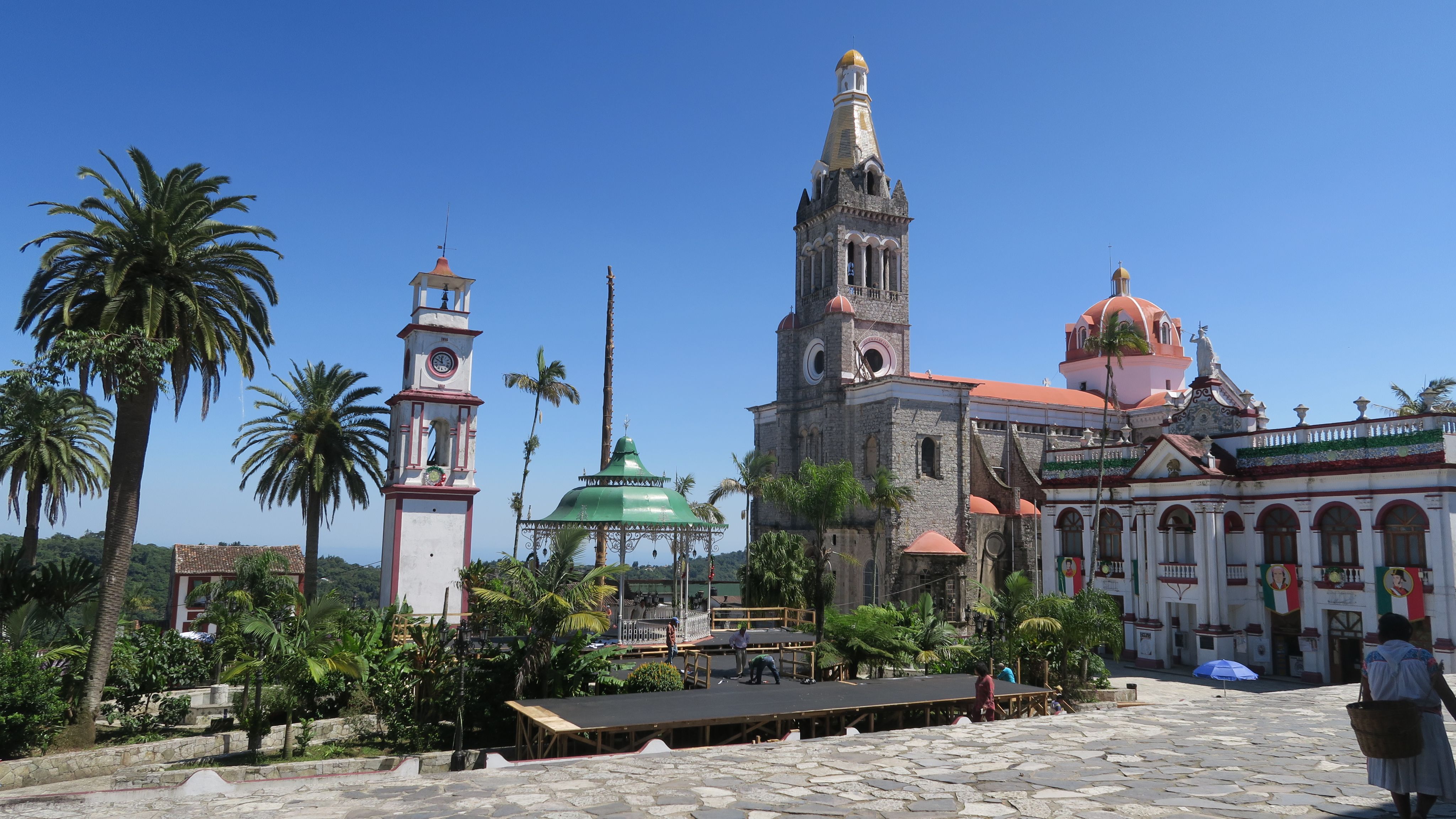
The main square in Cuetzalan del Progreso (photo by A. Lupo, 9/12/2017)
The main square in Cuetzalan del Progreso (photo by A. Lupo, 9/12/2017)

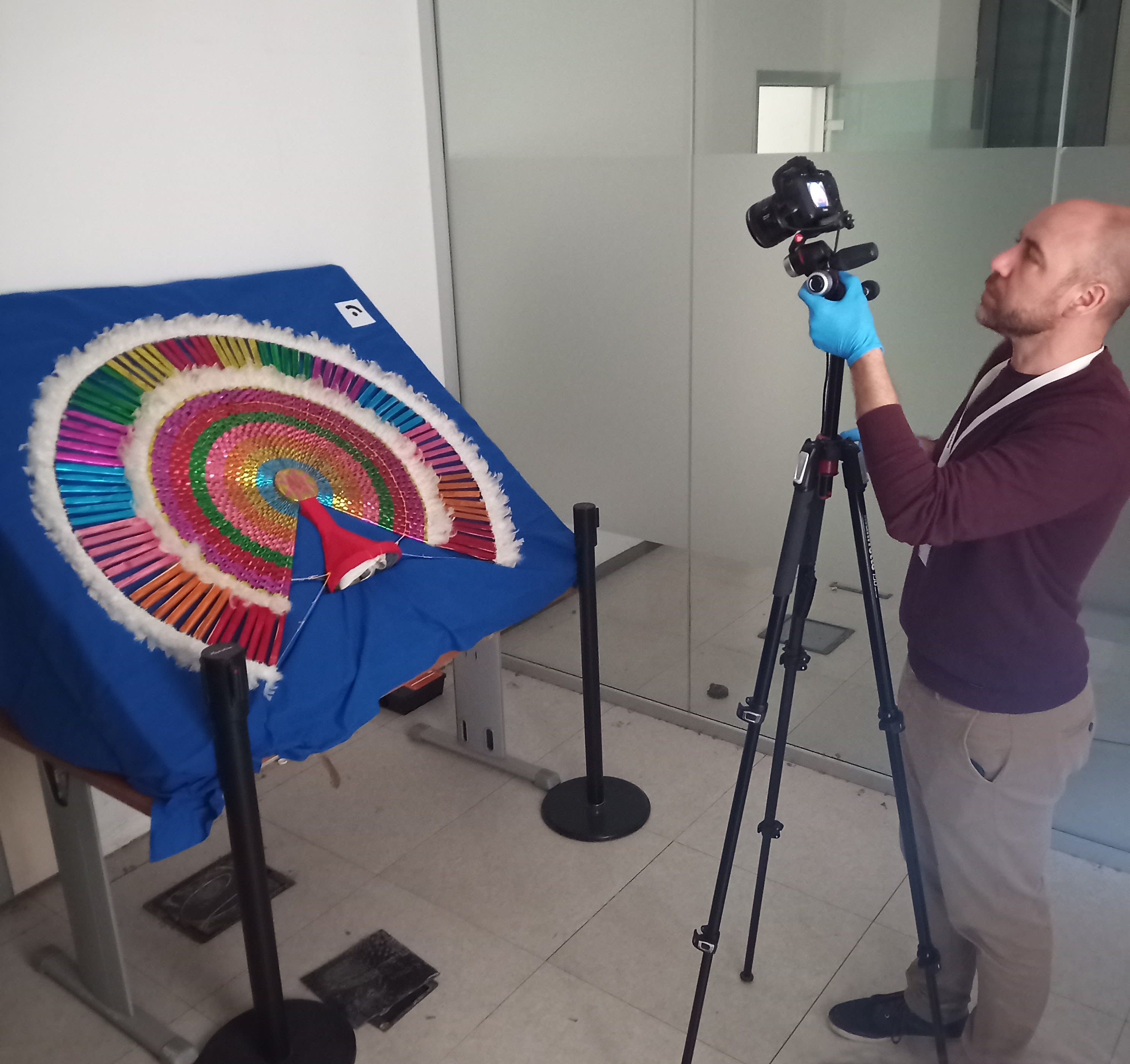
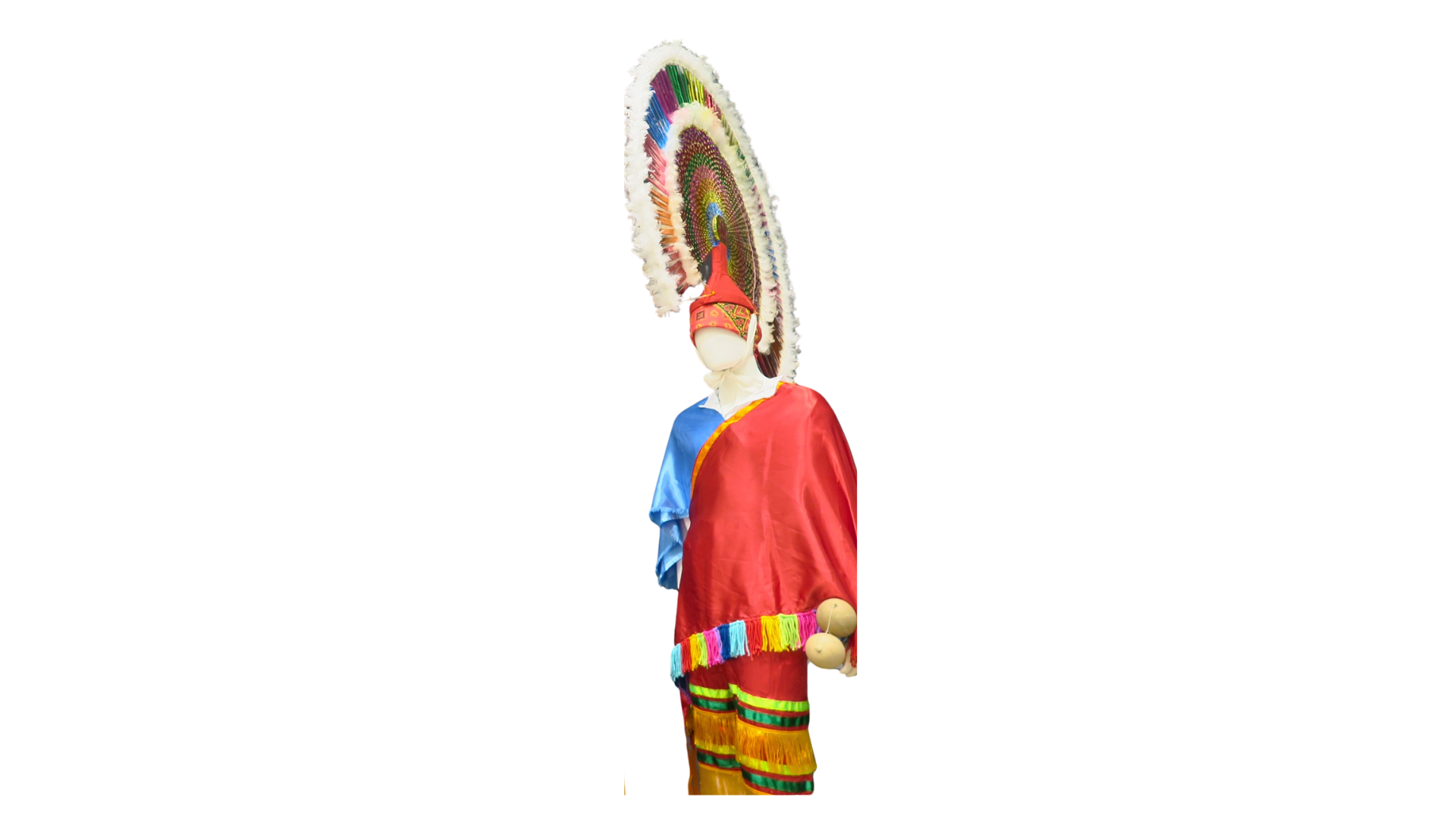
The Kuesalin dance costume donated by the Italian Ethnological Mission in Mexico to the Museum of Civilization in Rome and scanned by Daniele Ferdani of MOLAB-CNR (photo by V. Bellomia, 4/17/2025)
The Kuesalin dance costume donated by the Italian Ethnological Mission in Mexico to the Museum of Civilization in Rome and scanned by Daniele Ferdani of MOLAB-CNR (photo by V. Bellomia, 4/17/2025)
The Maseual (or Nahua) people of the municipality of Cuetzalan, in the Sierra Norte de Puebla, speak an eastern variant of Nahuatl and live off agriculture, trade in their flourishing handicrafts, and a growing tourist industry. Among the aspects that most clearly characterize their social life are numerous ceremonial dances, which accompany the feasts of the patron saints.
The dance of the Kuesalimej (macaws) is one of the oldest and most evocative of this tradition, and although it is considered by many to be the most representative of Cuetzalan, it is becoming increasingly difficult and costly to perform it and recruit new dancers.
This risk prompted Italian researchers to acquire a costume to display in the MUCIV - Museo delle Civiltà - Rome, to give international recognition and visibility to the dance, and at the same time to deliver to the dancers and bilingual schools of Cuetzalan the ethnographic materials collected over the last decades. This for contributing to the preservation and revitalization of this heritage, which has extraordinary aesthetic appeal and scientific interest, as well as fundamental identity value.
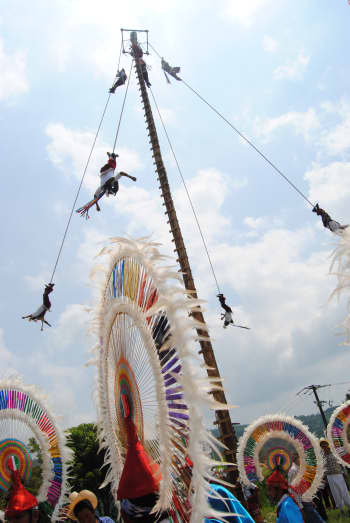

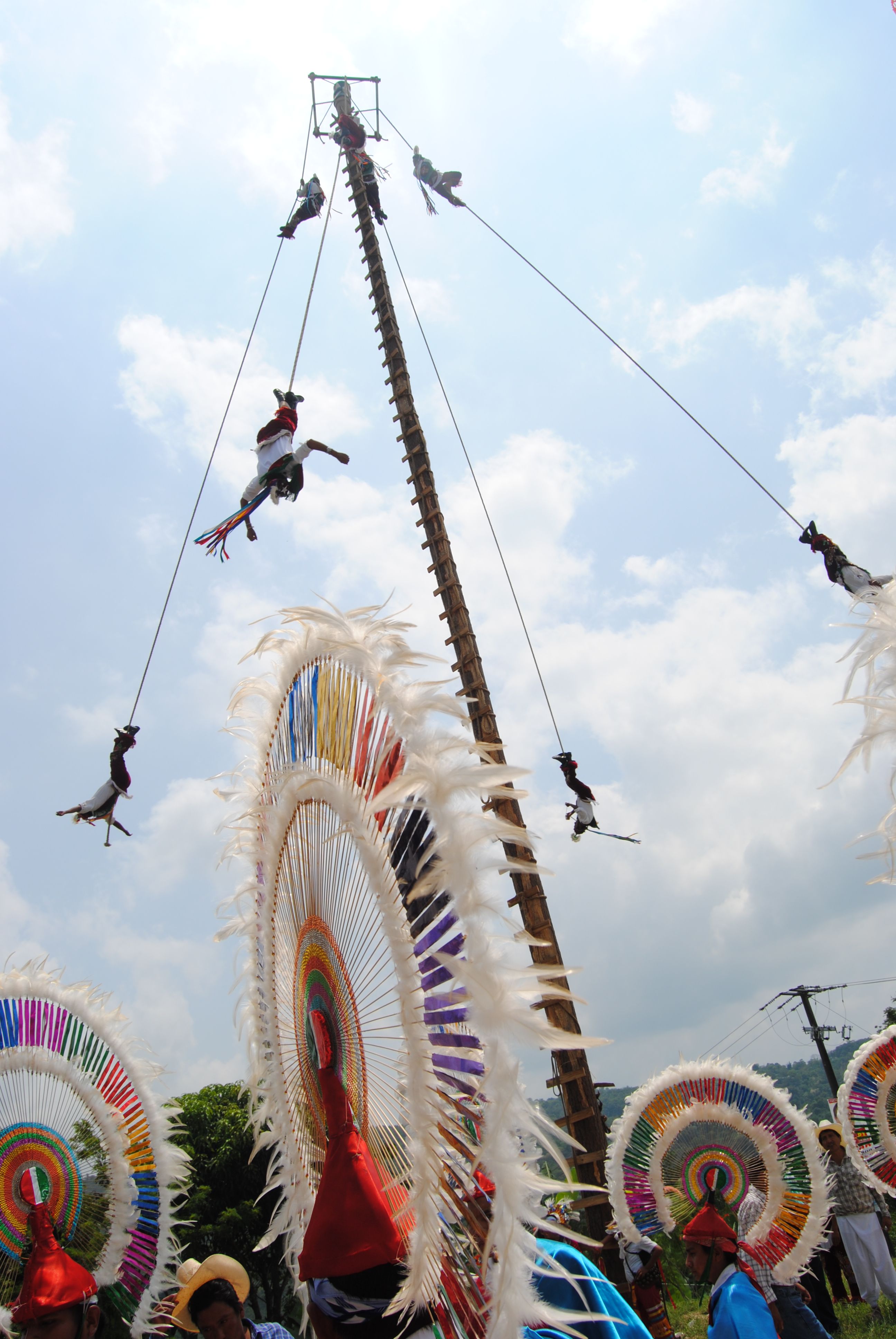
"This is soul, life, and heart, which is given to dance"
.01
Dance as a form of devotion and prayer
The fusion of pre-Hispanic heritage and colonial imposition
All indigenous peoples in Mexico have a deep-rooted tradition of ritual dances, which are not merely an opportunity for entertainment and socialization, but represent one of the main ways in which individuals and communities communicate with the extra-human world.
Since pre-colonial times, Mesoamerican civilizations practiced dance in most of their religious celebrations, expressing through the sound of musical instruments, songs, and dance steps the devotion of their members to the deities, on whom they believed their precarious existence depended.
At the time of the Conquest, the Spanish attempted to eradicate these customs, which they considered idolatrous because they were directed toward “pagan” deities and linked to sacrifices. In evangelizing the indigenous peoples, they taught them other dances of Iberian origin, which depicted the triumph of Christianity over the “infidels”, equating the Moors recently expelled from Spain with the Amerindians who had just been subjugated and converted. The result was that indigenous dances changed form (costumes, attributes, and symbols) and recipients (God and the saints instead of the ancient gods) and combined with those of European origin, giving rise to a new syncretic, original and vibrant dance tradition.
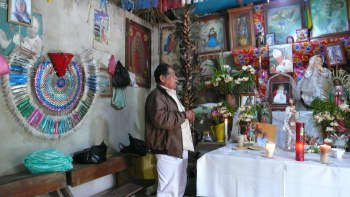
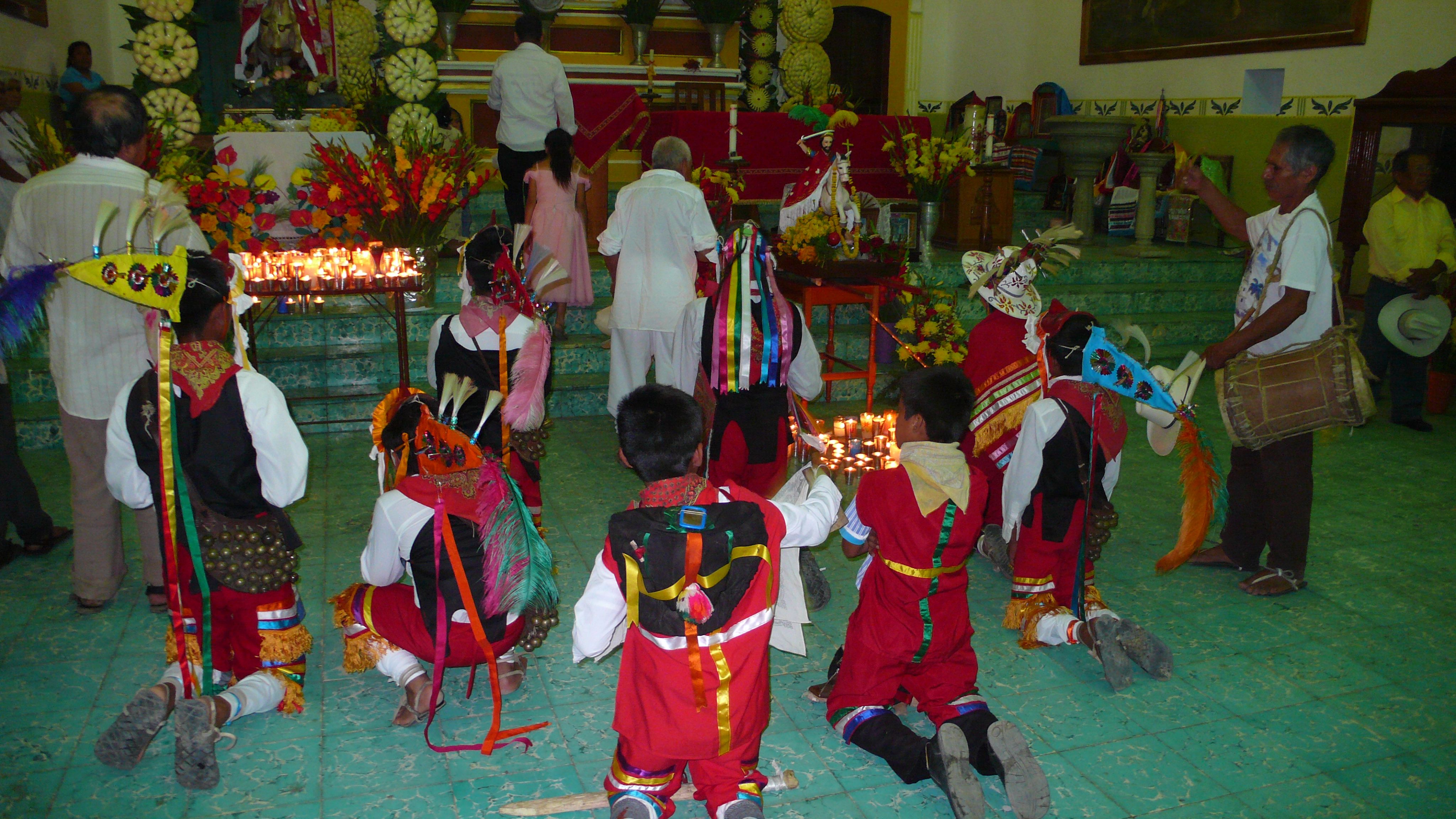
In Cuetzalan, participation in ceremonial dances is one of the elements that distinguishes the indigenous majority from the economically more prosperous mestizo minority. The decision to join a dance group is seen as a kind of vow (motentalilis; Sp. promesa) offered to the gods to earn their favor and the granting of health, well-being, and harmony for oneself and the community.
The dancers’ effort (symbolically summarized by the word neton, “sweat”) and the sincere joy with which they perform their movements are considered a true offering to the saints and to God, no less concrete and equally welcome than the candles, flowers, incense, and prayers offered to them in churches and on household altars.
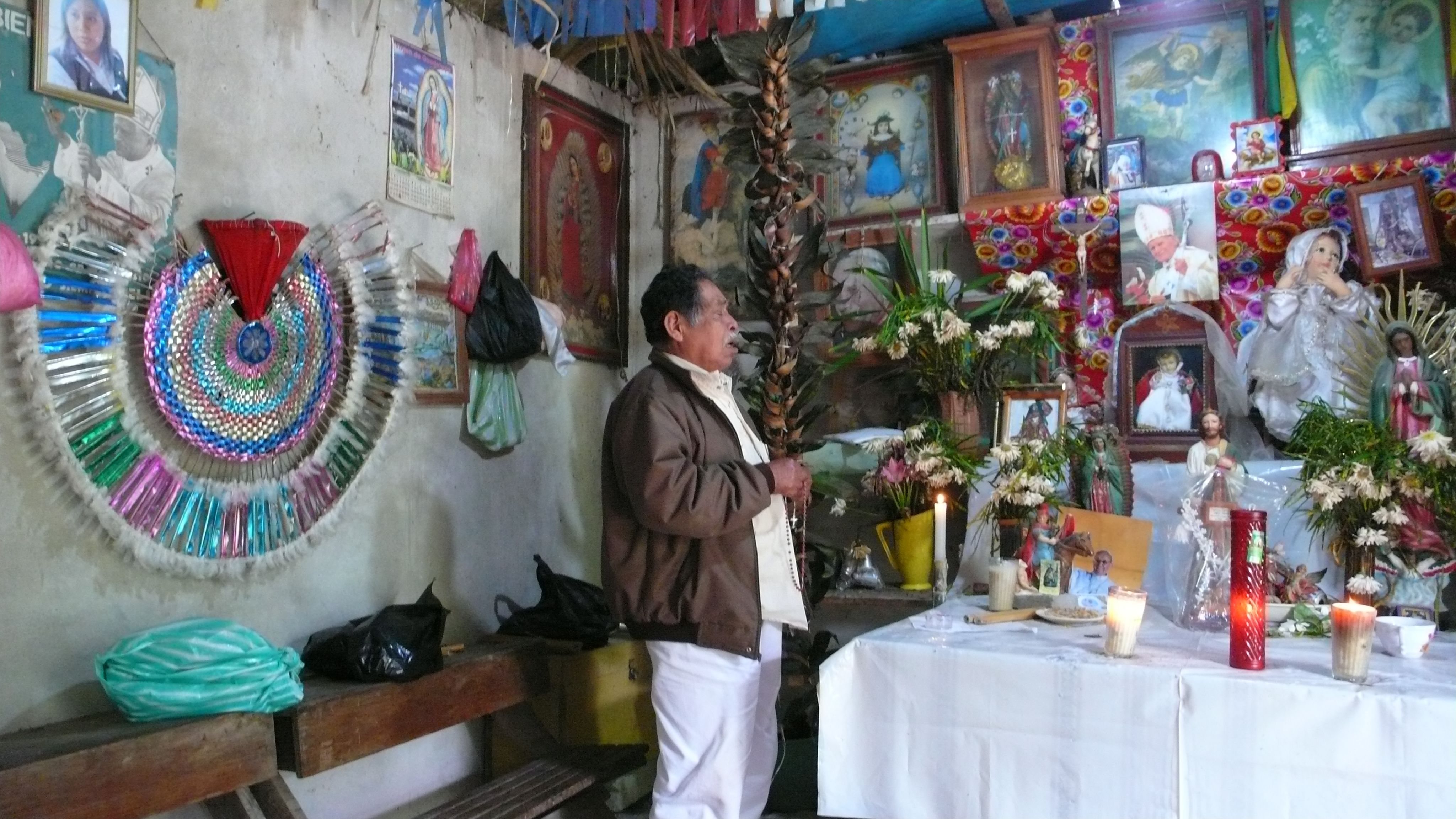
Dance is a way of praising God. When I dance, I pray and say to Him, “Give me health, my God. Give health to my brothers and sisters. Forgive us for our sins".

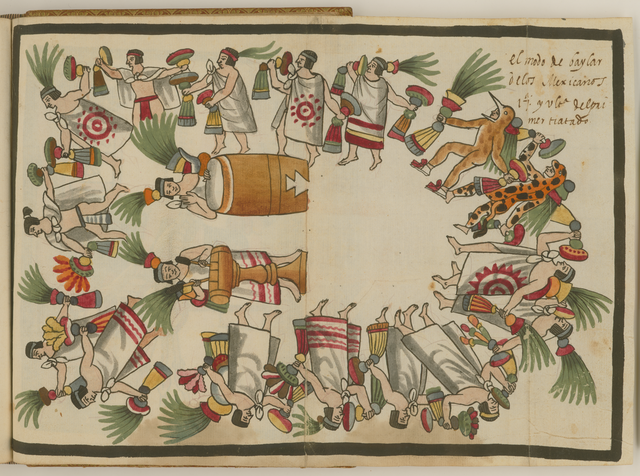
Pre-Hispanic ceremonial dances in a pictographic manuscript from the early colonial period (Tovar Codex from Wikicommons)
Pre-Hispanic ceremonial dances in a pictographic manuscript from the early colonial period (Tovar Codex from Wikicommons)
"We indigenous people have maintained this identity through dance, through music, through rituals in community celebrations and family celebrations, dance, indigenous medicine"
Isauro Chávez, 8/2002, quoted in the article
"Superponer sonidos, superponer culturas" of G. Tuzi (2013), p.374.


.02
The ceremonial dances of Cuetzalan
A kaleidoscope of colors, sounds, movements, and emotions
When the patron saint festivals are celebrated in the communities of Cuetzalan, the square and streets adjacent to the church fill with a tumultuous crowd, where the many different dance groups saturate the eyes and ears with a simultaneous whirlwind of colors and movements and overlapping melodies.
This apparent confusion is not perceived as disorder or cacophony, as each group is perfectly capable of moving independently, while it is believed that it is precisely the multitude of dancers that constitutes the quality of their “offering,” not unlike the prayers that the faithful raise individually to God and which collectively express the intensity of devotion that He pleases.
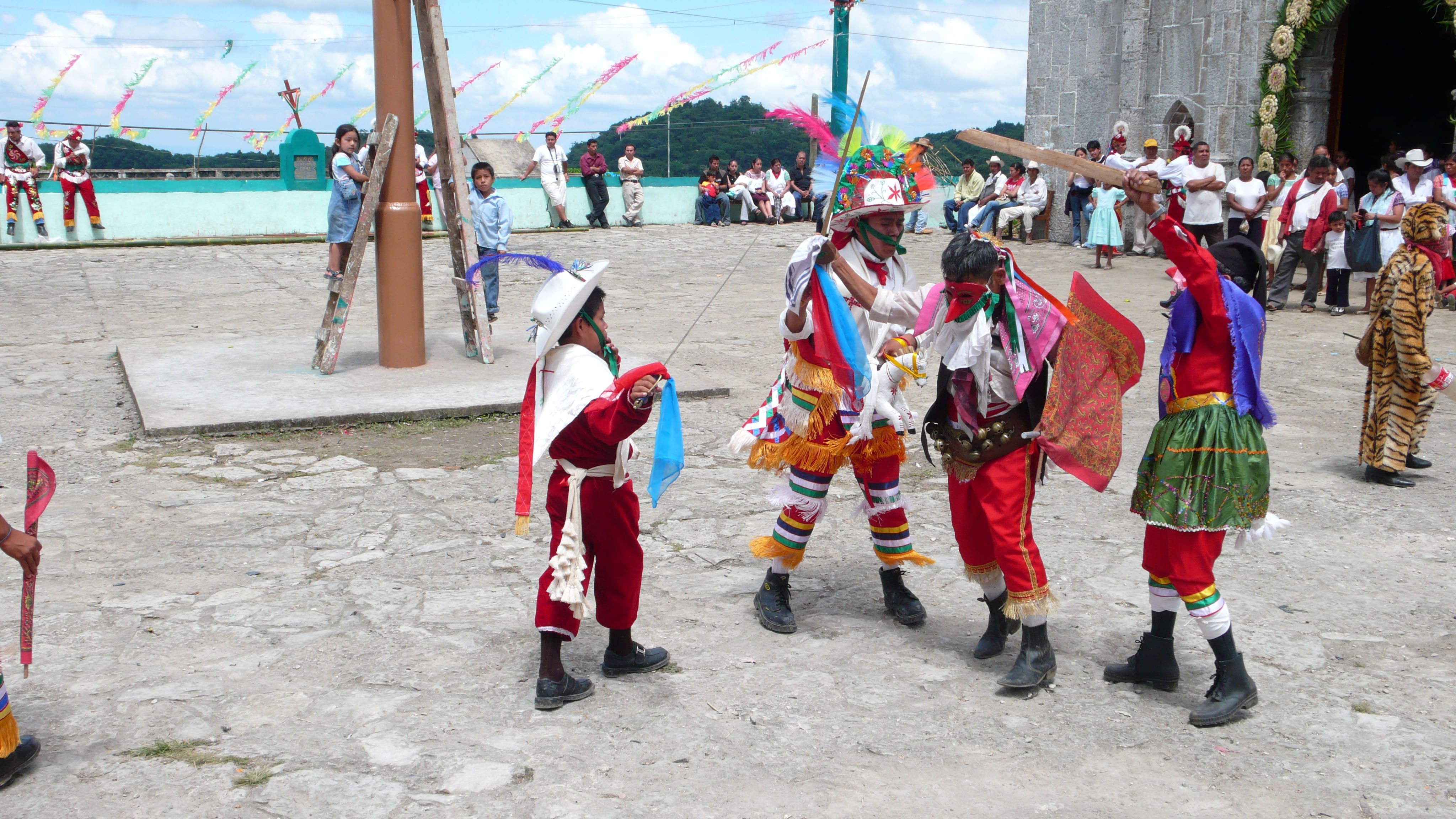
Alongside dances of clear pre-Hispanic origin, such as the Kuapatanini (better known as Voladores) and the Kuesalimej (called Quetzales in Spanish), there are others of colonial origin, such as the Santiagos, the Negritos, the Matarachines, the Migueles, the Toreadores, and the Vegas, now assimilated by the Nahua as “typically indigenous” because they are not usually practiced by mestizos.
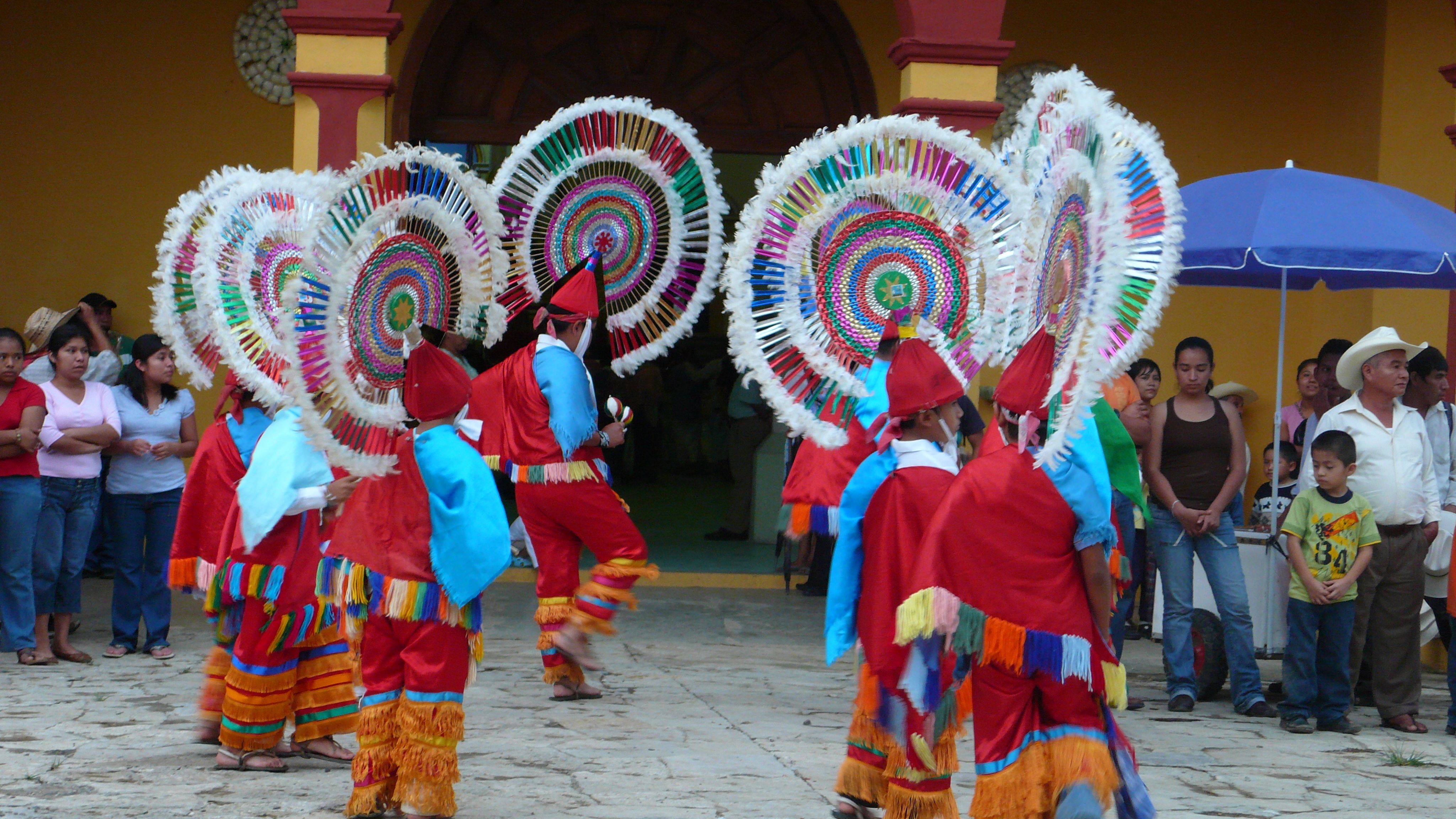
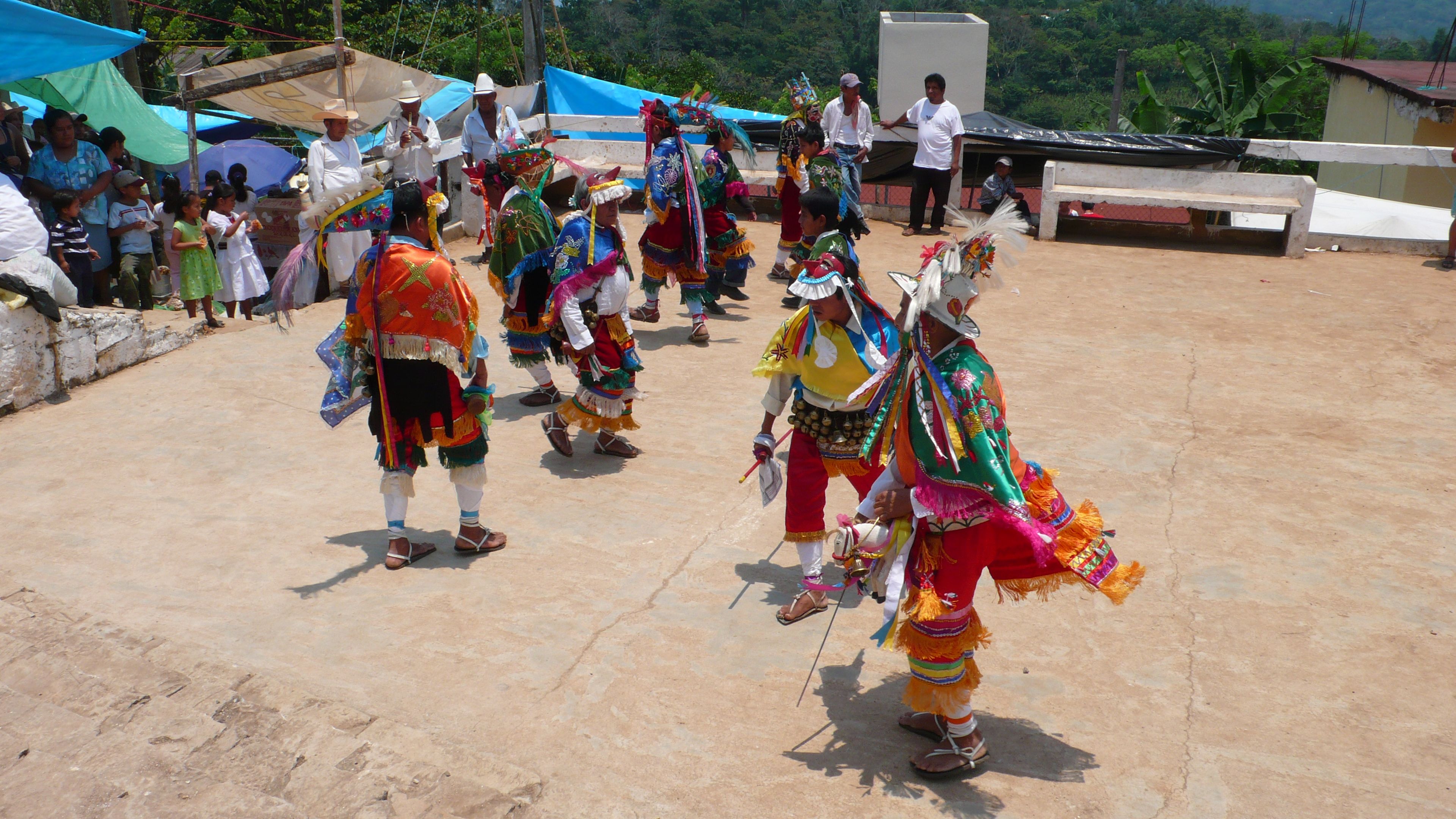
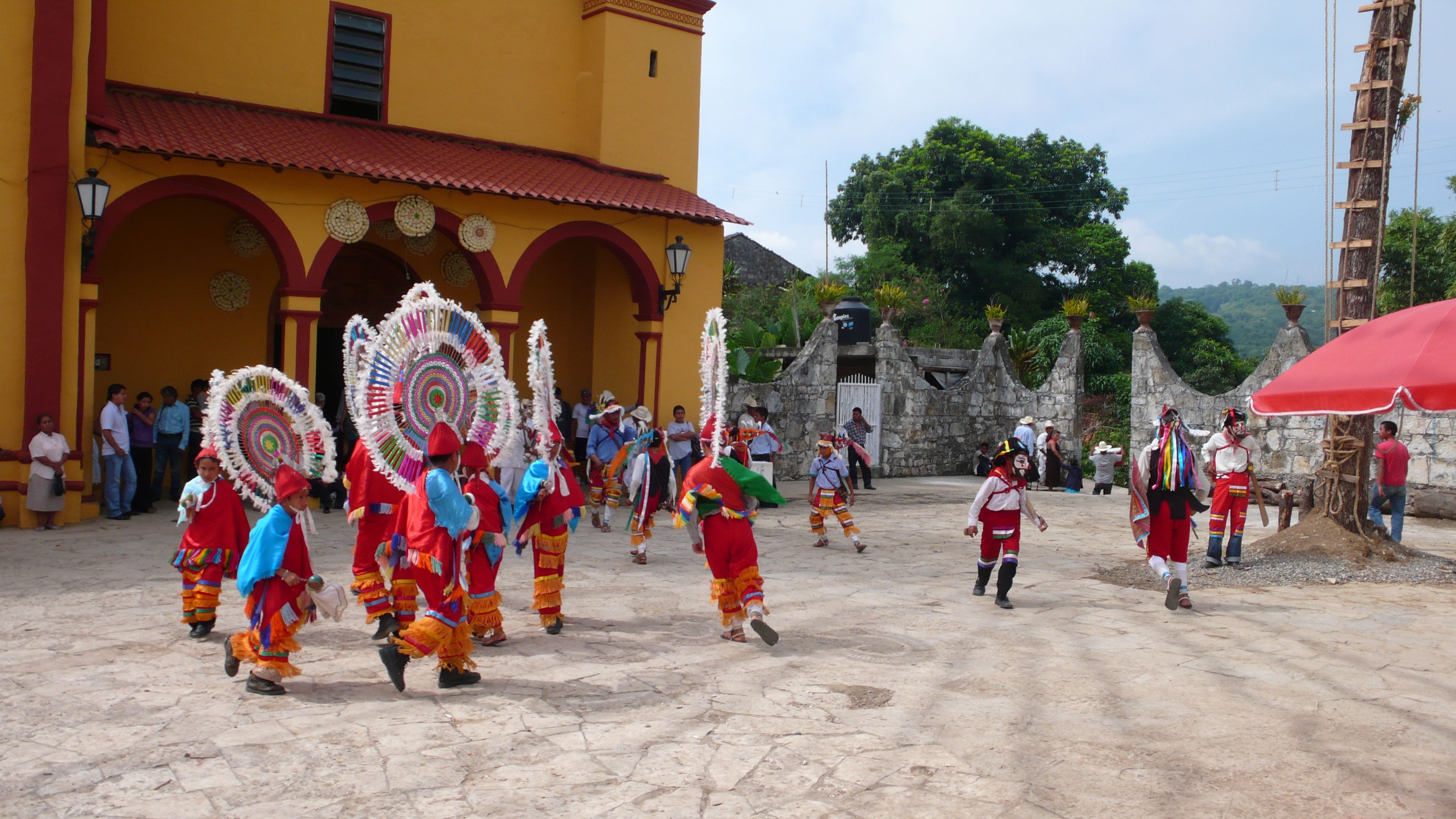
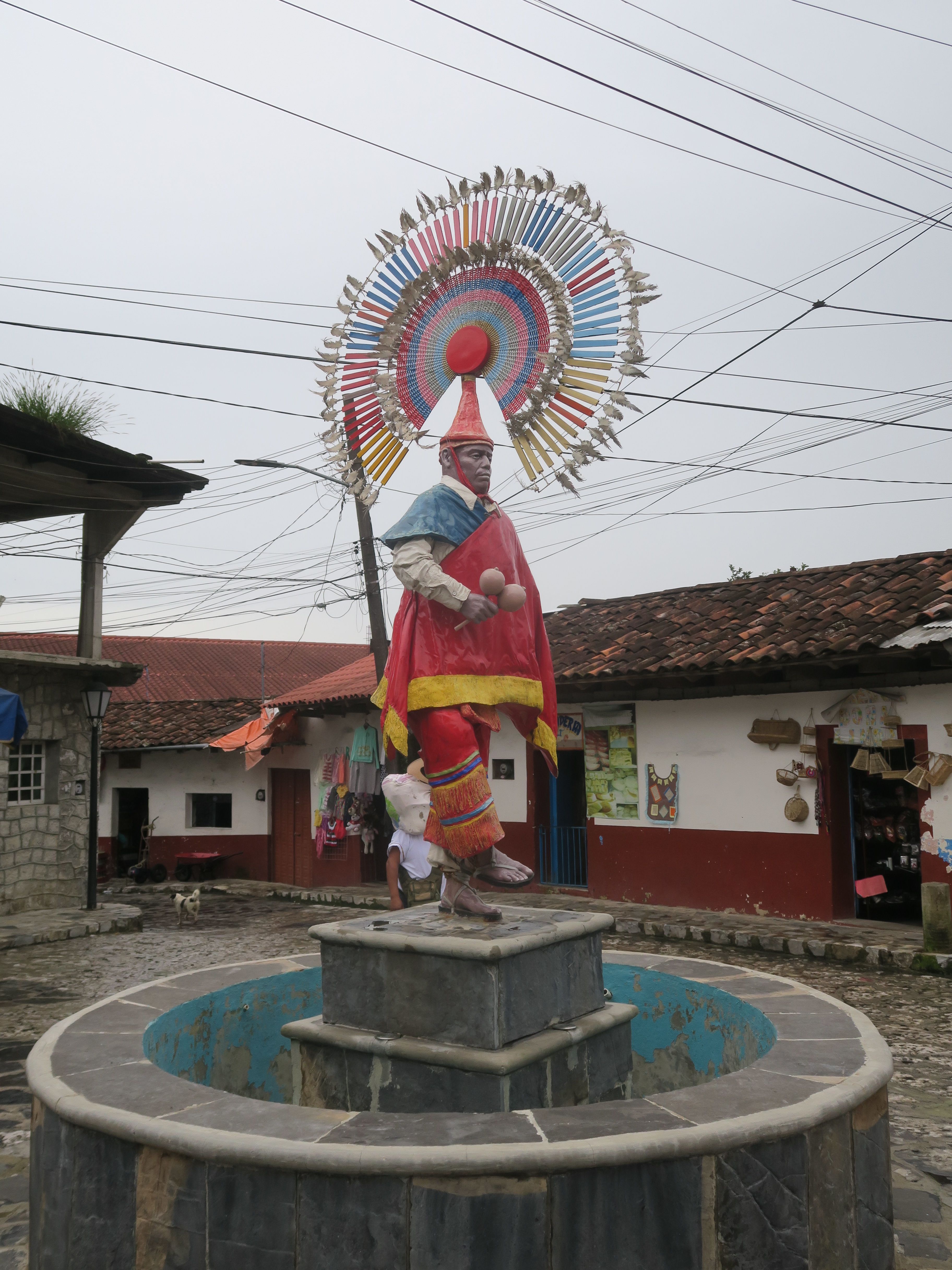
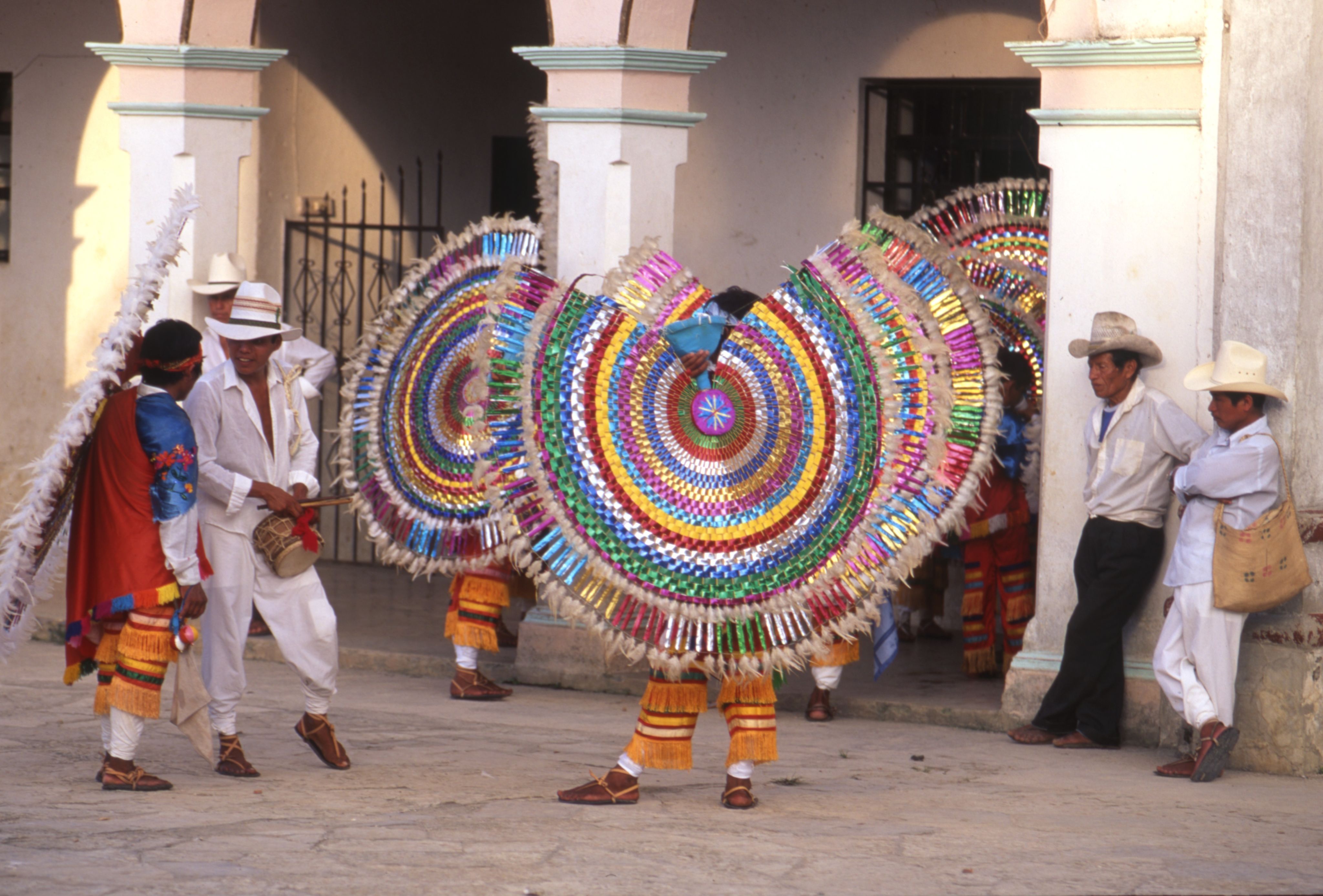
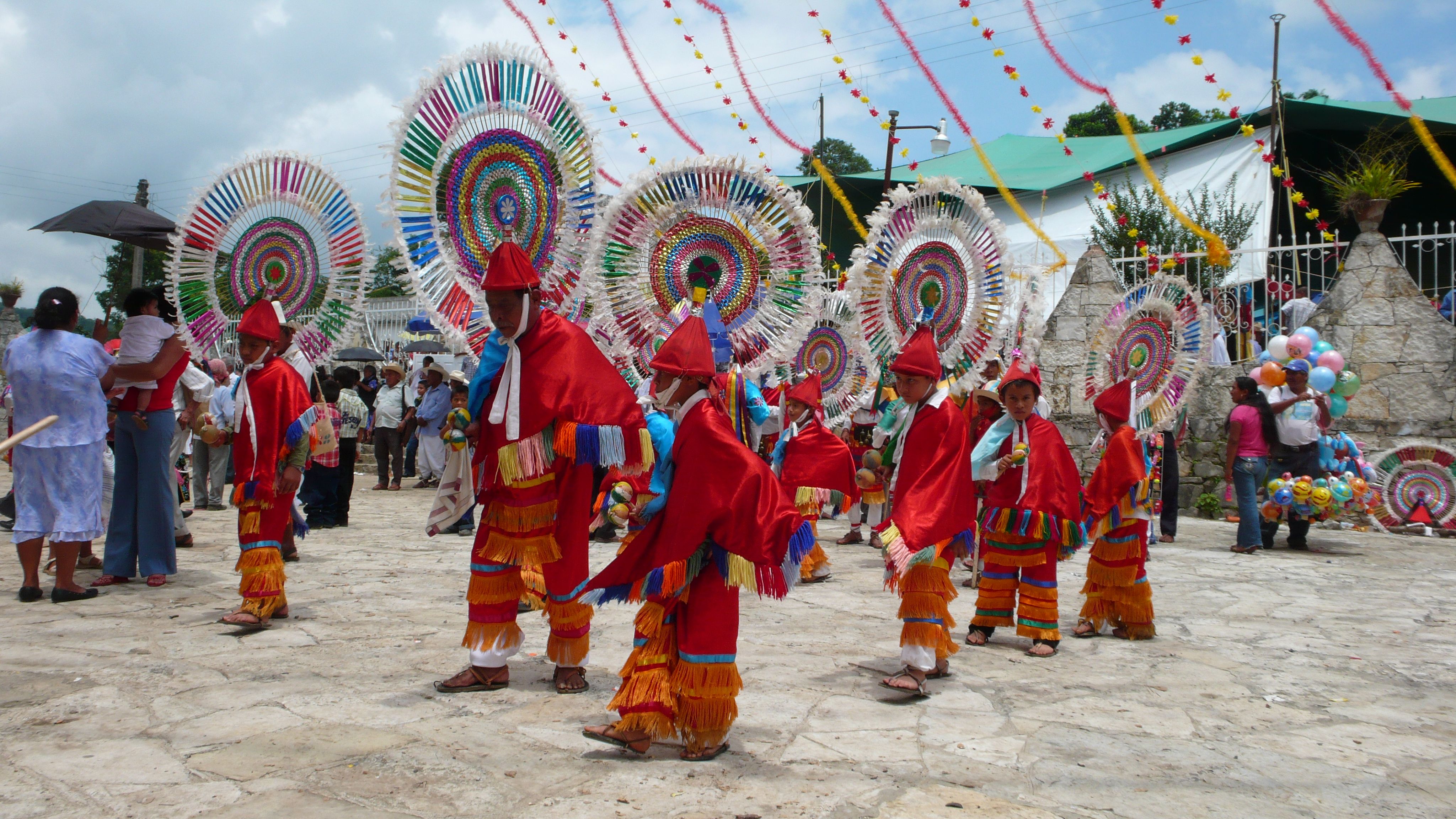
While the Voladores stand out for the spectacular nature of their perilous performance —which consists of gliding slowly in wide circular loops from a very high pole— the Kuesalimej owe their appeal to their colorful costumes, featuring large circular headdresses made of shiny ribbons and feathers.
But the centrality of this dance for the Nahua derives above all from the fact that it represents the movements of birds, now extinct, that gave the town its name (formerly called Cuezallan, “place where macaws abound”), so much so that it is considered «the most important dance in Cuetzalan, more important than the Voladores» (Miguel Cruz, interview of 13/9/2018).
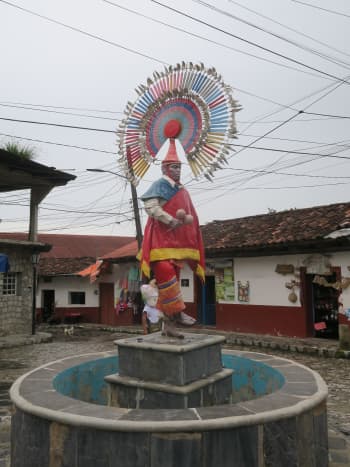
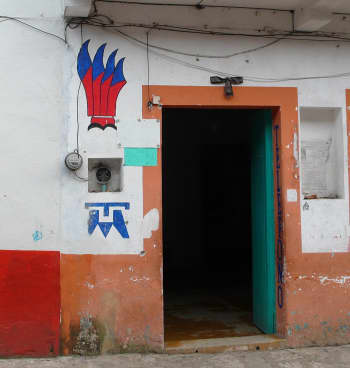
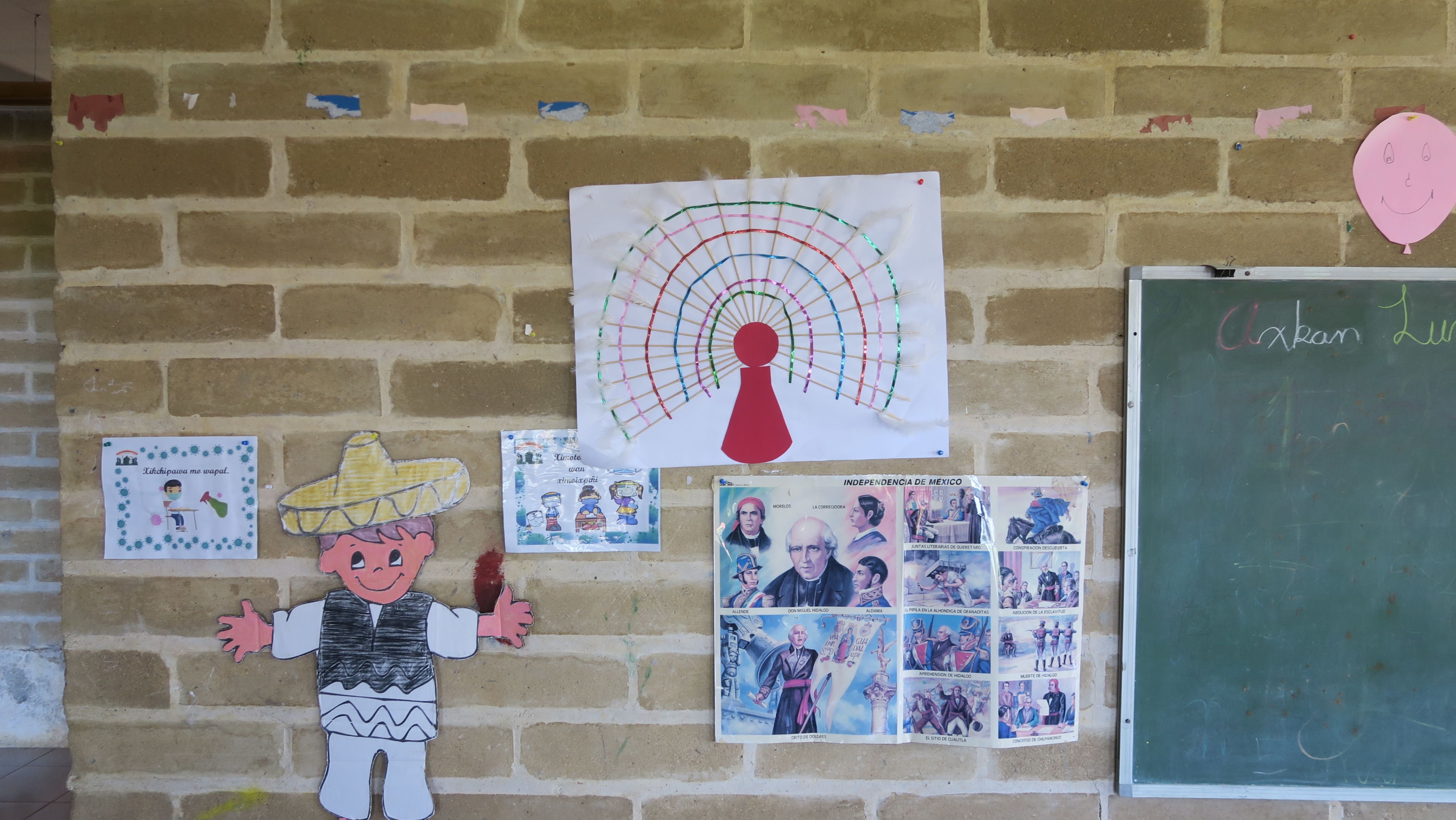
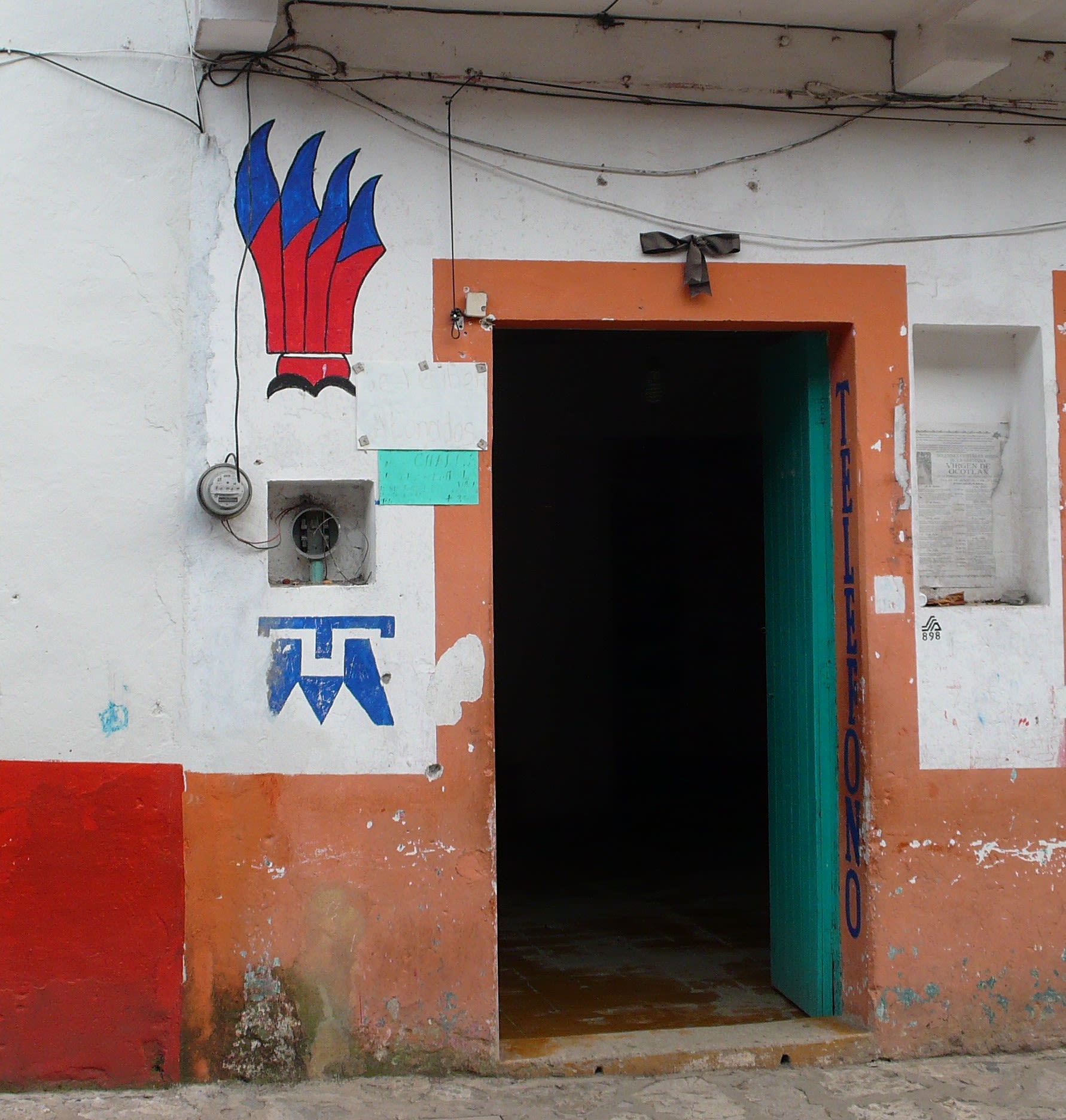
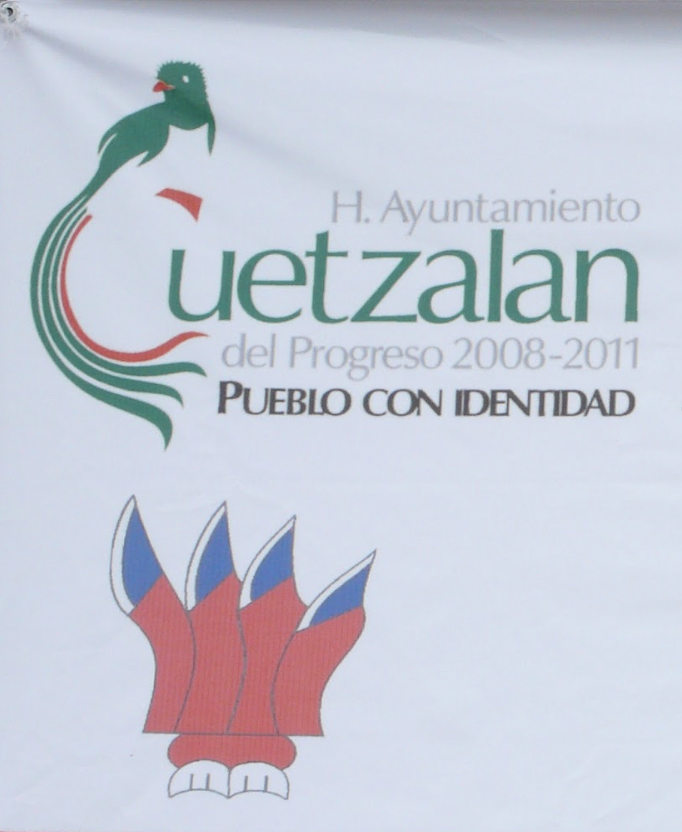
In local iconography, crafts, and tourist advertising, the Kuesalin “crown” has become a graphic symbol of this town and the absence of the Kuesalimej is enough to declare a festival a failure, which is not the case for other dances.

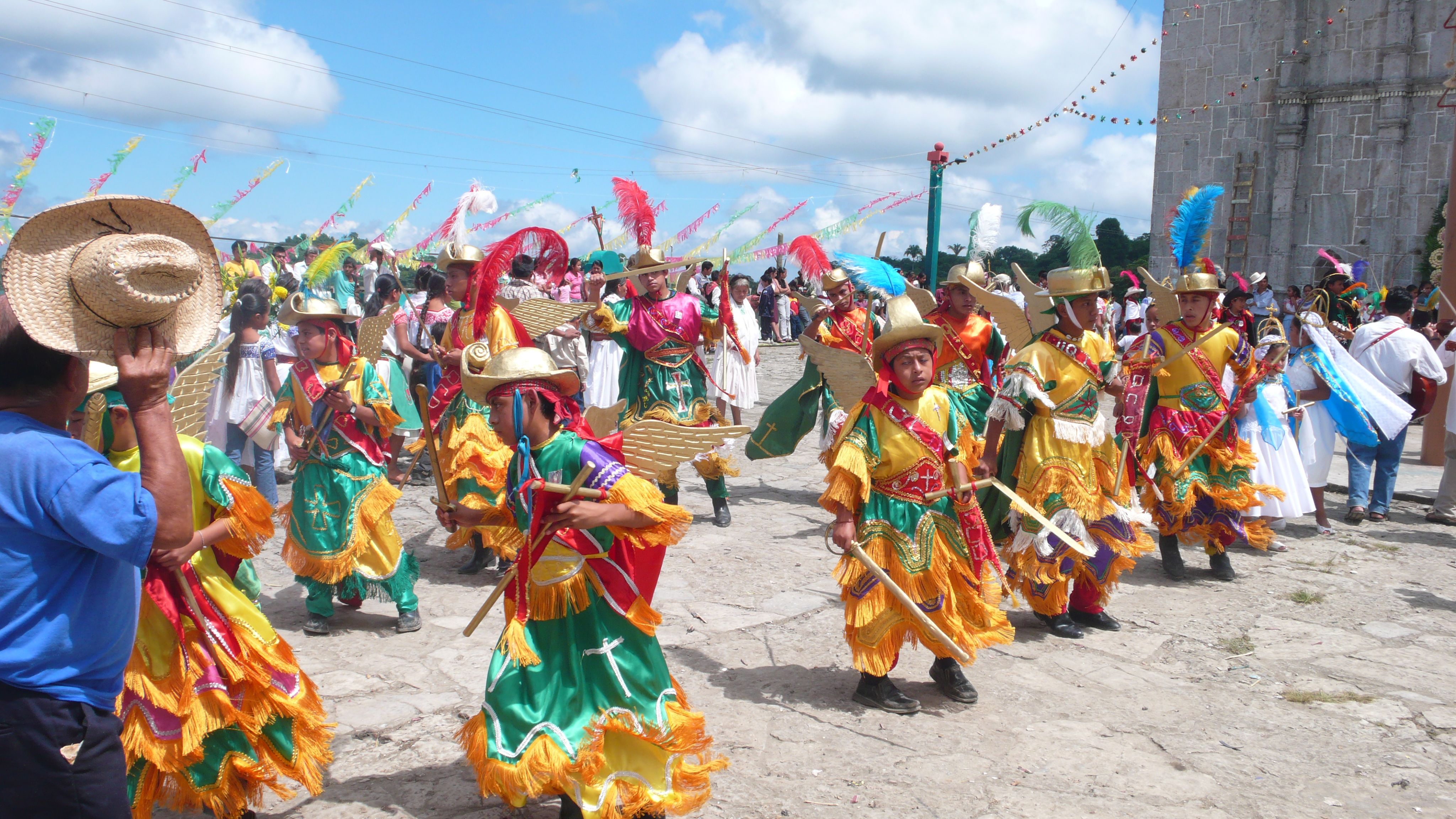
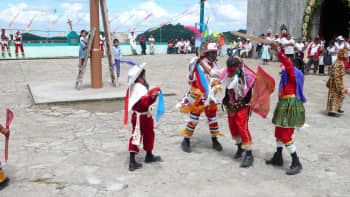
Dance of the Migueles during the patron saint festival of San Miguel Tzinacapan (photo by A. Lupo, 9/30/2006)
Dance of the Migueles during the patron saint festival of San Miguel Tzinacapan (photo by A. Lupo, 9/30/2006)
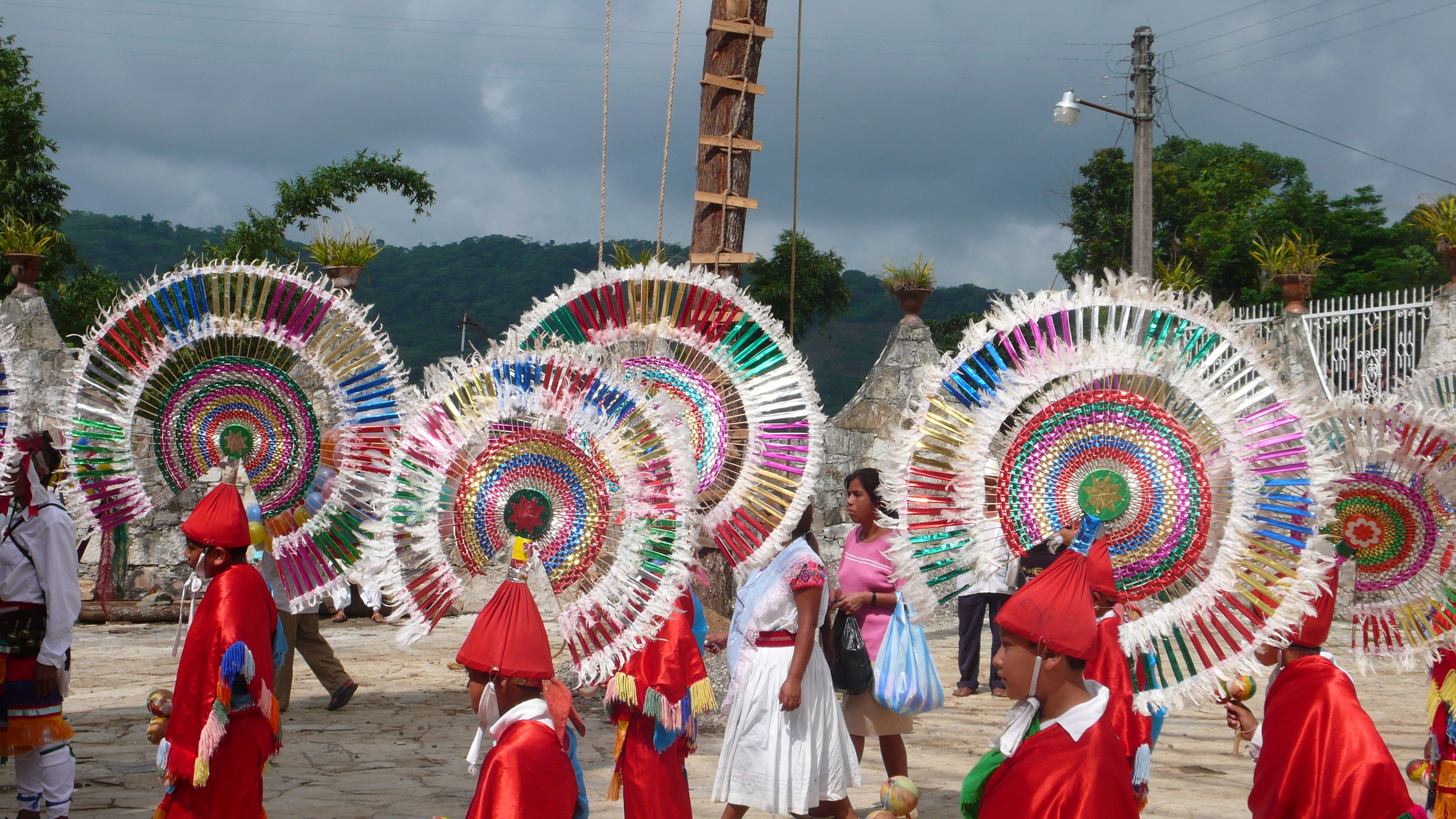
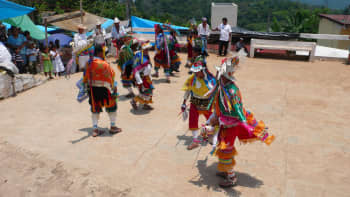
Dance of the Kuesalime during the patron saint festival of Santiago Yancuictlalpan (photo by A. Lupo, 25/7/2009)
Dance of the Kuesalime during the patron saint festival of Santiago Yancuictlalpan (photo by A. Lupo, 25/7/2009)
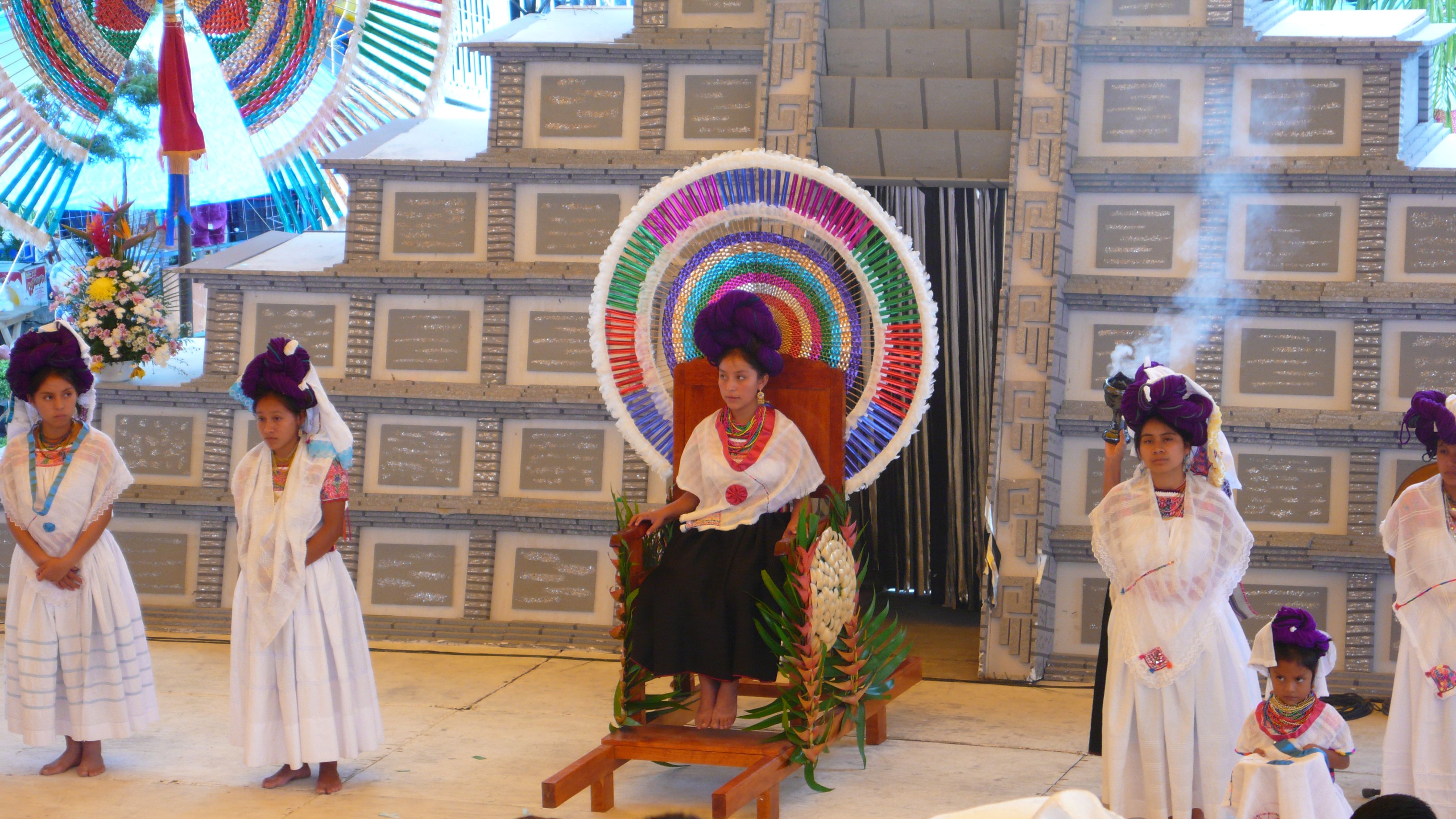
Enthronement of the Reina del huipil (a kind of beauty contest) in the square of Cuetzalan (photo by A. Lupo, October 4, 2006)
Enthronement of the Reina del huipil (a kind of beauty contest) in the square of Cuetzalan (photo by A. Lupo, October 4, 2006)

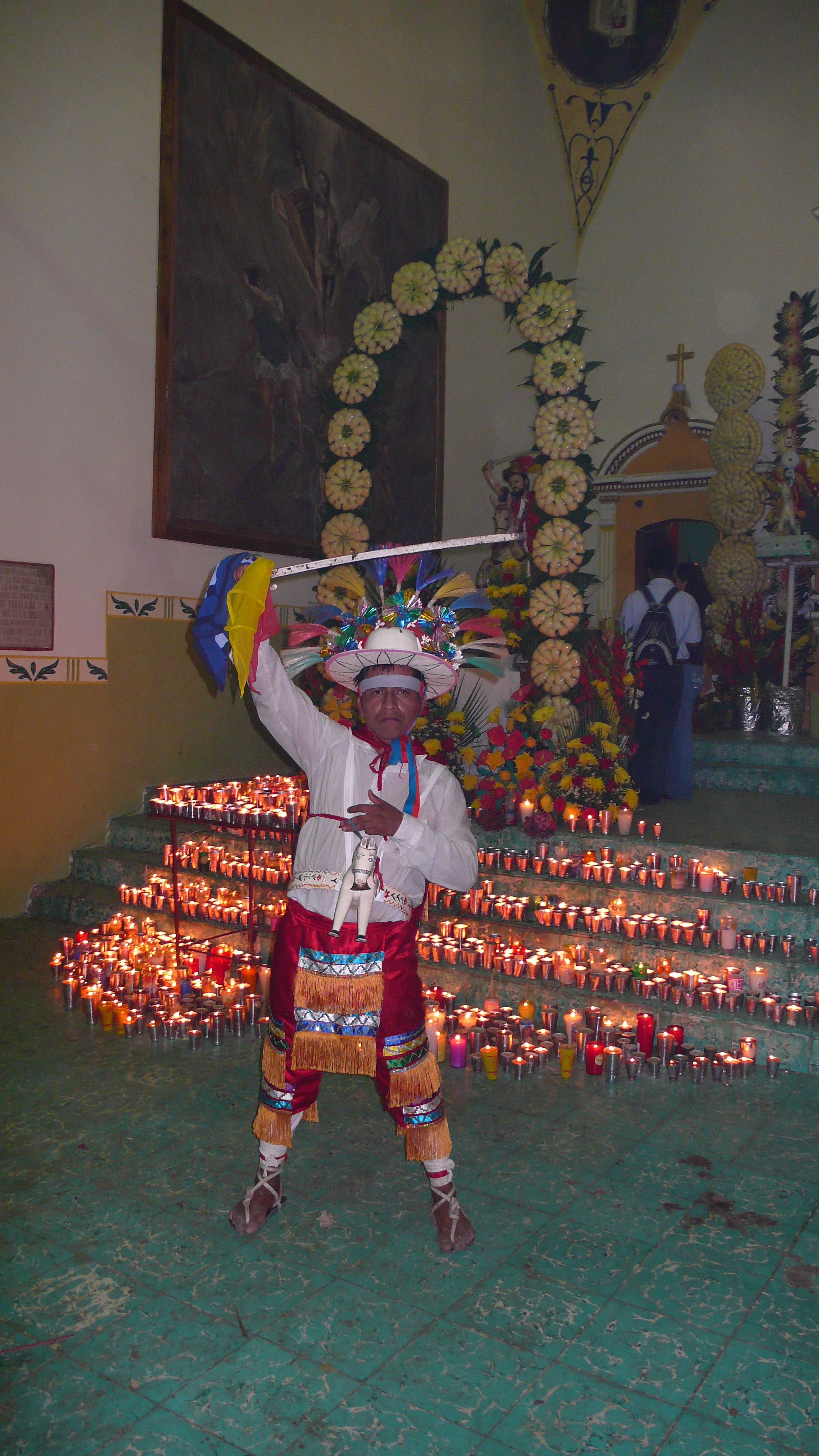
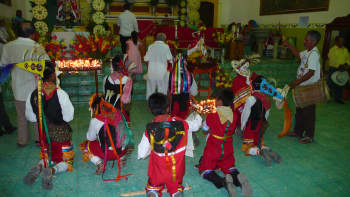
Dancer impersonating Saint James in front of the image of the saint, Santiago Yancuictlalpan (photo by A. Lupo, July 25, 2009)
Dancer impersonating Saint James in front of the image of the saint, Santiago Yancuictlalpan (photo by A. Lupo, July 25, 2009)
"Yes, we are closer to God. We participate in God, we are followers of Christ. We praise him with our costumes, with our wisdom: it’s prayer."


.03
Kuanezcayot: an iridescent “crown”
The elements and symbolism of the Kuesalin costume
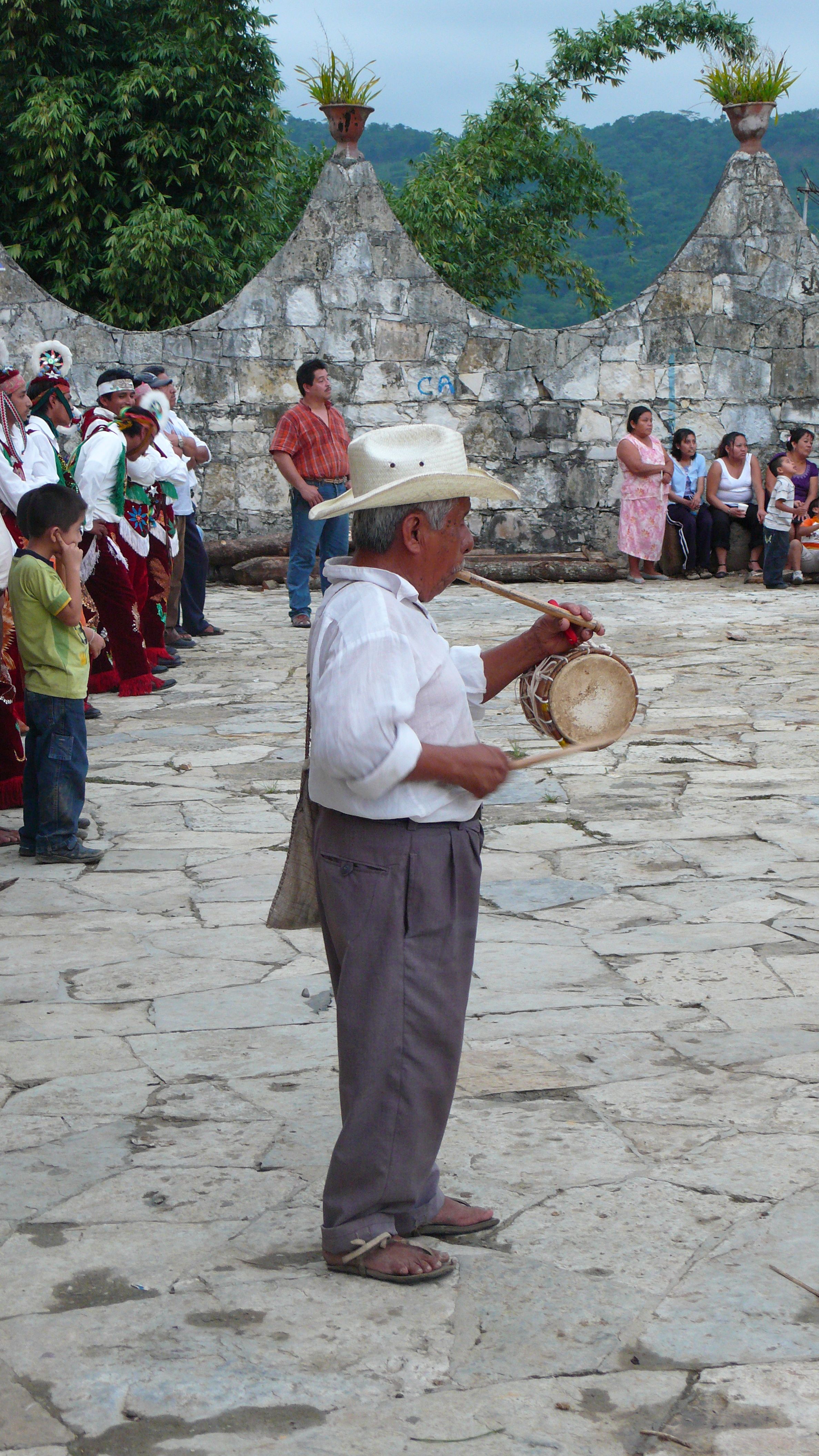
The Kuesalimej dance is performed by a dozen dancers, who move to the rhythm of different musical motifs (or sones, from 16 to 30) played by a single musician who simultaneously plays the reed flute and drum.
It takes place by accompanying the saints in procession through the streets of the village or by performing in the church and in the square in front of it.
Along with the effort put into the entire festival, the beauty of the costumes, enhanced by the play of light produced by the coordinated movements of the dancers, is part of the offering they present to the deity. This is why they devote so much care to the manufacture and preservation of their garments and “crowns,” which are spectacular but also fragile and ephemeral (especially in the hot and humid climate of the Sierra).
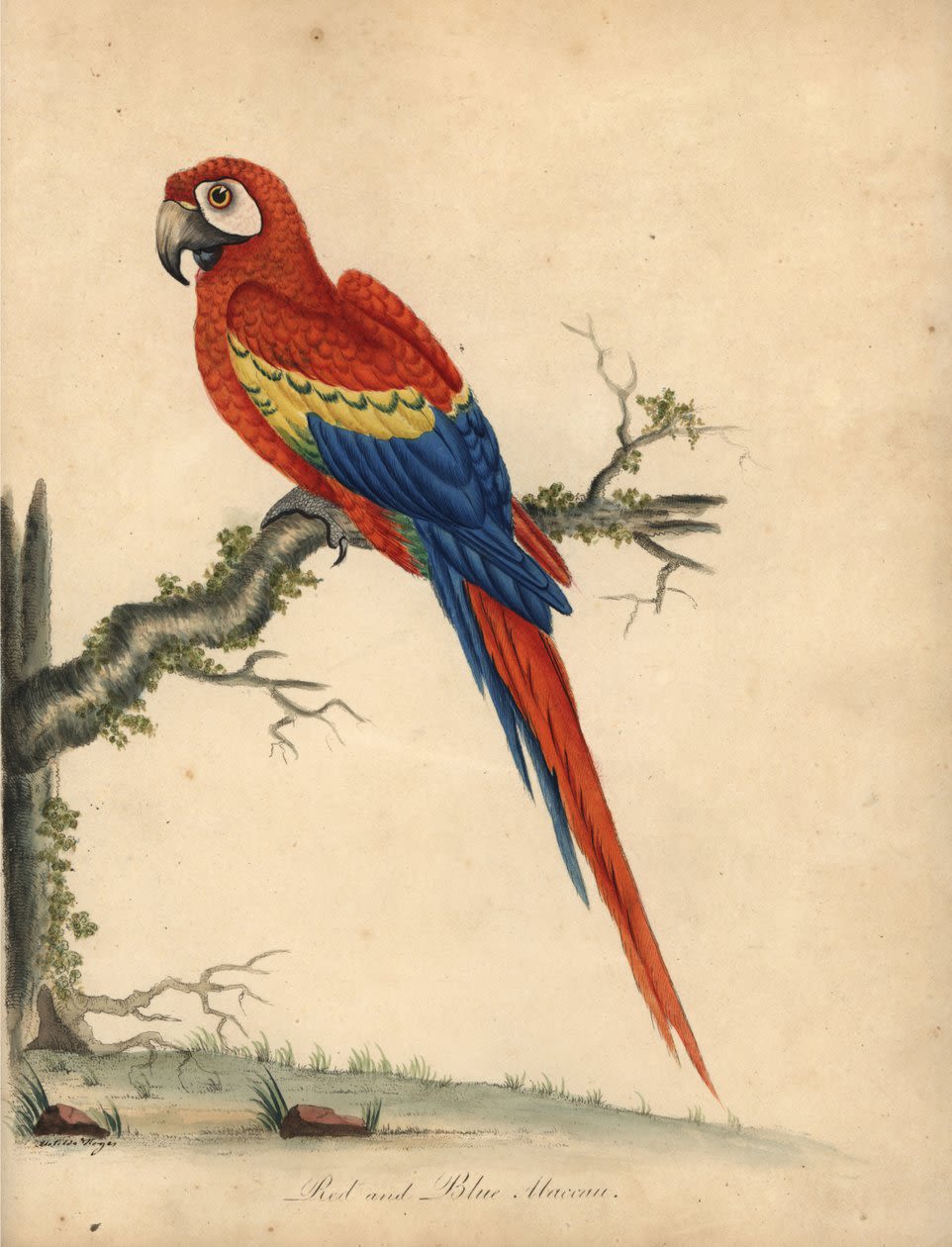
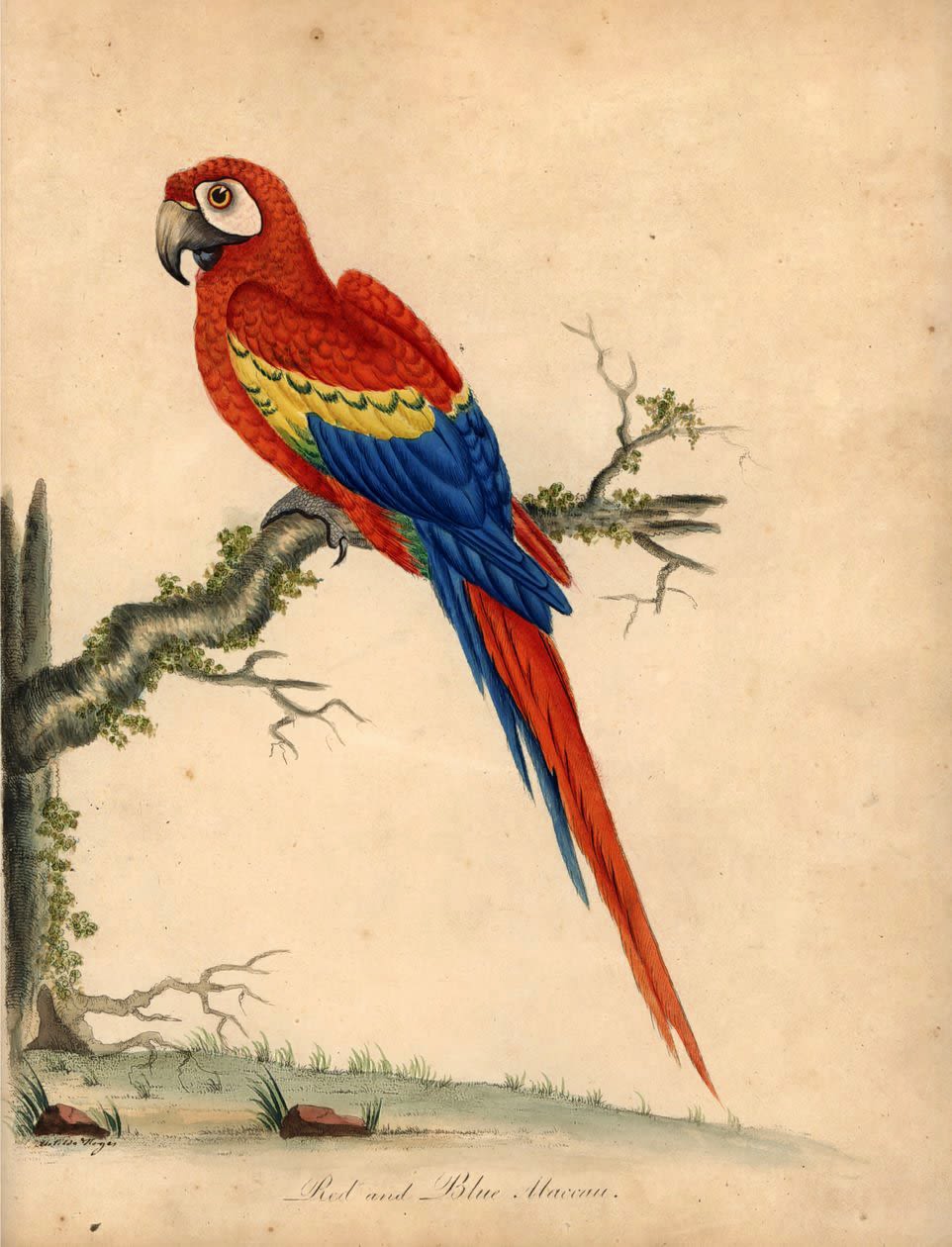
The predominant colors of the costume (red, blue, and yellow) reproduce the plumage of the scarlet macaw (Ara macao): in pre-Hispanic times, it embodied the fiery, solar, and celestial component of the forces that, in the dualistic conception of the Mesoamerican cosmos, animate all living beings, in combination with the humid and terrestrial forces of the lush tropical vegetation, personified by another bird, the green quetzal (Trogon splendens).
The fact that the Kuesalimej are called Quetzales in Spanish by the mestizos has led some to identify the dancers with these birds, which are better known and more attractive to tourists. However, this is not enough to conceal the symbolism of the costume and dance, which clearly emerges from the colors of the garments, the radiating shape of the “crown,” and the terminology used to describe its parts, inspired by light radiation: the headdress is called kuaneskayot “sign of the head” (from nesi “to show oneself, to appear”, root of tanesi “it [the sun] appears = dawn”), while the multicolored metallic paper that adorns the rays is called itauiloni “its splendor” (from tauil “light”).
The motifs decorating the center of the “crown” also have astral significance: sun, moon, stars, or stylized flowers (according to ancient solar symbolism).
All the elements of the dance contribute to elevating a choral hymn to God.

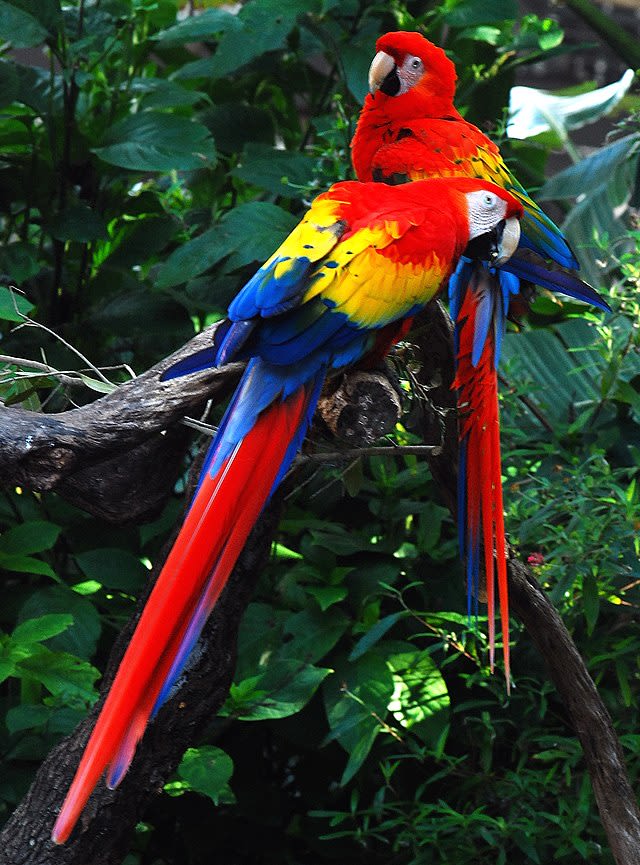
Kuesaltotot

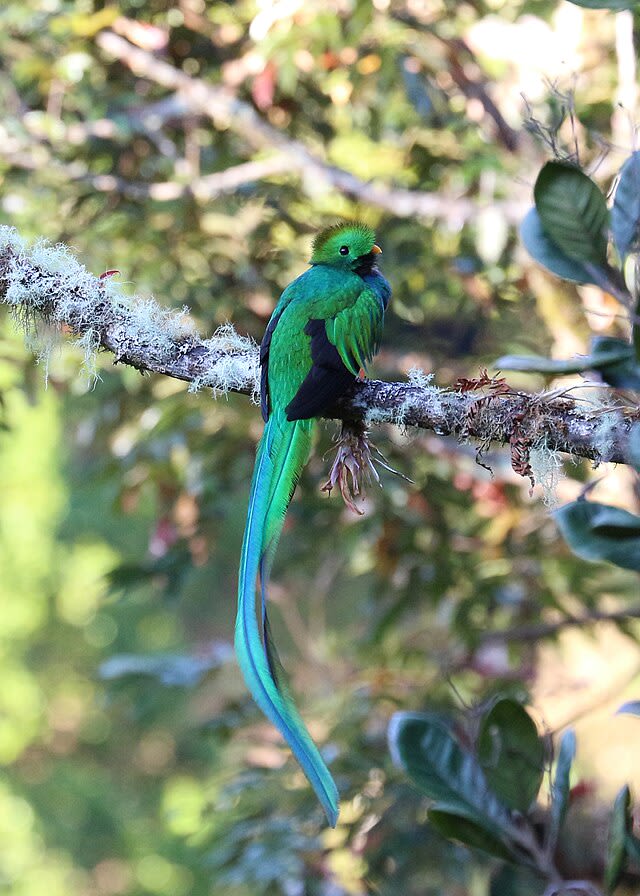
Quetzal
"The flute, then, is when the bird was singing. But we cannot sing like the bird. Then [you can] imitate it with the flute. And when it danced, it sounded, the bird’s feet sounded, that is the drum [...] The drum is the sound of what the bird did".

.04
The words of dance
Stories and prayers about the dance of the Kuesalimej
The Kuesalimej dance essentially consists of a harmonious combination of music and body movements, which, unlike other dances, does not involve singing or (as in the case of the Santiagos) verbal exchanges.
However, there are stories about its origins, anecdotes about the dancers, discussions about the quality of the costumes and performances, prayers for its success, as well as comments on its meaning (diligently collected by researchers).
Although all are aware of its great antiquity, some recount the experience of having seen the last kuesaltotomej (macaws) in the woods around Cuetzalan, others claim to have witnessed the introduction of this dance in their village many decades ago, while others still remember the misadventures of dancers unable to control the effects of alcohol consumption.
To ensure that the performance runs smoothly, avert the envy of other dancers, and prevent the most negative effects of intoxication, the leaders of the Kuesalimej invoke the saints they are about to celebrate, asking them to extend divine protection over the dancers.
In one of these prayers, the leader of the Tacuapan group, José Morales, compared the alcohol they would consume to holy water (tatiochiualatsin), which Christ on the cross had transformed from poison into an invigorating drink, so as to ensure that – even after a possible hangover – the dancers could come back to their senses, just as "He" himself had risen from the dead after three days.
The words spoken in this ritual context reveal the profound meaning of the dance, in which the colorful costumes are metaphorically called “flowers” (xochit) and considered part of the “offering” (tajpalol), the dancers “give pleasure to the feet” (timetspakitij) and, while “having fun” (timoixpetanitij), “pay homage to the saint,” venerating him (tikmouistiliti totajtsin Santiago apóstol). When questioned by researchers, they also explain how the music evokes the sounds made by the birds whose names they bear: the flute imitates the bird’s song and the drum imitates the sound of its footsteps on the branch on which it perched.

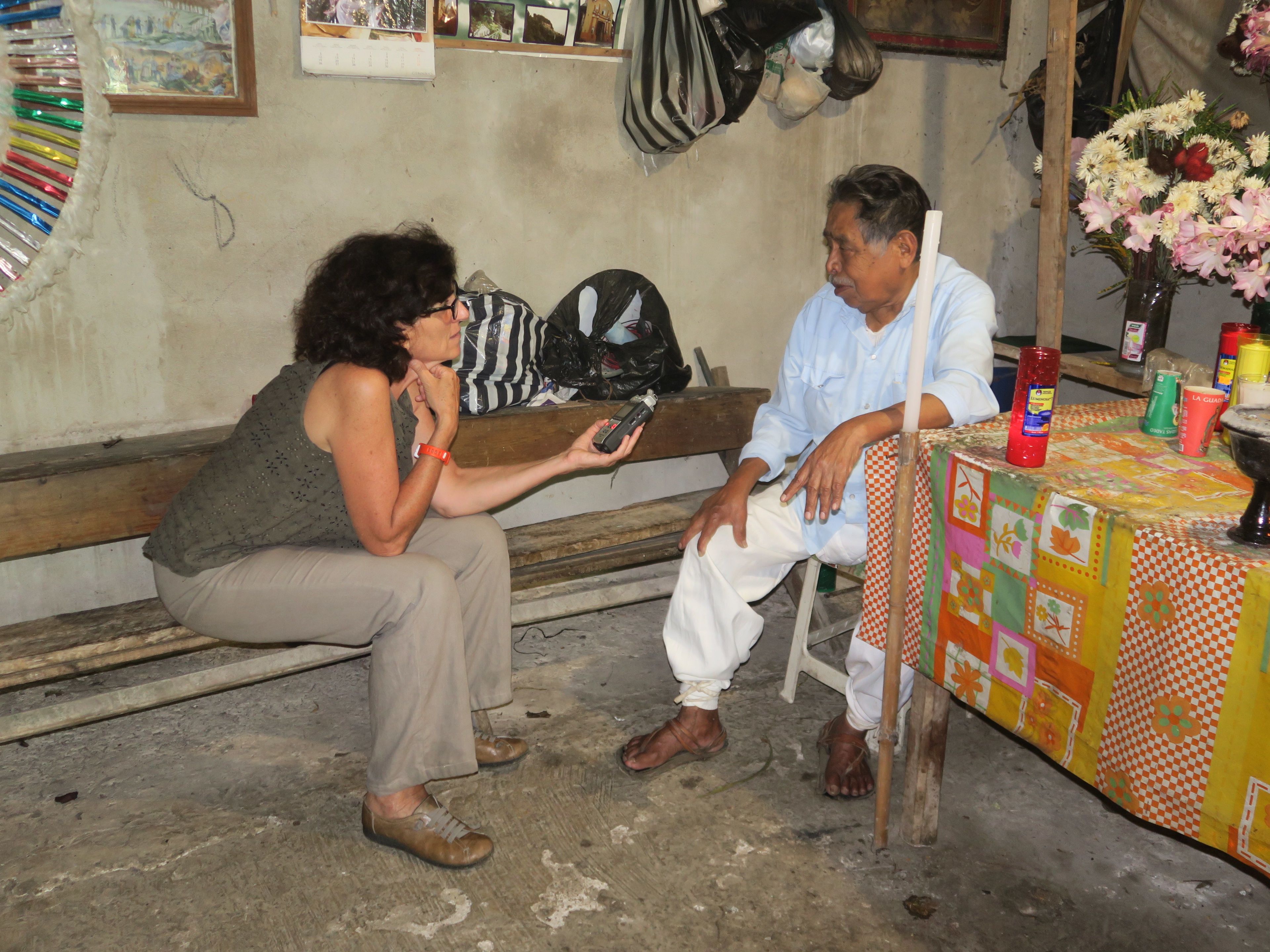
Ethnomusicologist Grazia Tuzi interviewing ritual specialist Miguel Cruz at his home in Zuapilaco (photo by A. Lupo, 9/13/2018)
Ethnomusicologist Grazia Tuzi interviewing ritual specialist Miguel Cruz at his home in Zuapilaco (photo by A. Lupo, 9/13/2018)
Audio narration by Miguel Cruz on the effects of drunkenness on dancers (rec. A. Lupo 9/17/2016)
Audio narration by Miguel Cruz on the effects of drunkenness on dancers (rec. A. Lupo 9/17/2016)
Isidro Soto explains the symbolism of the music of the Kuesalime dance (video by A. Lamorgese, 7/22/2023)
Isidro Soto explains the symbolism of the music of the Kuesalime dance (video by A. Lamorgese, 7/22/2023)
Audio fragment of José Morales reciting the Nahuatl prayer for the successful outcome of the Kuesalime dance (recording by A. Lupo, December 6, 1988)
Audio fragment of José Morales reciting the Nahuatl prayer for the successful outcome of the Kuesalime dance (recording by A. Lupo, December 6, 1988)
"Dance groups do not like to dance before the queen of a festival, even though they do so, because that is not the purpose of dance, nor is dancing before any authority figure the meaning of dance. […] To speak of dance today means to demand recognition as a right, as an expression of our cultural life, […] to demand that we be recognized constitutionally so that we may be treated with respect".

.05
Pitfalls and opportunities
Dance and its transformations in contemporary times
Like all other aspects of Nahua culture, dance is also undergoing significant changes. Some obstacles stem from wage labor and migration to urban centers, which deprive adults of the time needed to rehearse and participate in all the festive ceremonies, while school attendance hinders the participation of younger dancers.
At the same time, the growing secularization of society is reducing the number of people willing to devote years of their lives to the worship of saints, while the rising cost of the materials used to make the costumes is making the practice increasingly expensive.
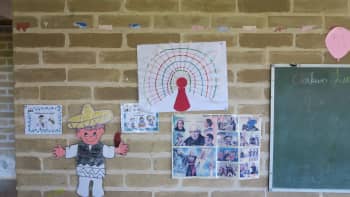
In addition to this, the recent recognition by UNESCO of the Voladores as Intangible Cultural Heritage of Humanity (2009) has attracted many new practitioners to this dance, drawing them away from others, including the Kuesalimej. Nevertheless, all of them are actively promoted as a fundamental expression of Nahua culture in Cuetzalan’s bilingual schools, stimulating pupils’ interest and awareness of this traditional practice.
At the same time, the booming tourism market has increased interest in ceremonial dances, sometimes distorting their purpose, but nevertheless giving the Kuesalimej a special significance, making them a sort of icon of Cuetzalan. To the point that, after years in which tourist iconography had been inspired by the glyph with red macaw feathers representing this place name in pre-Hispanic pictography, a new identification with the quetzal bird gradually took hold. This prompted some groups to change the color of their costumes, replacing blue with green.
No less significant — and socially much more relevant — is the fact that, thanks to the principles of gender equality promoted by schools, access to dance groups is no longer reserved for males, so that a growing number of girls and young women are enthusiastically participating in performances. In short, despite facing many difficulties, the dance of the Kuesalimej shows a vital ability to adapt.







The dances that open the way for the procession during the patron saint festival of Santiago Yancuictlalpan (video by A. Lamorgese, 7/25/2023)
The dances that open the way for the procession during the patron saint festival of Santiago Yancuictlalpan (video by A. Lamorgese, 7/25/2023)
Kuesalime in green costumes in Tzinacapan (video by A. Lamorgese, 2023)
Kuesalime in green costumes in Tzinacapan (video by A. Lamorgese, 2023)
Girls dancing in Tzinacapan (video by A. Lamorgese, 2023)
Girls dancing in Tzinacapan (video by A. Lamorgese, 2023)
"The costume you see there means a lot to us, because it is not just an outfit, but for us it reflects work, wisdom, knowledge, and above all, it represents our grandparents, our grandmothers who came before us [...] because it is a lesson we have inherited from our ancestors and, above all, because it also represents our being"
.06
Between schools, museums, and archives
New forms of dialogue and collaboration between scholars and native communities
Since 1984, researchers from the Italian Ethnological Mission in Mexico have been following the activities of dance groups in the community of Santiago Yancuictlalpan, in particular the Kuesalimej, once led by José Morales, Aristeo Salgado, and Miguel Cruz.
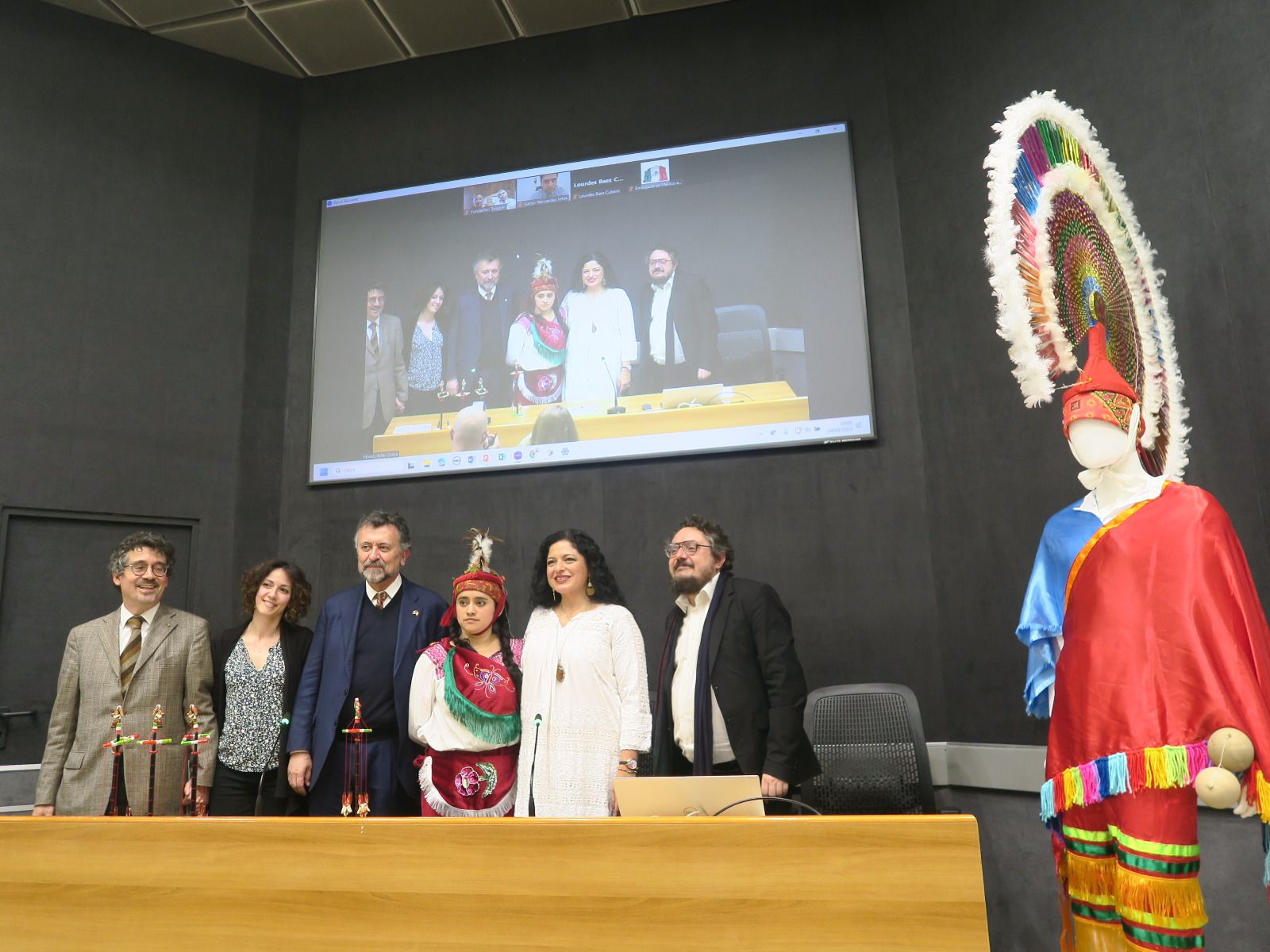
After Don Miguel’s death at the remarkable age of 93, we decided to purchase a Kuesalin costume from his successor, Isidro Soto, to be donated to the MUCIV - Museo delle Civiltà - Roma, where it was welcomed into the new exhibition dedicated to the Americas. The delivery to the Museum, which took place in 2023 in the presence of Mexico’s Secretary of Culture, Alejandra Frausto, was an important recognition of the cultural value of this dance.
Speaking remotely at the ceremony, Micaela Garrido, director of the Kalnemachtiloyan bilingual school in Cuetzalan, and Isidro Soto, leader of the Kuesalimej group in Zuapilaco, expressed their proud awareness of the significance that such an acquisition can have for the protection and enhancement of indigenous cultural heritage.
However, the survival of this and other dances will depend above all on the ability of the communities of the Sierra to ensure generational renewal and the motivation of musicians and dancers, as well as the resources for their travel and the making of costumes. To this end, we have made the Mission’s digital archives available to a number of schools and dance groups, providing them with recordings of oral texts relating to the narratives and prayers of their leaders, and above all those from the musical repertoire of masters who are now deceased.
An attempt was thus made to remedy the intrinsic transience of an intangible tradition constantly exposed to the risk of disappearing along with its bearers, giving the ethnographic materials accumulated over decades of research a concrete social utility, which adds to their documentary value and scientific interest.
The hope shared by Italian researchers and Nahua dancers is well summarized in the words of Isidro Soto: "May our tradition and our colors live on. The colors of our Kuesalin, our dance, and our group represent joy, and our gratitude to God that we are still here on this earth".
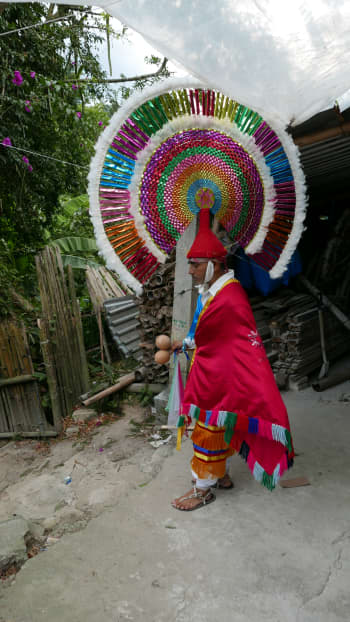
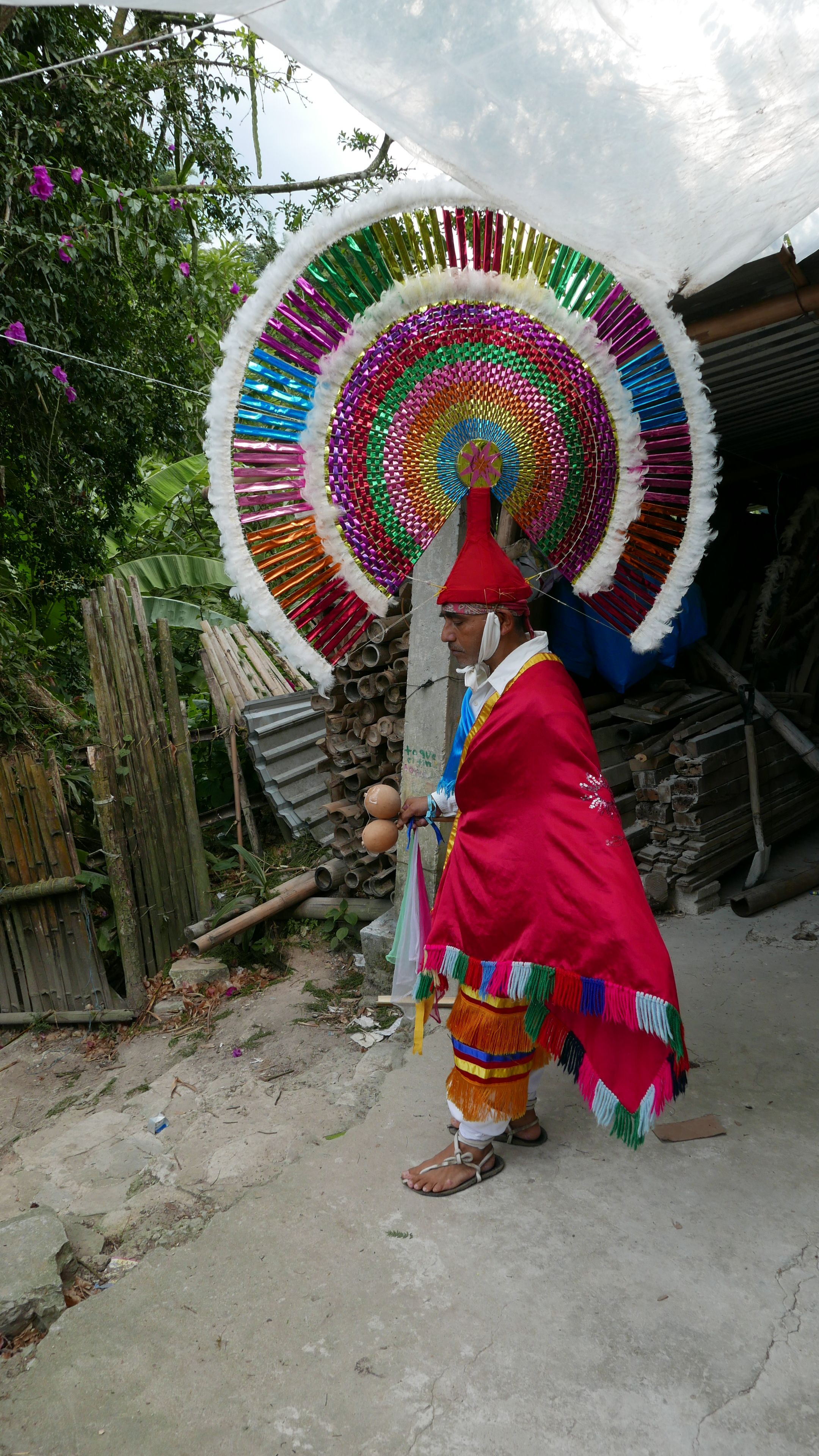
KUESALIN DANCER COSTUME


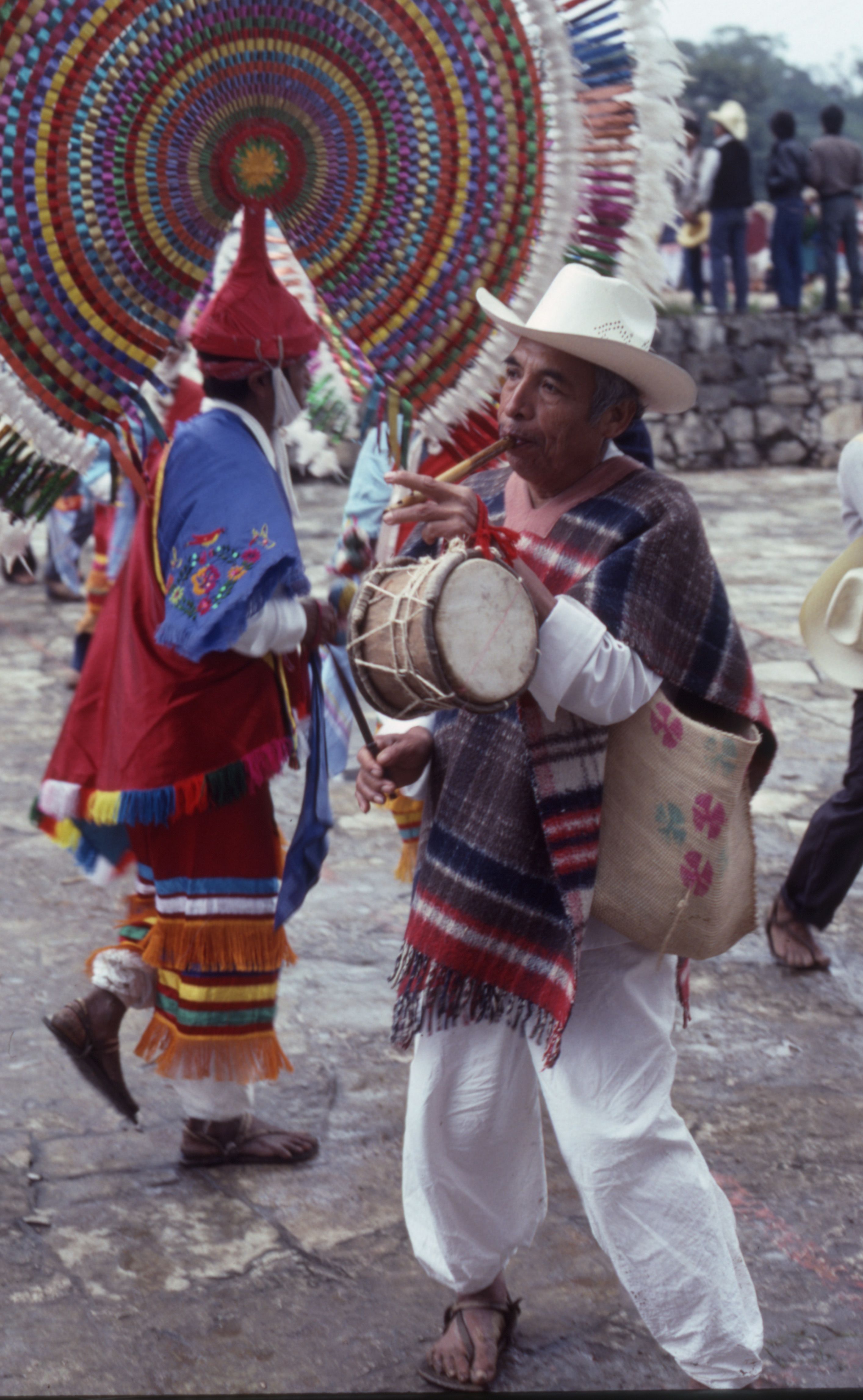




José Morales leads the Kuesalimej of Tacuapan playing in the main square of Santiago Yancuictlalpan (photo by A. Lupo, December 12, 1988)
José Morales leads the Kuesalimej of Tacuapan playing in the main square of Santiago Yancuictlalpan (photo by A. Lupo, December 12, 1988)

Aristeo Salgado, musician and leader of the Kuesalime of Cuauhtapanaloyan, playing in the streets of Santiago Yancuictlalpan (photo by A. Lupo, July 25, 2002)
Aristeo Salgado, musician and leader of the Kuesalime of Cuauhtapanaloyan, playing in the streets of Santiago Yancuictlalpan (photo by A. Lupo, July 25, 2002)
Miguel Cruz and the Kuesalime group from Zuapilaco dance in the square of Santiago Yancuictlalpan (photo by A. Lupo, July 25, 2009)
Miguel Cruz and the Kuesalime group from Zuapilaco dance in the square of Santiago Yancuictlalpan (photo by A. Lupo, July 25, 2009)
Delivery of the Kuesalin dance costume to the Museum of Civilization in Rome (from left: Alessandro Lupo, director of MEIM, Valeria Bellomia, head of museum affairs at MEIM, Carlos García de Alba, Mexicanambassador to Italy, Irene García, dancer with the Voladores de Cuetzalan, Alejandra Frausto, Mexican Secretary of Culture, Andrea Viliani, director of the Museum of Civilization, photo by A. Lupo, 23/3/2023)
Delivery of the Kuesalin dance costume to the Museum of Civilization in Rome (from left: Alessandro Lupo, director of MEIM, Valeria Bellomia, head of museum affairs at MEIM, Carlos García de Alba, Mexicanambassador to Italy, Irene García, dancer with the Voladores de Cuetzalan, Alejandra Frausto, Mexican Secretary of Culture, Andrea Viliani, director of the Museum of Civilization, photo by A. Lupo, 23/3/2023)
 Built with Shorthand