
Shamanic Artifacts of the Upper Rio Negro
Between historical journeys and contemporary claims in the State of Amazonas, Brazil
The population
The Upper Rio Negro, located on the border between Brazil, Colombia, and Venezuela, is one of the Amazonian regions with the highest density of indigenous populations, with 23 ethnic groups speaking 19 languages, each with their own histories and traditions.
The colonial period
During the colonial period, many non-indigenous people crossed this area in an attempt to establish political, economic and religious dominance. This intensified between the 19th and 20th centuries when missionaries violently persecuted the villages of the Tukano and Arawak peoples, destroying the casas do saber (houses of knowledge) and appropriating the shamanic artefacts stored within them. This event marked the beginning of a profound social and cultural transformation that led to the silencing of much traditional knowledge.
Preservation of a culture
Nevertheless, the indigenous population never stopped resisting and passing on their values, knowledge, and memories to subsequent generations, albeit with the caution requested by the discrimination perpetrated, first and foremost, by a government apparatus hostile to the preservation of a culture and way of life that was - and, sometimes, still is - considered an obstacle to the economic “development” of the Brazilian state.
Today, numerous local Indigenous associations advocate for recognition of ethnic difference and corresponding rights and, in collaboration with non-governmental indigenist organizations, international partners, academic researchers, and others agents, they promote projects aimed at revitalizing and valuing ancient memories and traditional knowledge. Among these, it is the recovery - for now, virtual - of shamanic artifacts once taken, together with the knowledge they embody, and their return to their regions of origin: the focus of the following sections.
The Rio Negro, the largest tributary of the Amazon River, flows through a region inhabited by several Indigenous peoples, each with its own language, history, and traditions.
Contact with outsiders transformed many of these cultures but neither erased their presence nor their ability to resist and transmit their ancestors’ teachings.
The Rio Negro is the largest tributary of the Amazon River.
Measuring approximately 2,000 km in length, its drainage basin covers an area of almost 700,000 km² along the tri-border area of Colombia, Venezuela and Brazil, where it flows into the Amazon at Manaus. The Rio Negro's course is conventionally divided into three sections: the upper, middle and lower sections.
The upper part, also known as the Alto Rio Negro, has been inhabited for centuries by 23 indigenous groups belonging to the Tukano, Arawak, Nadahup and Yanomami language families.
The Tukano language family comprises the Arapasso, Bará, Barassano, Dessano, Karapanã, Kotiria, Kubeo, Ye'ba, Mahsa, Mirititapuia, Piratapuia, Siriano, Tariano, Tukano, Tuyuka and Werekena ethnic groups, who are primarily found along the Uaupés, Tiquié, Papuri and Apaporis rivers.
The Baniwa, Kuripako and Baré peoples live in the Içana river basin and belong to the Arawak group. The Hupdah live on the banks of the Papuri and Tiquié rivers; the Yupdëh live on the Tiquié and Apaporis rivers; and the Dow and Nadeb live in the middle and lower reaches of the Rio Negro. These groups all belong to the Nadahupí language family.
The Yanomami occupy the region to the left of the Rio Negro, on the border with Venezuela and the Brazilian state of Roraima.
Of all the groups, those belonging to the Tukano and Arawak groups share the most cultural similarities. They differ in aspects such as their origin stories, language, rules of clan division and relations, and attribution to a specific portion of territory. Consequently, they have different relationships with specific craftsmanship based on the most abundant ecological resources in that territory. Members of these groups live scattered among their communities of origin in inland regions and in small and medium-sized cities such as Iauaretê, São Gabriel da Cachoeira, Santa Isabel do Rio Negro, Barcelos and Manaus.
The relationship with the urban dimension and with non-indigenous society has been a pervasive aspect since colonial times, but it has gradually intensified in the 20th century with the involvement of the indigenous population in Western-style economic activities and thanks to the access that the city offers to a whole range of services, including health and education.
The waters of the Rio Negro flow as silent witnesses to the history beating in the soul of its people and will know no peace until it will be fully recognized and respected
View of the town of Barcelos, capital of the Captaincy of São José do Rio Negro. Drawing made during the Viagem Philosophica led by the Portuguese-Brazilian naturalist Alexandre Rodrigues Ferreira between 1783 and 1792. National Digital Library of Rio de Janeiro.
View of the town of Barcelos, capital of the Captaincy of São José do Rio Negro. Drawing made during the Viagem Philosophica led by the Portuguese-Brazilian naturalist Alexandre Rodrigues Ferreira between 1783 and 1792. National Digital Library of Rio de Janeiro.
View of the village of São Joaquim do Cuané, on the banks of the Rio Uaupés. Drawing made during the Viagem Philosophica led by the Portuguese-Brazilian naturalist Alexandre Rodrigues Ferreira between 1783 and 1792. National Digital Library of Rio de Janeiro
View of the village of São Joaquim do Cuané, on the banks of the Rio Uaupés. Drawing made during the Viagem Philosophica led by the Portuguese-Brazilian naturalist Alexandre Rodrigues Ferreira between 1783 and 1792. National Digital Library of Rio de Janeiro
View of the Içana River. Drawing made during the Viagem Philosophica led by Portuguese-Brazilian naturalist Alexandre Rodrigues Ferreira between 1783 and 1792. National Digital Library of Rio de Janeiro.
View of the Içana River. Drawing made during the Viagem Philosophica led by Portuguese-Brazilian naturalist Alexandre Rodrigues Ferreira between 1783 and 1792. National Digital Library of Rio de Janeiro.
Geopolitical map of the Upper and Middle Rio Negro region showing Indigenous Lands, conservation units, and communities. Personal archive of the authors, August 2025.
Geopolitical map of the Upper and Middle Rio Negro region showing Indigenous Lands, conservation units, and communities. Personal archive of the authors, August 2025.
Ritual practices and shamanic ceremonies are central to the culture, social life, politics and spirituality of the peoples of the Upper Rio Negro. These ceremonies follow an annual cycle of collective celebrations associated with significant events in the lives of humans and animals. Each celebration features its own unique songs, dances and musical instruments. The most notable of these are the Dabucuri celebrations and the Yurupari ritual complex. The former strengthen marital bonds and kinship ties. The Yurupari rites, on the other hand, establish a connection between the human life cycle and cosmic time. Central to these rites is the use of special sacred flutes and trumpets made from fragments of the paxiuba palm (Socratea exorrhiza), representing the bones of the common ancestor. In local narratives, the paxiuba palm represents the bones of each clan's common ancestor, which shattered into several pieces when the palm tree was cut down. Each piece was then used to make a flute. When the flutes are played, the ancestors come back to life and the players become them, dissolving the separation between past and present. In this way, the order that existed at the time of creation is restored, ensuring the clan’s identity is preserved.
On both festive occasions, ritual specialists and masters of ceremony wear a series of ornaments and handle various ritual objects. These include ornaments for the head, waist, arms and legs made from bird feathers, plant materials and animal components; quartz and jaguar tooth necklaces; ceremonial sticks; and musical instruments such as deer bone flutes and pan flutes. There are also small wooden stools and cigars and cigar holders. Each of these artefacts belongs to a set comprising one example of each type, donated by a specific ancestor to the members of a community in times past. The collections must be kept separate from each other in special wicker boxes and only used at the appropriate time, accompanied by specific songs and dances.
The “objects,” as they are called, are not mere artifacts; they are ancestors, pieces of a people’s soul, now lost in foreign lands.
Headband belonging to the ritual specialist or, depending on the ceremonial context, one of his initiates. Plant fiber and toucan feathers. Preserved at the Missionary Ethnological Museum of Colle Don Bosco, in the province of Asti (Italy). Personal archive of the authors, January 2020
Headband belonging to the ritual specialist or, depending on the ceremonial context, one of his initiates. Plant fiber and toucan feathers. Preserved at the Missionary Ethnological Museum of Colle Don Bosco, in the province of Asti (Italy). Personal archive of the authors, January 2020
Plumes artefacts that are part of the ritual specialist’s headdress to be worn during traditional dances and ceremonies. Preserved at the Missionary Ethnological Museum of Colle Don Bosco, in the province of Asti (Italy). Personal archive of the authors, January 2020.
Plumes artefacts that are part of the ritual specialist’s headdress to be worn during traditional dances and ceremonies. Preserved at the Missionary Ethnological Museum of Colle Don Bosco, in the province of Asti (Italy). Personal archive of the authors, January 2020.
Headbands that are part of the ritual specialist’s headdress to be worn during traditional dances and ceremonies. Preserved at the Missionary Ethnological Museum of Colle Don Bosco, in the province of Asti (Italy). Personal archive of the authors, January 2020.
Headbands that are part of the ritual specialist’s headdress to be worn during traditional dances and ceremonies. Preserved at the Missionary Ethnological Museum of Colle Don Bosco, in the province of Asti (Italy). Personal archive of the authors, January 2020.
Shamanic maracas which are played during traditional dances and ceremonies. Preserved at the Missionary Ethnological Museum of Colle Don Bosco, in the province of Asti (Italy). Personal archive of the authors, January 2020.
Shamanic maracas which are played during traditional dances and ceremonies. Preserved at the Missionary Ethnological Museum of Colle Don Bosco, in the province of Asti (Italy). Personal archive of the authors, January 2020.
Headbands belonging to the ritual specialists or, depending on the ceremonial context, one of his initiates. Plant fiber and toucan and parrot feathers. Preserved at the Missionary Ethnological Museum of Colle Don Bosco, in the province of Asti (Italy). Personal archive of the authors, January 2020.
Headbands belonging to the ritual specialists or, depending on the ceremonial context, one of his initiates. Plant fiber and toucan and parrot feathers. Preserved at the Missionary Ethnological Museum of Colle Don Bosco, in the province of Asti (Italy). Personal archive of the authors, January 2020.
A shamanic wicker chest, also known as the “chest of humanity,” originally containing the dancers' entire suit. It was kept suspended inside the great house of knowledge and could only be opened by its guardian on appropriate occasions. Preserved at the Missionary Ethnological Museum of Colle Don Bosco, in the province of Asti (Italy). Personal archive of the authors, October 2025.
A shamanic wicker chest, also known as the “chest of humanity,” originally containing the dancers' entire suit. It was kept suspended inside the great house of knowledge and could only be opened by its guardian on appropriate occasions. Preserved at the Missionary Ethnological Museum of Colle Don Bosco, in the province of Asti (Italy). Personal archive of the authors, October 2025.
Wearing these ornaments is not just a way of decorating the body; it is a true transformation into the ancestor they represent. These objects are not merely inanimate things; they are characters that participate in a mythology about the Universe.
Each one is given a specific name and territoriazised based on the mythological narratives in which it appears or is the protagonist. This means that they belong to the place where they were created and should remain there forever, among the members of the clan that produced them.
Body ornaments and ritual objects have their own vitality and power. This vitality and power is determined by the purpose and use that distinguishes each of them, and is manifested during the ceremonial and shamanic practices peculiar to each clan. Through these objects, the ancestors are present and ensure that every ritual action is carried out in accordance with the rules established at the time of creation.
For this reason, these objects are sacred, and the knowledge they convey is kept secret and cannot be shared with just anyone — especially non-indigenous people. Within each ethnic group, they play a fundamental role in preserving and passing on the ways of life and organisation of the peoples of the Upper Rio Negro to new generations. They help to maintain the identity of their clan by passing on unique knowledge about history, artistic techniques, spirituality, nature and the territory. In this way, they strengthen the bond with their ancestral representatives and their sense of cultural and territorial belonging.
However, most of these artifacts are no longer found in their communities of origin and people only preserve their historical memory. This tradition still exists only in the Upper Tiquié, Papuri and Uaupés regions, places that were more difficult for colonisers to reach.
These peoples, guardians of ancestral secrets, saw their worlds turned to ash, their houses of knowledge burned by brutal intolerance from hands that never understood the forest’s essence.
Their power-objects were taken, ripped from their homelands, imprisoned in distant display cases, in the cold corridors of “civilization’s” museums.
From the 18th century onwards, as the conquest of the Amazon was systematized and scientific exploration of the territory intensified, indigenous objects produced in the Upper Rio Negro began to circulate increasingly frequently outside their geographical and geopolitical area.
Several individuals contributed to the collection of artifacts of various kinds, aiming to enrich the private and public collections that had begun to be created in Europe since the 1500s.
These artifacts were displayed in public to educate the population about the supposed evolutionary sequence of human societies, in which Europeans occupied the top position and all other groups, including Amazonian indigenous peoples, were considered to be 'primitive' and devoid of any form of morality or civilization.
As for the Upper Rio Negro, detailed accounts exist of seven notable travellers who crossed the territory. The first was the Portuguese naturalist Alexandre Rodrigues Ferreira in the 1780s.
He was followed by the Austrian Johann Natterer in the 1820s and 1830s; the British naturalist and explorer Alfred Russel Wallace in 1853; the Franciscan priest Illuminato Giuseppe Coppi in 1880; the Italian Count Ermanno Stradelli in 1890; the German naturalist Theodor Koch-Grünberg in 1903; and the ethnologist Curt Nimuendaju in 1927.
All of them set about describing the populations inhabiting the region and their cultural practices more or less meticulously, but above all they collected their artifacts, which often involved deception and violence.
This colonial approach escalated into outright persecution with the arrival of the Salesian missionaries in 1915. Determined to eradicate what they considered to be a "demonic culture", the missionaries burned all the great casas de saberes and banned any local practices linked to shamanic rituals. Ancestral objects were also taken away.
Instead of being destroyed, however, they suffered the same fate as those collected in previous eras: being locked away in the cold, silent rooms of museums and religious institutions in Europe and the United States, where they remain to this day.
Representative drawing of a pair of Iurupixuna indigenous people, made in 1787 during the Viagem Philosophica led by the Portuguese-Brazilian naturalist Alexandre Rodrigues Ferreira between 1783 and 1792. © Biblioteca do Real Museu e Jardim Botânico da Ajuda (1768-1836) (ULisboa/MUHNAC).
Representative drawing of a Cuturu indigenous man, made in 1787 during the Viagem Philosophica led by the Portuguese-Brazilian naturalist Alexandre Rodrigues Ferreira between 1783 and 1792. © Biblioteca do Real Museu e Jardim Botânico da Ajuda (1768-1836) (ULisboa/MUHNAC).
Representative drawing of a Uerequena indigenous man, made in 1787 during the Viagem Philosophica led by the Portuguese-Brazilian naturalist Alexandre Rodrigues Ferreira between 1783 and 1792. © Biblioteca do Real Museu e Jardim Botânico da Ajuda (1768-1836) (ULisboa/MUHNAC).
More than simply repatriating these objects, what is sought is shared stewardship of their memories.
Indigenous representatives must lead this process, not only to free their ancestors but to retell, in their own terms, the story stolen along with them.
Storage drawer containing shamanic artefacts from Rio Negro at the Ethnological Museum of Colle Don Bosco, in the province of Asti (Italy). Personal archive of the authors, January 2020.
Storage drawer containing shamanic artefacts from Rio Negro at the Ethnological Museum of Colle Don Bosco, in the province of Asti (Italy). Personal archive of the authors, January 2020.
Storage cabinet shelf containing shamanic quartz necklaces from Rio Negro at the Ethnological Museum of Colle Don Bosco, in the province of Asti (Italy). Personal archive of the authors, January 2020.
Storage cabinet shelf containing shamanic quartz necklaces from Rio Negro at the Ethnological Museum of Colle Don Bosco, in the province of Asti (Italy). Personal archive of the authors, January 2020.
Shamanic objects in the permanent exhibition of the Ethnological Museum of Colle Don Bosco, in the province of Asti (Italy). From the left, two feather belts, a support for cigars, two quartz necklaces and one wooden stool, of exclusive use of one tìof the ritual specialists. Personal archive of the authors, October 2020.
Shamanic objects in the permanent exhibition of the Ethnological Museum of Colle Don Bosco, in the province of Asti (Italy). From the left, two feather belts, a support for cigars, two quartz necklaces and one wooden stool, of exclusive use of one tìof the ritual specialists. Personal archive of the authors, October 2020.
Exhibition case at the Museum of Anthropology and Ethnology of Florence containing artefacts from the Rio Negro. Personal archive of the authors, July 2024.
Exhibition case at the Museum of Anthropology and Ethnology of Florence containing artefacts from the Rio Negro. Personal archive of the authors, July 2024.
Baniwa masks exhibited at the Quay Brainly Museum in Paris, France. Personal archive of the authors. October 2025.
Baniwa masks exhibited at the Quay Brainly Museum in Paris, France. Personal archive of the authors. October 2025.
Exhibition case at the Welt Museum of Vienna showing artefacts from the Rio Negro related to the creation of the world. Personal archive of the authors, October 2020.
Exhibition case at the Welt Museum of Vienna showing artefacts from the Rio Negro related to the creation of the world. Personal archive of the authors, October 2020.
One of the many issues arising from this context concerns the storage and display of shamanic objects in warehouses and public and missionary museums. Firstly, the clan organisation we mentioned is not at all respected. In most cases, ornaments belonging to the same set are divided by type, causing conflicts on a spiritual level between entities that find themselves having to share inappropriate spaces. For example, all headdresses are kept together, as are all belts and all quartz necklaces.
Furthermore, exhibitions rarely consider the indigenous categories through which these artifacts are interpreted, nor the complexity of the meanings and values they convey. Instead, they perpetuate strongly aestheticizing and exoticizing visions, in which the "savage" to be educated is predominant references to the abuses that the populations of the Upper Rio Negro have endured, and which have transformed them considerably – to the extent that they are sometimes denied the status of "indigenous" in public opinion – are few and often ineffective in providing adequate tools for understanding the current social and political reality of these groups, and the multiple processes of resistance and re-existence they are implementing.
However, in contrast to this approach, several claims have been made regarding this heritage and the cultural memory it preserves. If material restitution is not possible, indigenous representatives at least request that they be guaranteed some other type of access to the objects (virtual, for example) and that they be involved in the shared management of the museum practices developed around them. This should take into account the rules imposed by the original peoples in terms of how the objects should be organised and stored in warehouses, as well as the narratives proposed about them and their legitimate owners.
Digitizing collections is not a mere fallback in the face of challenges to material restitution.
It is a concrete, achievable form of cultural return, capable of reactivating connections and making heritage once again accessible to its communities of origin.
The first step in this direction was taken in 2017 with the launch of a research project aimed at mapping all collections of shamanic objects from the Upper Rio Negro region, particularly those from the Uaupés River basin. Led by anthropologist and Federal University of Pernambuco professor Renato Athias, and in collaboration with representatives of the Tukano ethnic-linguistic group, the project is based on the assumption that there is currently no comprehensive inventory of all the material taken from indigenous territories over the last three centuries and dispersed among various museums in Brazil, the United States, and Europe. The first collection to be catalogued and photographed was that held at the Museu do Estado de Pernambuco (MEPE), followed by collections from institutions such as the Smithsonian Institution in Washington, the Världskulturmuseet in Gothenburg, the Welt Museum in Vienna, the Quai Branly in Paris and the Museo Etnologico Missionario di Colle Don Bosco in Asti (Turin, Italy).
The aim is to systematize and contextualize the photographic material produced during visits to these important collections, by holding special meetings with custodians of historical, cosmological and shamanic knowledge from the Upper Rio Negro region.
This will then allow the project to create a virtual museum of the indigenous peoples of the Rio Negro, to be integrated. It is promoted by the main local indigenous association: Federation of Indigenous Organisations of the Rio Negro - Foirn, since 2005.
In a similar vein, collaboration with some members of the KNOT project, which began in 2024, led to dialogue with the directors of the Salesian Missionary Ethnological Museum in Colle Don Bosco.
They agreed to the proposal to carry out 3D scanning of four shamanic objects preserved at their institute in the Italian province of Asti. These models can be found in the official KNOT website, and will soon be available on the Museu Virtual dos Povos Indígenas do Rio Negro website.
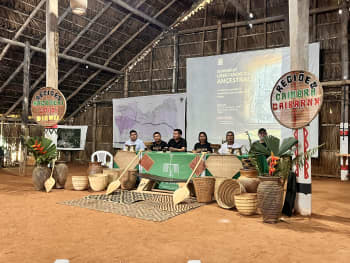
They are accompanied by information compiled by indigenous and non-indigenous experts and leaders during the International Seminar “Libertando os Ancestrais: a volta dos artefatos xamânicos para o Alto Rio Negro”, which took place from 25 to 29 August 2025 at the Casa do Saber (House of Knowledge) of Foirn in São Gabriel da Cachoeira.
 Built with Shorthand