
The Codex Vaticanus A
(Vat. Lat. 3738) as an object
An intercultural encyclopedia in New Spain and its European legacy

In the 16th century, European intellectuals were fascinated by the arrival of pre-Hispanic pictographic manuscripts, which, after the Spanish conquest, provided a unique insight into the ingenuity of the indigenous peoples.
Among these codices are the renowned Codex Borgia (Borg. mess. 1) and Codex Vaticanus B (Vat. Lat. 3773), which are now preserved in the Biblioteca Apostolica Vaticana. Additionally, pictographic manuscripts created during the early colonial period can be considered "descendants" of ancient pre-Hispanic traditions.
The Biblioteca Centrale of Florence holds the Codex Magliabechiano (CL. XIII. 3), while the Biblioteca Medicea Laurenziana of Florence preserves the celebrated Florentine Codex (Med. Palat. 218–220), an impressive encyclopedic project led by the Franciscan friar Bernardino de Sahagún with a group of indigenous intellectuals and painters.
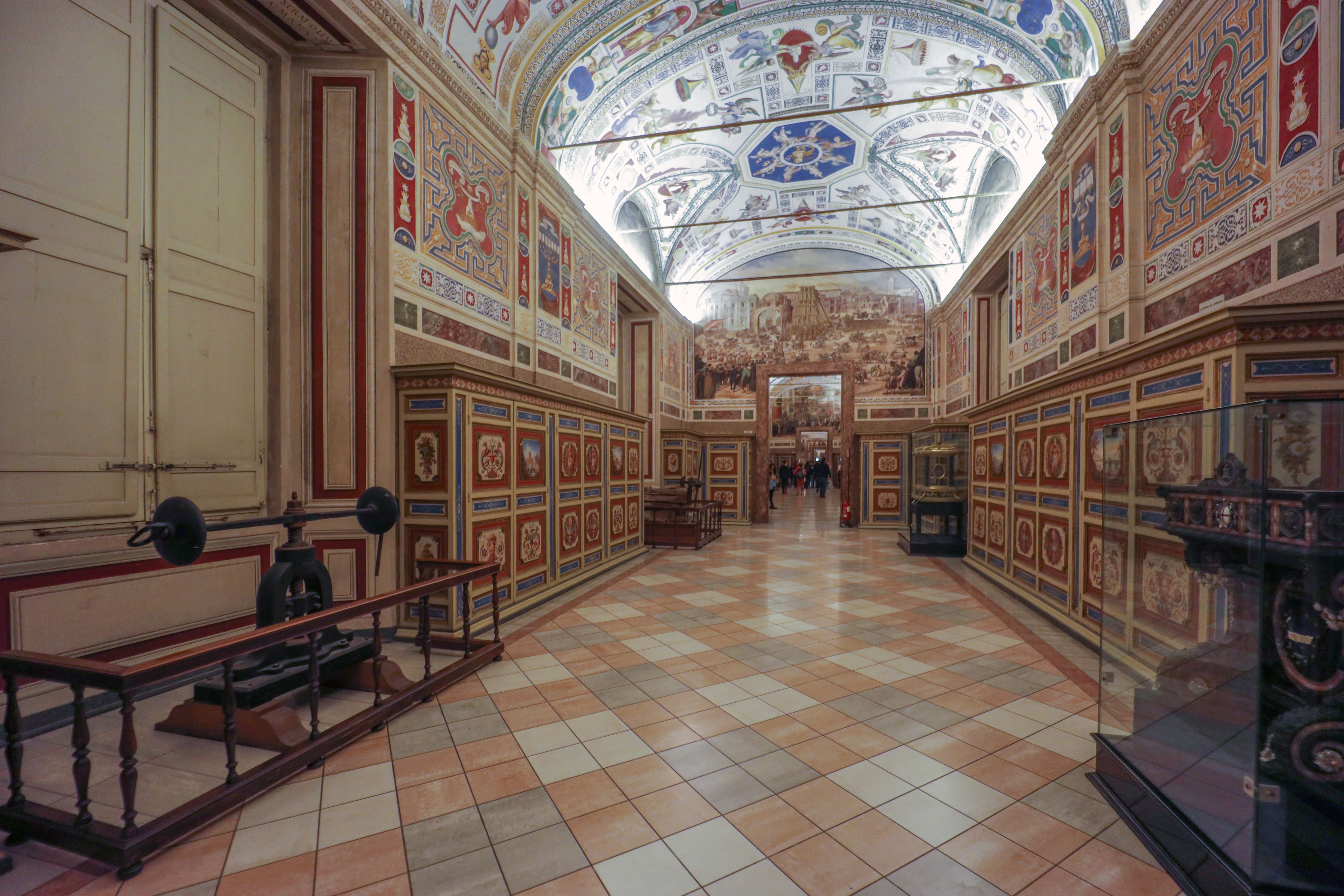
Codex Vaticanus A (Vat. Lat. 3738), also called Codex Ríos, is preserved in the Biblioteca Apostolica Vaticana. It is an extremely representative example of the hybrid manuscripts produced in New Spain during the early colonial period. The Mesoamerican cosmology, rituals, and history depicted and described in it constitute a significant testimony to the pre-Hispanic past. At the same time, the manuscript’s shipment to Italy and its rapid and intense reception make it an extraordinary specimen of the “social life” of objects.
However, the importance of the manuscript is not measured solely by its content, but also by the influence that, like other manuscripts, it exerted on European culture.
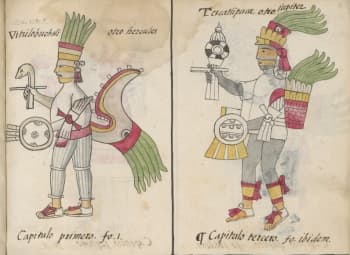

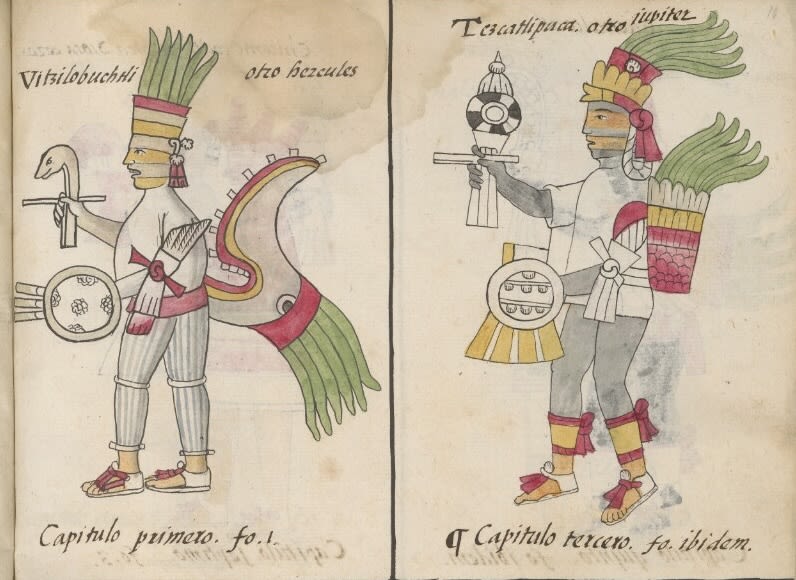
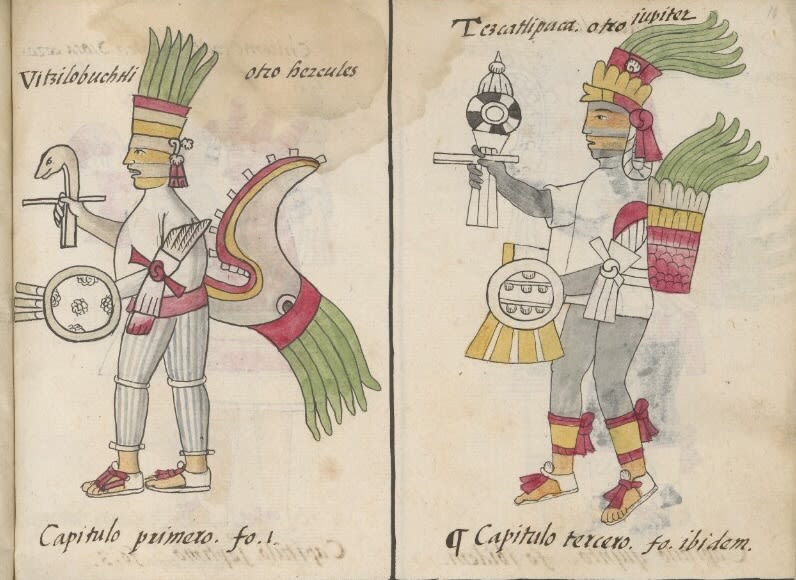
“Mesoamerican Gods”: Florentine Codex (Ms. Mediceo Palatino 218–20, Courtesy of the Biblioteca Medicea Laurenziana, Florence, and by permission of MiBACT, 1577), bk. 1, f. xiv r. Available at Digital Florentine Codex/Códice Florentino Digital, edited by Kim N. Richter, Alicia Maria Houtrouw, Kevin Terraciano, Jeanette Peterson, Diana Magaloni, and Lisa Sousa. Los Angeles: Getty Research Institute, 2023.
“Mesoamerican Gods”: Florentine Codex (Ms. Mediceo Palatino 218–20, Courtesy of the Biblioteca Medicea Laurenziana, Florence, and by permission of MiBACT, 1577), bk. 1, f. xiv r. Available at Digital Florentine Codex/Códice Florentino Digital, edited by Kim N. Richter, Alicia Maria Houtrouw, Kevin Terraciano, Jeanette Peterson, Diana Magaloni, and Lisa Sousa. Los Angeles: Getty Research Institute, 2023.

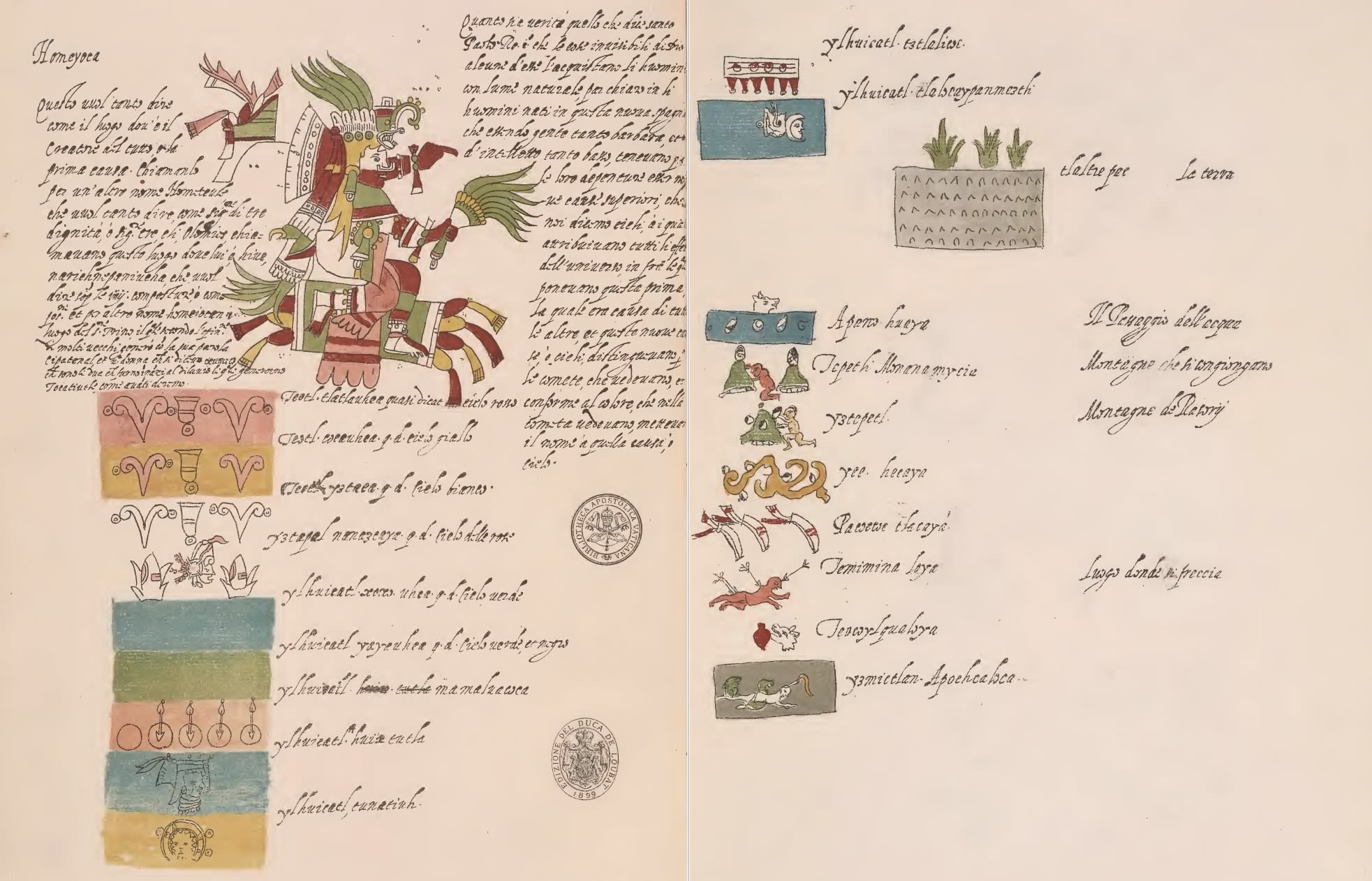
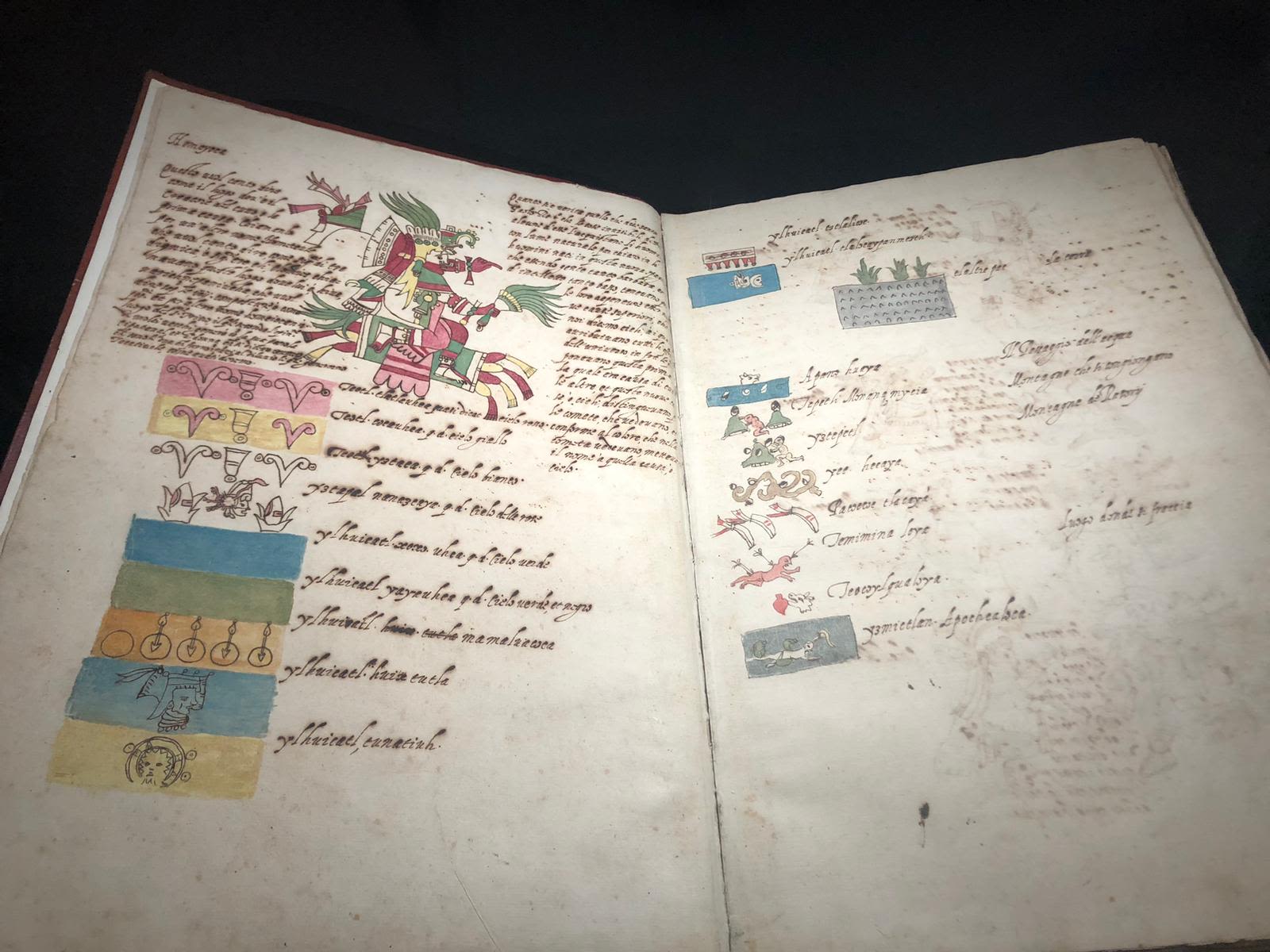
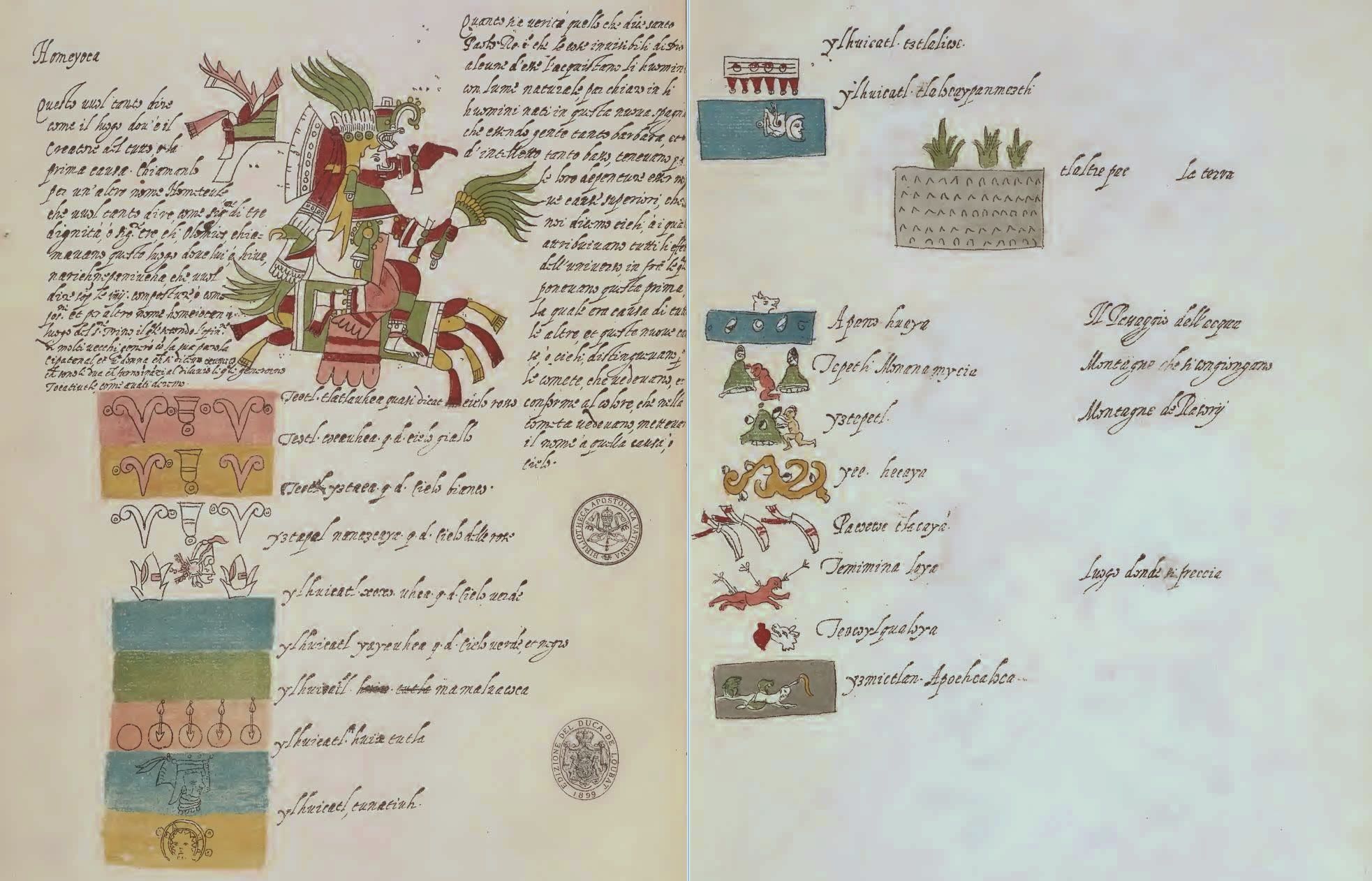
“The first pages of the Codex Vaticanus A”: Codex Vat. Lat. 3738, ff. 1r and 1v from the Loubat facsimile edition 1900
“The first pages of the Codex Vaticanus A”: Codex Vat. Lat. 3738, ff. 1r and 1v from the Loubat facsimile edition 1900

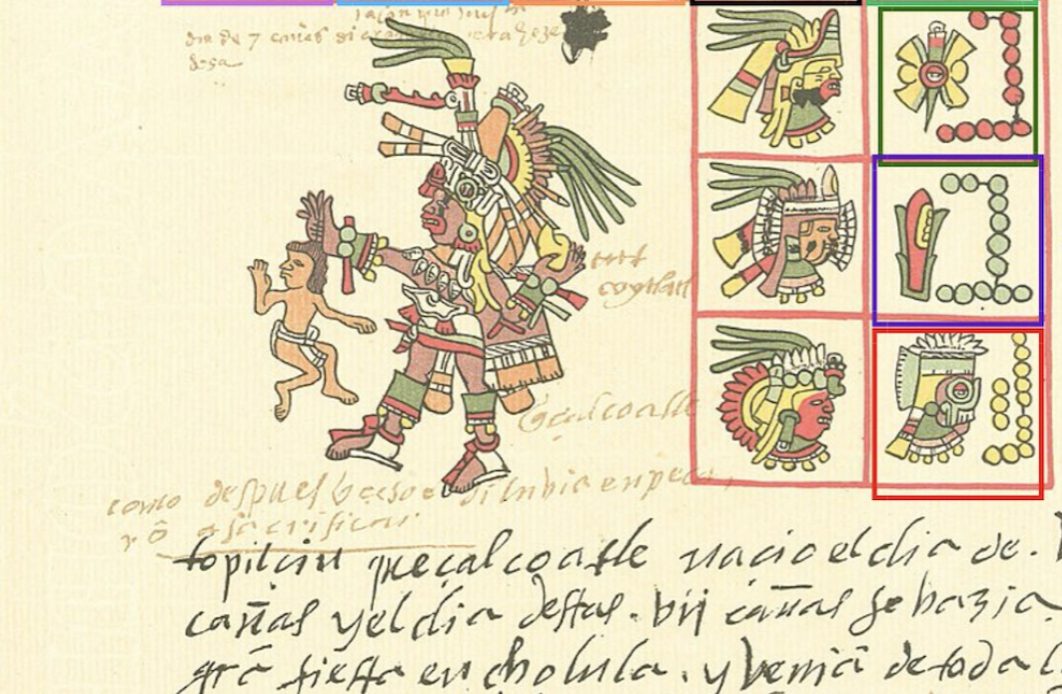
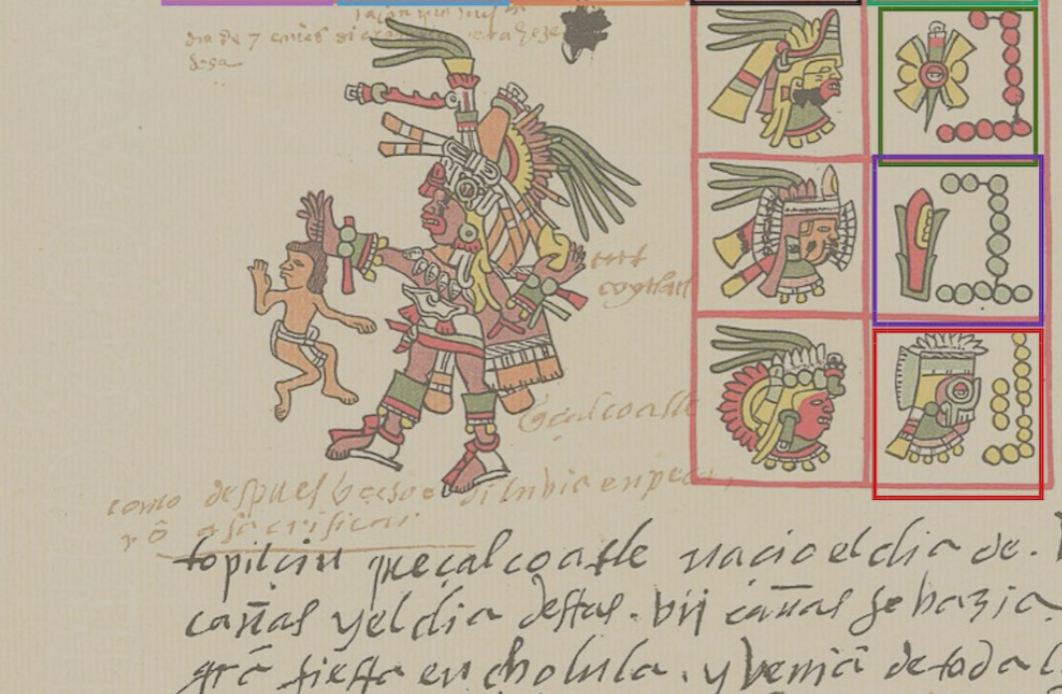
“Mexican God”: Codex Telleriano-Remensis, f. 10r - Bibliothèque nationale de France (1562)
“Mexican God”: Codex Telleriano-Remensis, f. 10r - Bibliothèque nationale de France (1562)
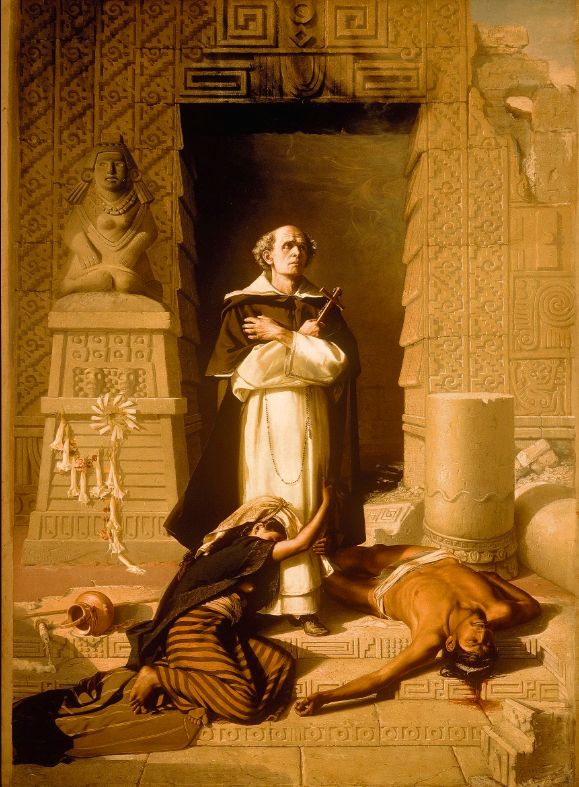
“Through symbols and writings formerly used, through the traditions of the old and of those who in the days of their infidelity were priests and pontiffs, and through the narrations of the lords and chief men to whom they were accustomed to teach the law and educate in their temples in order to render them learned, brought together before me with their books and hieroglyphics, which according to what is demonstrated are believed to be of ancient origin, many of them anointed with human blood”
.01
A colonial manuscript between two worlds
Structure, authorship, and intercultural conception
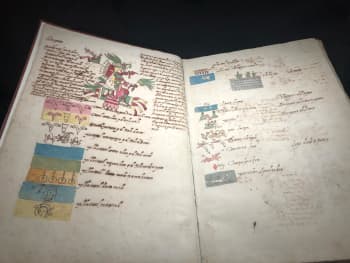
Codex Vaticanus A is a manuscript produced in the European in-folio format. It consists of 102 folios of early Italian paper bound as a book, pairing Mesoamerican paintings with extensive Italian glosses. It is among the few significant manuscripts on Mesoamerican civilisations written in Italian, which contributed to its appeal in the Italian cultural context from the late sixteenth century onward.
The codex was produced before 1566 and had likely already arrived at the Vatican by then. Although a partial copy of the Codex Telleriano-Remensis (MS Mexicain 385), preserved at the Bibliothèque nationale de France and compiled under the Dominican Pedro de los Ríos, the Codex Vaticanus A follows an autonomous design.
While reproducing much of the original manuscript, the codex also incorporates sections of considerable importance from both an ethnographic and a colonial policy perspective.
Conceived in a rapidly changing world, the manuscript presents a complex reworking and re-semantization of Mesoamerican knowledge.
Dominican friars made the codex to document and defend their missionary efforts in New Spain before the Roman Church, while also showcasing the intellectual abilities of indigenous communities and their readiness for Christian conversion.
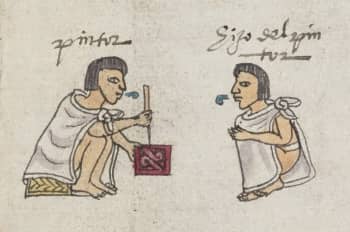
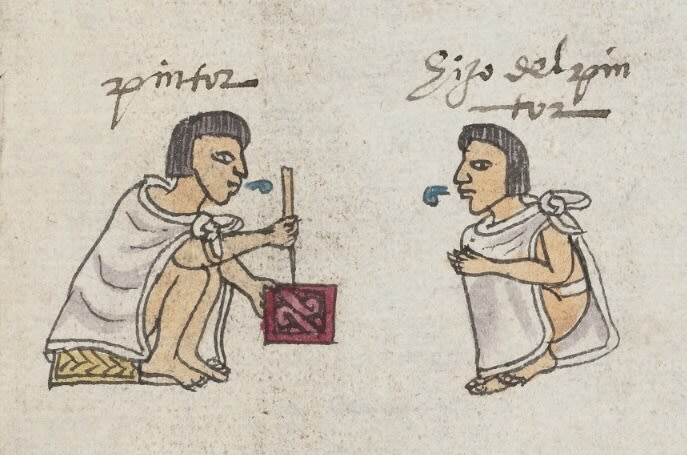
Indigenous painters (tlacuiloque) not only participated materially in its creation but also contributed with original ethnographic data. As a result, the codex occupies a liminal space in the history of New Spain: it is both a notable descendant of Mesoamerican pictographic traditions and a work employing European encyclopedic strategies, offering an exceptional, multivocal view of Mesoamerican civilisations.
“They gave me all the matters we discussed in pictures, for that was the writing they employed in ancient times. And the grammarians explained them in their language, writing the explanation at the bottom of the painting. I still have those originals”



.02
A missionary project
The making of the Codex Vaticanus A in the Dominican milieu of New Spain
The codex had clear theological and apologetic goals. Indeed, it resulted from the intense missionary and ethnographic activity in New Spain as Dominican friars supervised the project, aiming to present Rome with the early results of their evangelisation of indigenous peoples.
The pictorial content was probably completed around 1562, the final date represented in the annalistic section. Watermark codicological analysis confirms that the European paper was manufactured in Italy between 1557 and 1578, most likely between 1562 and 1573. Although this aspect, recent chemical studies have suggested that the manuscript was painted entirely in New Spain, as evidenced mainly using traditional indigenous materials to produce colors.
On the other hand, the purchase and shipment of Italian paper to the American territories suggest that the Dominicans considered the project extremely important and intended to produce a manuscript of exquisite craftsmanship. Furthermore, the refined calligraphy used for the glosses and the large size of the manuscript suggest that the Dominicans intended to send the codex to the sophisticated circles of the papal court.
The Codex Vaticanus A, likely compiled within the same Dominican milieu as the Codex Telleriano-Remensis (produced under the direction of Pedro de los Ríos in the convent of Puebla), was seemingly prepared as a finalized volume intended for transport to Italy by Juan de Córdova in 1564 during the Dominican General Chapter in Bologna, possibly with other Mesoamerican artefacts.
The manuscript was clearly rapidly assembled. Moreover, Italian glosses could have been written only after the completion of the Codex Telleriano-Remensis, which means, as noted, after 1562. At the same time, the glosses were sometimes copied without the necessary attention. They were, indeed, probably penned by two Spanish-speaking hands, as shown by frequent hispanisms, misunderstandings of Italian, and errors in indigenous words and names.


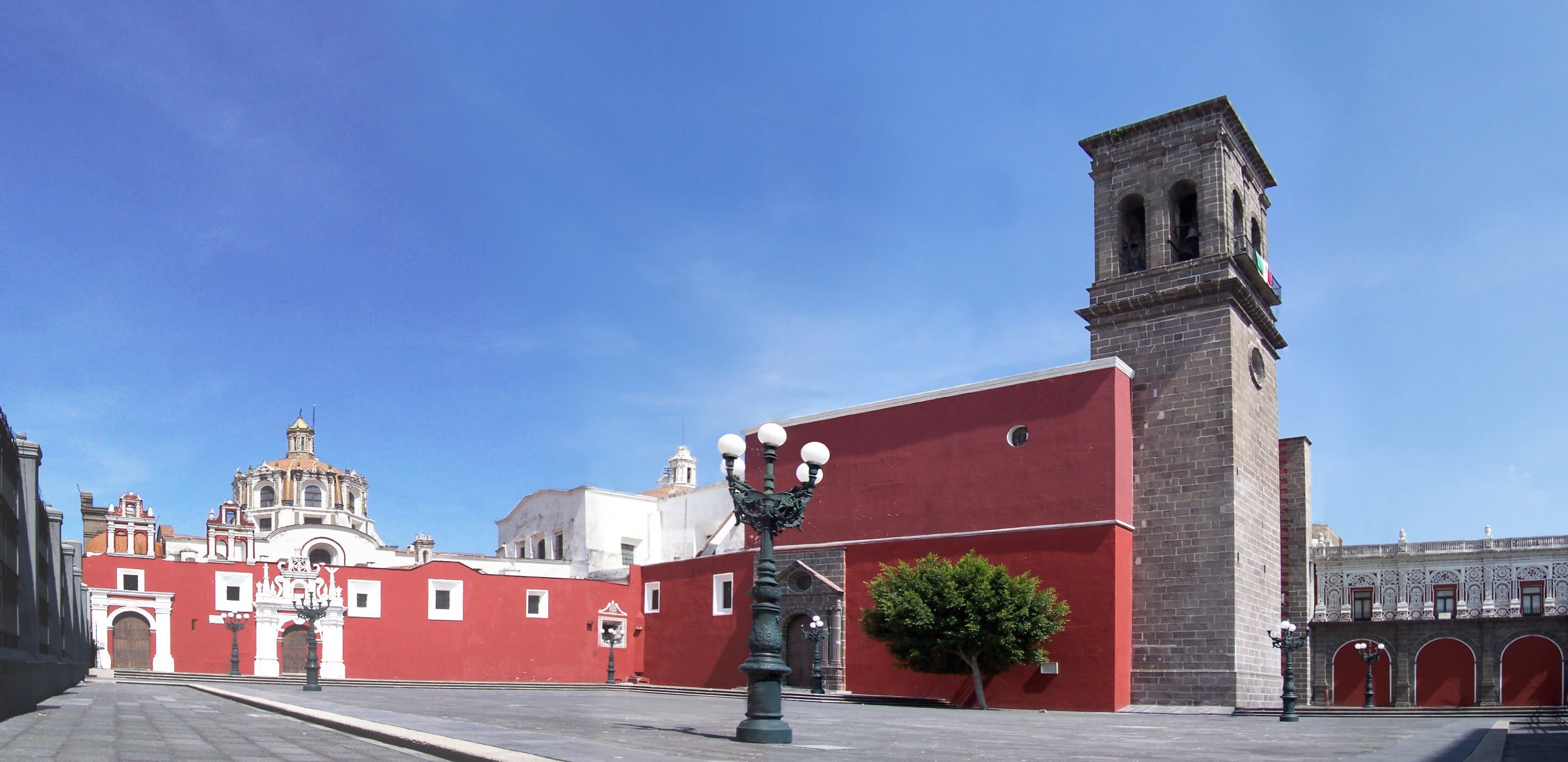
Convent Church of Santo Domingo, Puebla
Convent Church of Santo Domingo, Puebla
"These natives had five books which, as I said, were written in pictures and symbols.
The first book dealt with years and calculations of time; the second, with the days with the feasts which the Indians observed during the year; the third, with dreams, illusions, superstitious and omens in which the Indians believed; the fourth, with baptism and with names that were bestowed upon children; the fifth, with the rites ceremonies and omens of the Indians related to marriage"

.03
Codicological challenges and
editorial legacy
Artistic heterogeneity and historical “disorder” of the manuscript
Codex Vaticanus A comprises 102 folios of early European paper in codex format. Its earliest binding, noted in the 1596 Rainaldi inventory, was in black leather, while the present red leather binding, bearing the arms of Pope Pius IX and Cardinal Luigi Lambruschini, dates to the first half of the 19th century.
Codicological analysis has identified the Anchor and Agnus Dei as the principal watermarks, both Italian, likely from Fabriano. Although the paper was produced in Italy, at least 29 tlacuiloque (indigenous painters) have been identified as part of the graphic execution, and they displayed significantly diverse styles. The varying quality of the lines and the irregularity of the pictographs, which are sometimes unpolished or lack important elements present in the Codex Telleriano-Remensis, suggest that the painters had different technical skills and varying degrees of familiarity with indigenous pictographic conventions. However, far from being mechanical copyists, Indigenous painters often integrated elements from traditional and local ethnographic knowledge.
As already noted, an analysis of the process of creating and compiling the manuscript reveals signs of haste not only in the copying of the images from the Codex Telleriano-Remensis. The current layout shows the pages in a wrong order, particularly in the sections dedicated to the calendar and the annals. For this reason, the problem of reconstructing the original sequence of the manuscript has long occupied scholars. The first to conduct a systematic codicological analysis was the Cardinal Librarian Franz Ehrle in 1900, while a revised facsimile edition was published by Ferdinand Anders and Maarten Jansen in 1996. Both studies attributed the incorrect pagination of the codex to a 19th-century binding. However, as we shall see, recent studies show that the disordered layout of the codex must have been created much earlier, probably as early as the second half of the 16th century.







Watermark (Codex Vat. Lat. 3738, f. 54 from the Loubat facsimile edition 1900)
Watermark (Codex Vat. Lat. 3738, f. 54 from the Loubat facsimile edition 1900)

Watermark (Codex Vat. Lat. 3738, f. 102 from the Loubat facsimile edition 1900)
Watermark (Codex Vat. Lat. 3738, f. 102 from the Loubat facsimile edition 1900)

Watermark (Codex Vat. Lat. 3738, f. 101 from the Loubat facsimile edition 1900)
Watermark (Codex Vat. Lat. 3738, f. 101 from the Loubat facsimile edition 1900)
.04
From cosmic order to cultural translation
A theological reframing in the opening section of
the Codex Vaticanus A
Codex Vaticanus A is structured into autonomous thematic sections, composed at different stages and by different hands. While, as previously noted, the manuscript reproduces images and glosses from the Codex Telleriano-Remensis, it also includes entirely original materials of exceptional relevance, both for the study of Mesoamerican cultures and for understanding the religious history of the early modern period.
A substantial portion of the codex is devoted to religious matters. Its opening section focuses on a cosmology and a sort of sacred History, a part absent from the Codex Telleriano-Remensis. This section occupies an independent group of sheets probably added in the final stage of the manuscript's production. It is of considerable interest, as it offers an extremely original Christian reinterpretation of the traditional Mesoamerican cosmological model and mythology relating to some of the main indigenous deities, which were reimagined in these pages through the lens of Dominican theology. For example, the mythical cycle relating to the cultural hero known as Quetzalcoatl (“Feathered Serpent”) was boldly reinterpreted within an explicit xhristological framework.
The following sections systematically describe the two traditional calendars, both that associated with divination and that with the festive calendar linked to the calculation of the solar cycle. It is in this part of the manuscript that page-order errors emerge, revealing the challenges encountered in the understanding of the document in Rome. The codex presents two distinct calendrical sections: the first dedicated to the Tonalpohualli, the 260-day divinatory calendar based on the combination of 13 numbers and 20 signs; the second to the 18 veintenas, the eighteen 20-day periods that comprise the 365-day solar year.
The value of the calendrical sections lies not only in the richness of previously undocumented ethnographic data but also in the evident process of intercultural translation, often manifested in the Italian glosses, which, for example, compare indigenous divination with European astrology.
"And likewise were recorded the achievements and stories of conquests and wars, and the events of the principal lords;
the temporal and notable signs of heaven, and general pestilences;
at what time, and under what lord they occurred;
and all the lords who principally ruled this New Spain, until the Spaniards came to it”

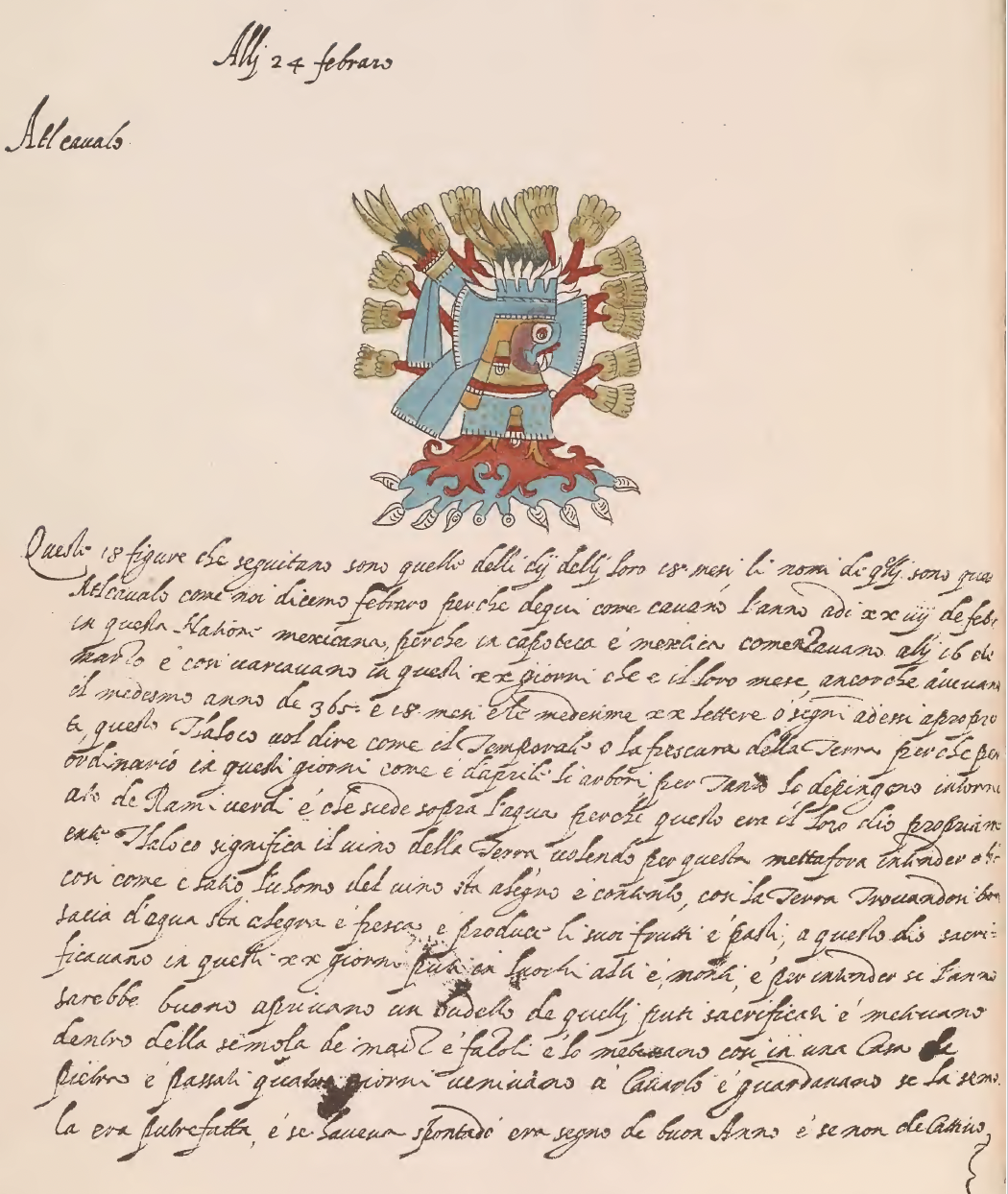

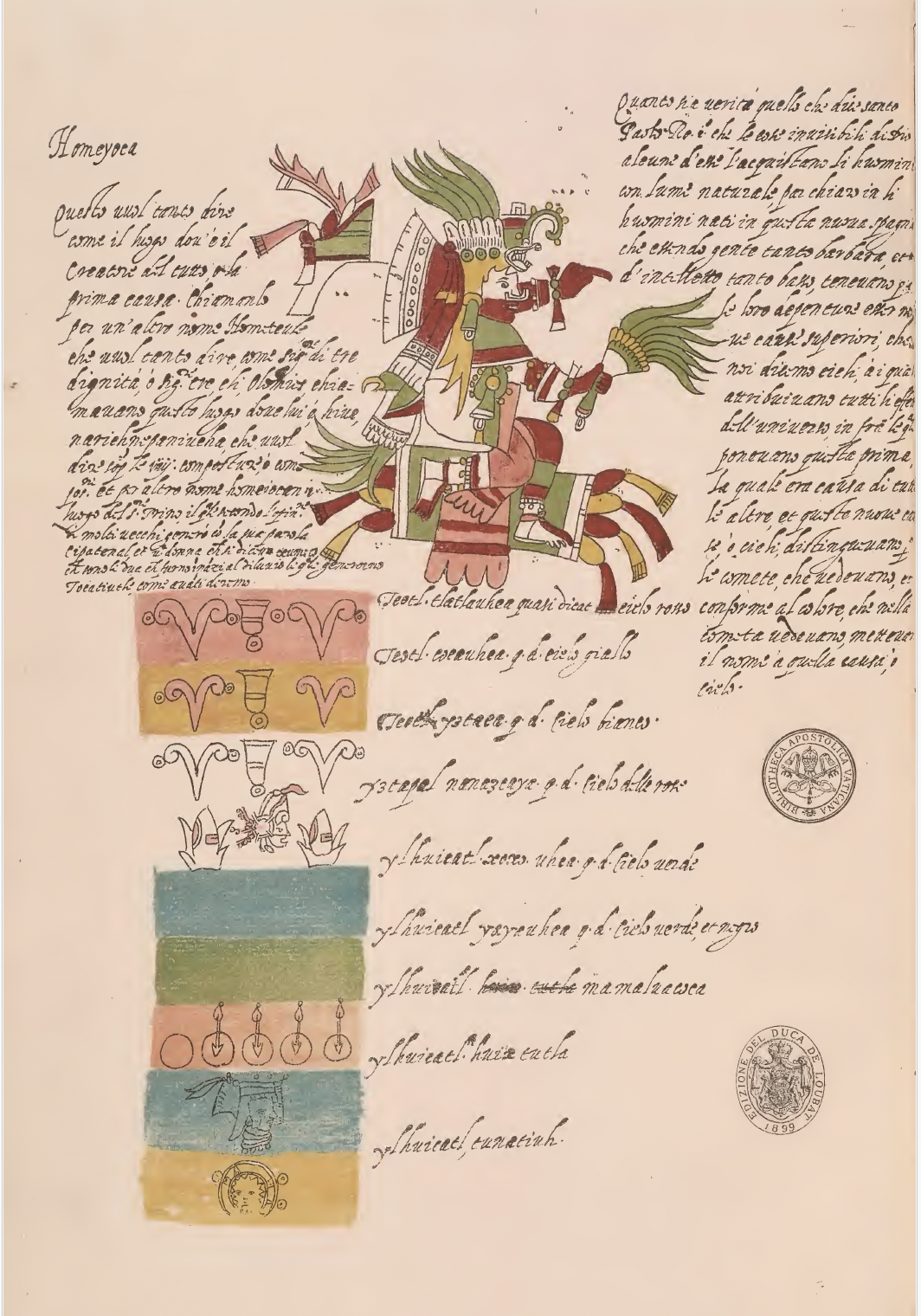
“The 13 layers of the sky” (Codex Vat. Lat. 3738, f. 1v from the Loubat facsimile edition 1900)
“The 13 layers of the sky” (Codex Vat. Lat. 3738, f. 1v from the Loubat facsimile edition 1900)

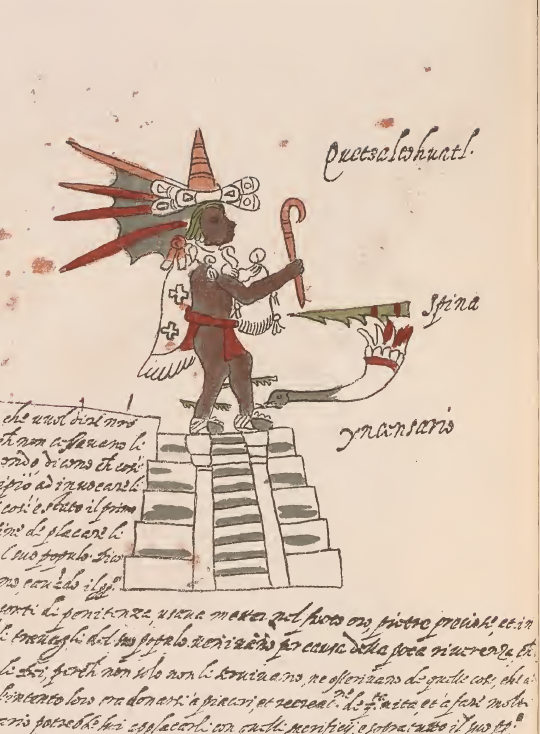
“Quetzalcoatl” (Codex Vat. Lat. 3738, f. 7v from the Loubat facsimile edition 1900)
“Quetzalcoatl” (Codex Vat. Lat. 3738, f. 7v from the Loubat facsimile edition 1900)

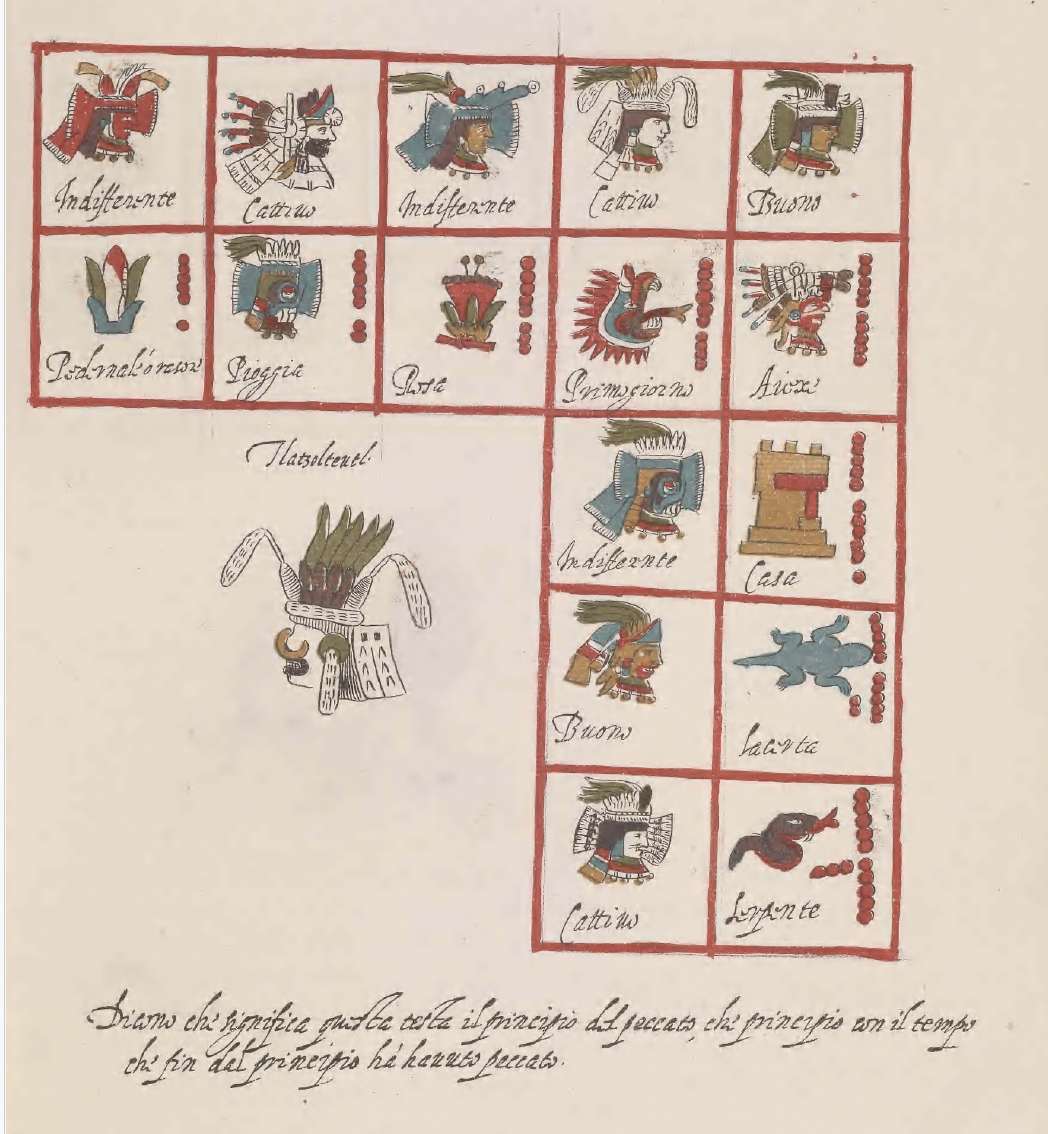
“The goddess Tlazolteotl” (Codex Vat. Lat. 3738, f. 19r from the Loubat facsimile edition 1900)
“The goddess Tlazolteotl” (Codex Vat. Lat. 3738, f. 19r from the Loubat facsimile edition 1900)
.05
From indigenous daily life to their history
Secular customs, material culture, and historical Annals in the Codex Vaticanus A
The second part of the codex shifts its focus to the secular dimensions of life among the peoples of Mesoamerica. This section offers a not entirely systematic account of Indigenous customs and rites, incorporating ethnographic observations that have no direct counterpart in the Codex Telleriano-Remensis and are therefore of exceptional value for the study of Mesoamerican civilisations.
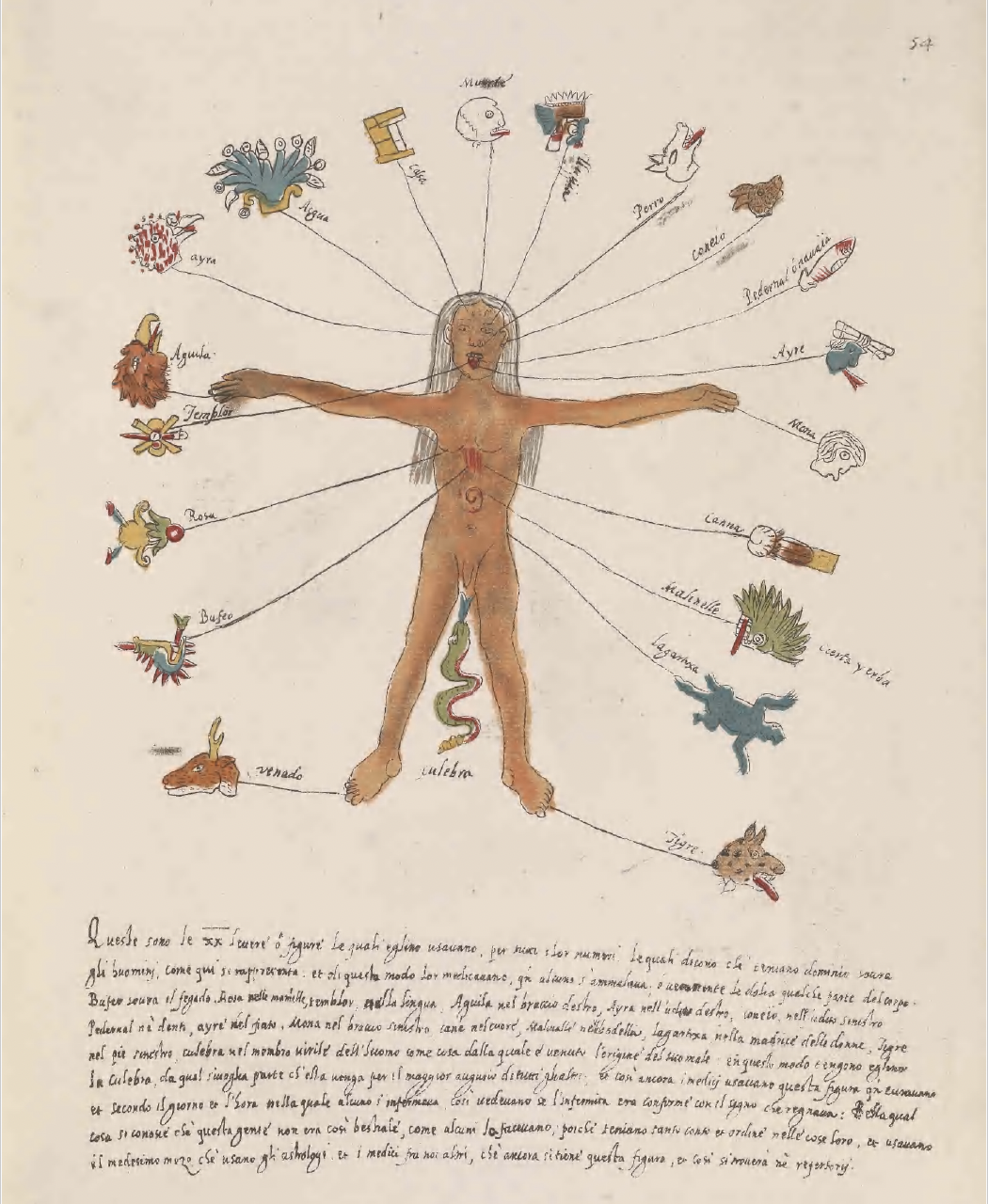
Among its most notable illustrations, it is a striking representation of a human figure surrounded by the twenty day-signs, used for medical and astrological diagnosis: an early and remarkably sophisticated example of intercultural hybridization.
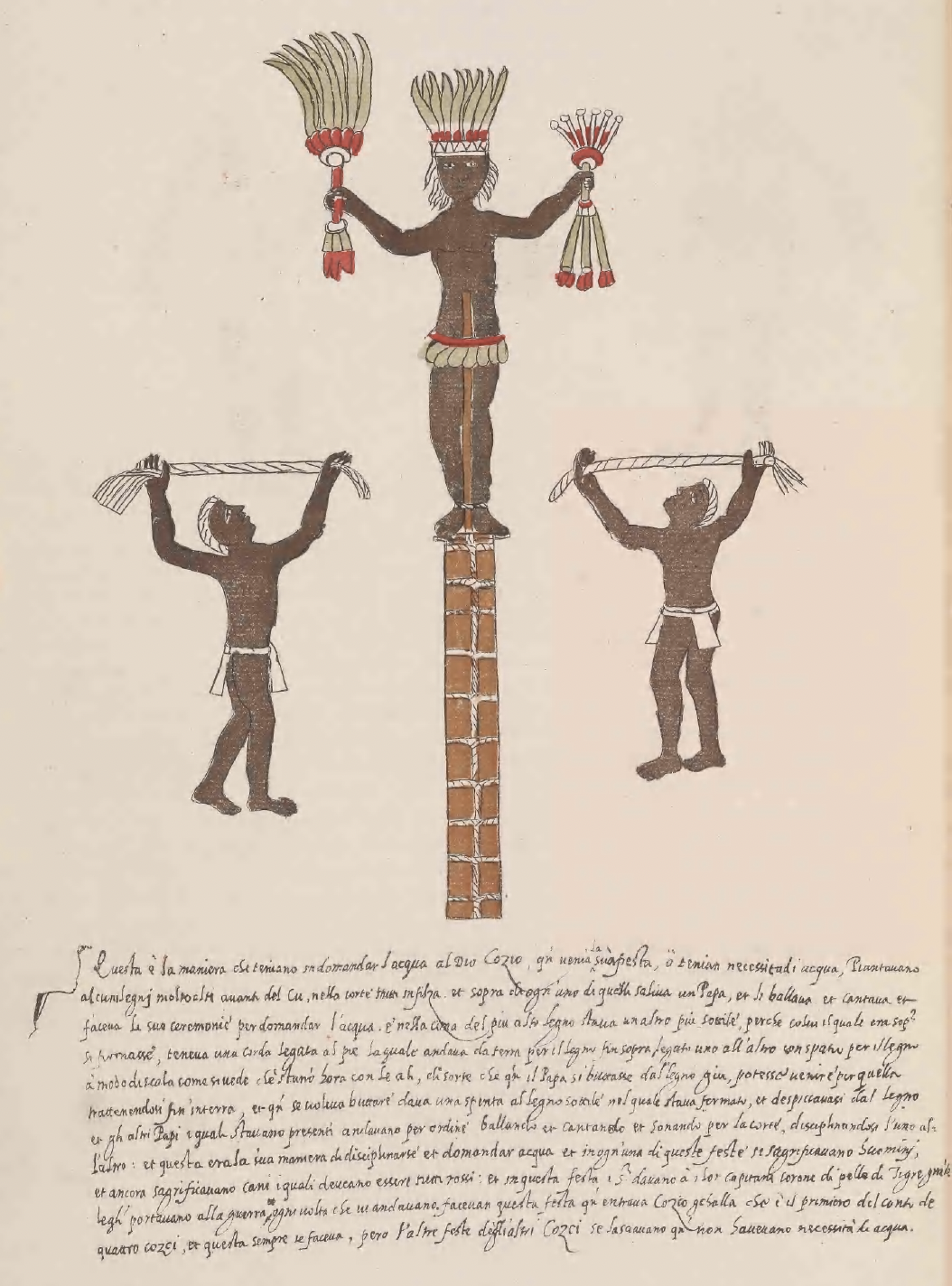
The manuscript also devotes considerable attention to indigenous material culture. Its pages describe ritual and sacrificial practices, drawing on the ethnographic knowledge of a Dominican friar active in the Mixtec-Zapotec region. Of particular interest is the section devoted to costumes and insignia, which documents the different styles of military, noble, and government clothing, once again demonstrating the sophisticated craftsmanship of Mesoamerica.
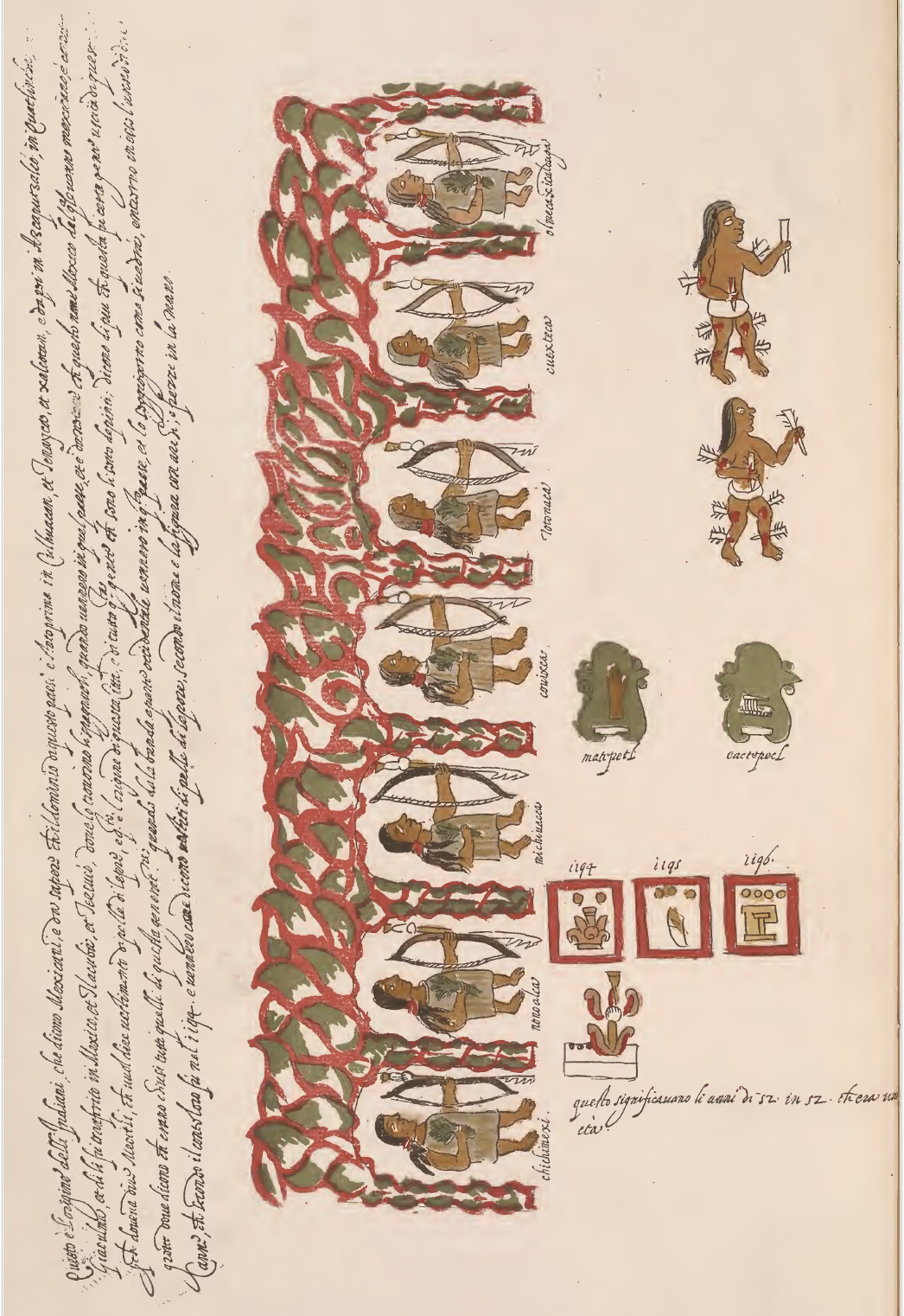
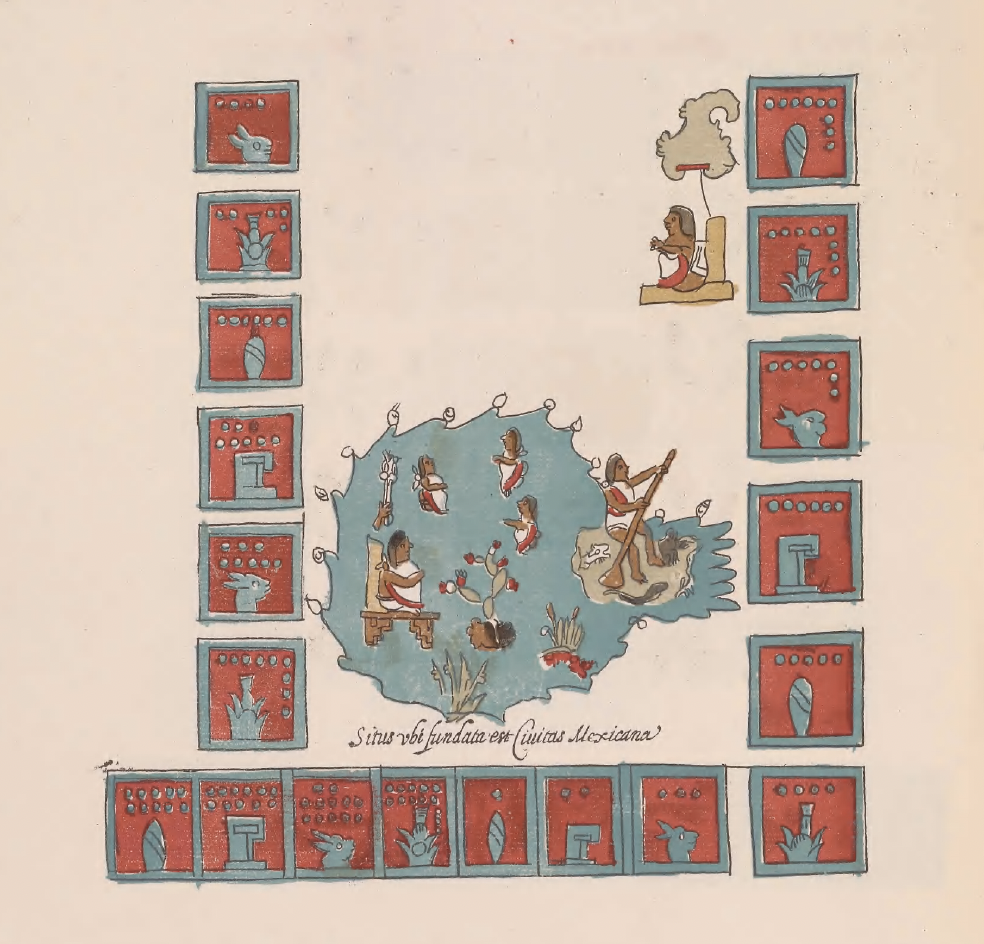
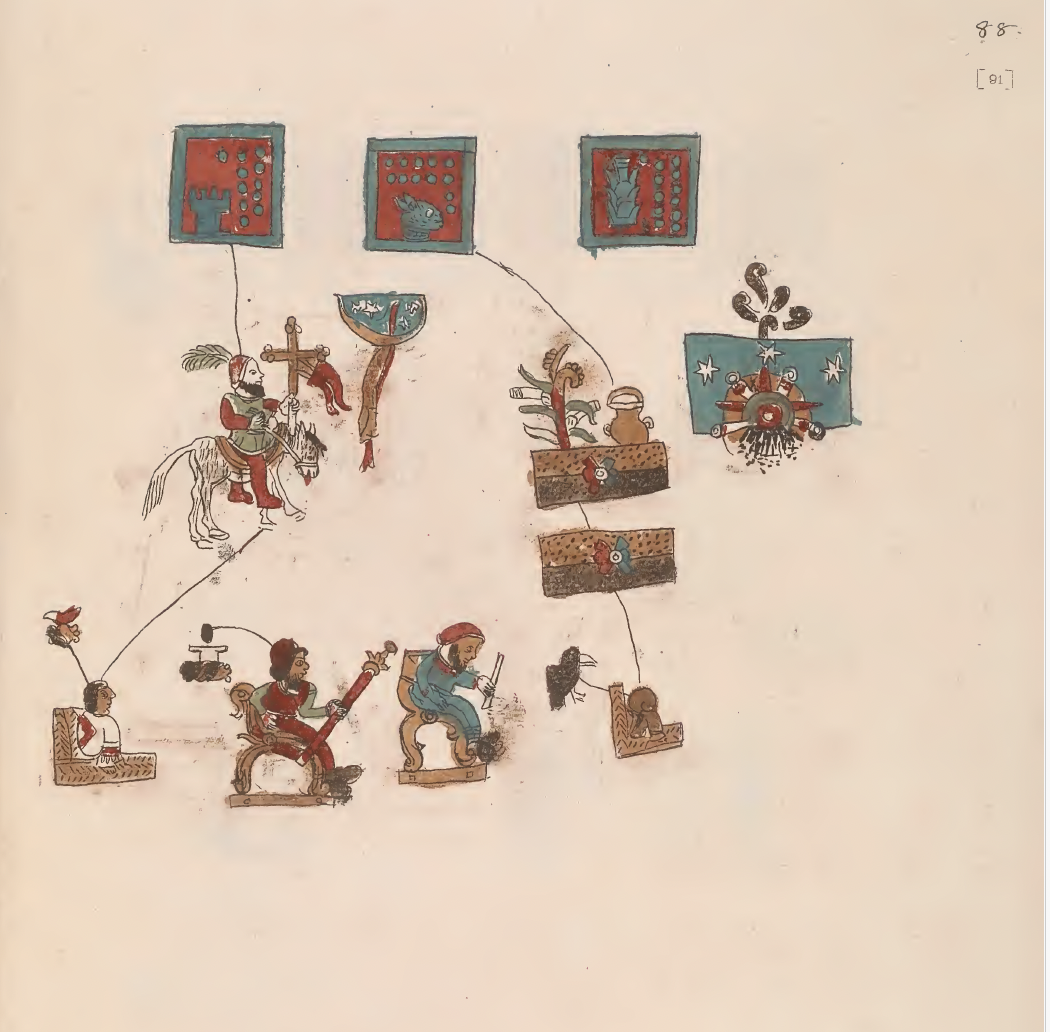
The final section of the codex is devoted to historical annals and derives entirely from the Codex Telleriano-Remensis. It presents the history of the people of Huitzilopochtli in pictorial form, from their departure from Chicomoztoc (“Seven Caves”) and the first New Fire ceremony in 1194, through to dramatic colonial events. The last part of the historical annals shows a depiction of Hernán Cortés' arrival on horseback and provides a detailed sequence of colonial developments that ended in 1562. Further evidence of the manuscript’s rapid production is seen in the fact that this section contains Italian glosses only on the first two pages and never received a full explanatory commentary.
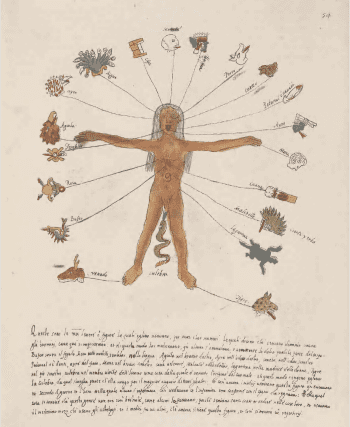
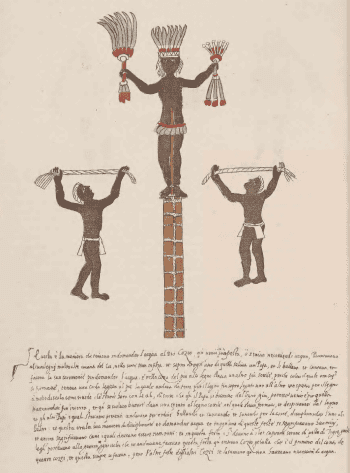
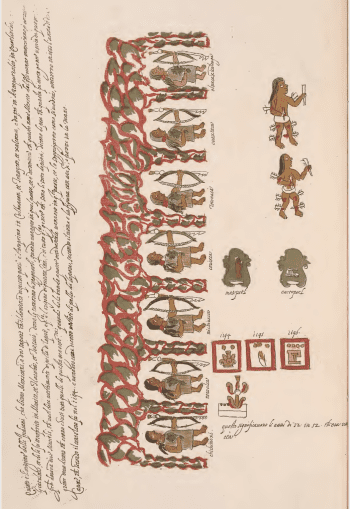
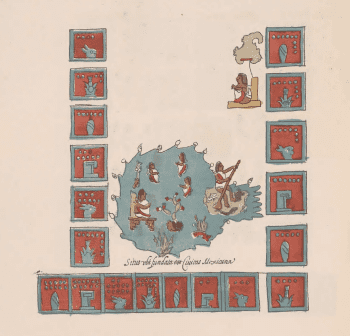
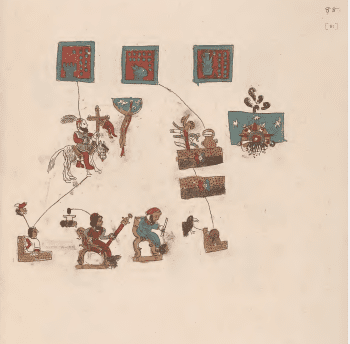





“And so, in this place they call the New World, both in the West and in the East, I have noticed such conformity between Egyptian superstitions and those of this country that I have been amazed at times”
.06
A manuscript in transit
Intellectual and antiquarian reception between Rome and Venice
As previously noted, Codex Vaticanus A was sent to Rome as a gift by members of the Dominican Order involved in the evangelisation of New Spain. Beyond its impact on the Order’s institutional policies, the manuscript began a “second life” in Italy, where it rapidly became an object of intellectual and antiquarian interest.
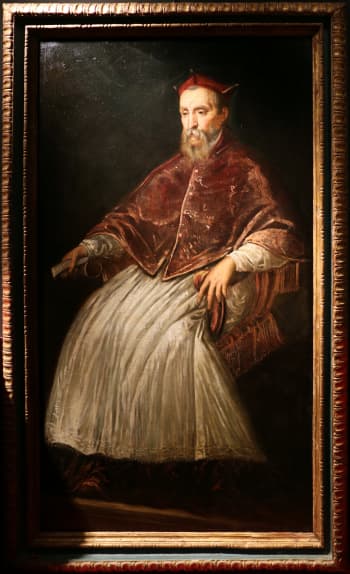
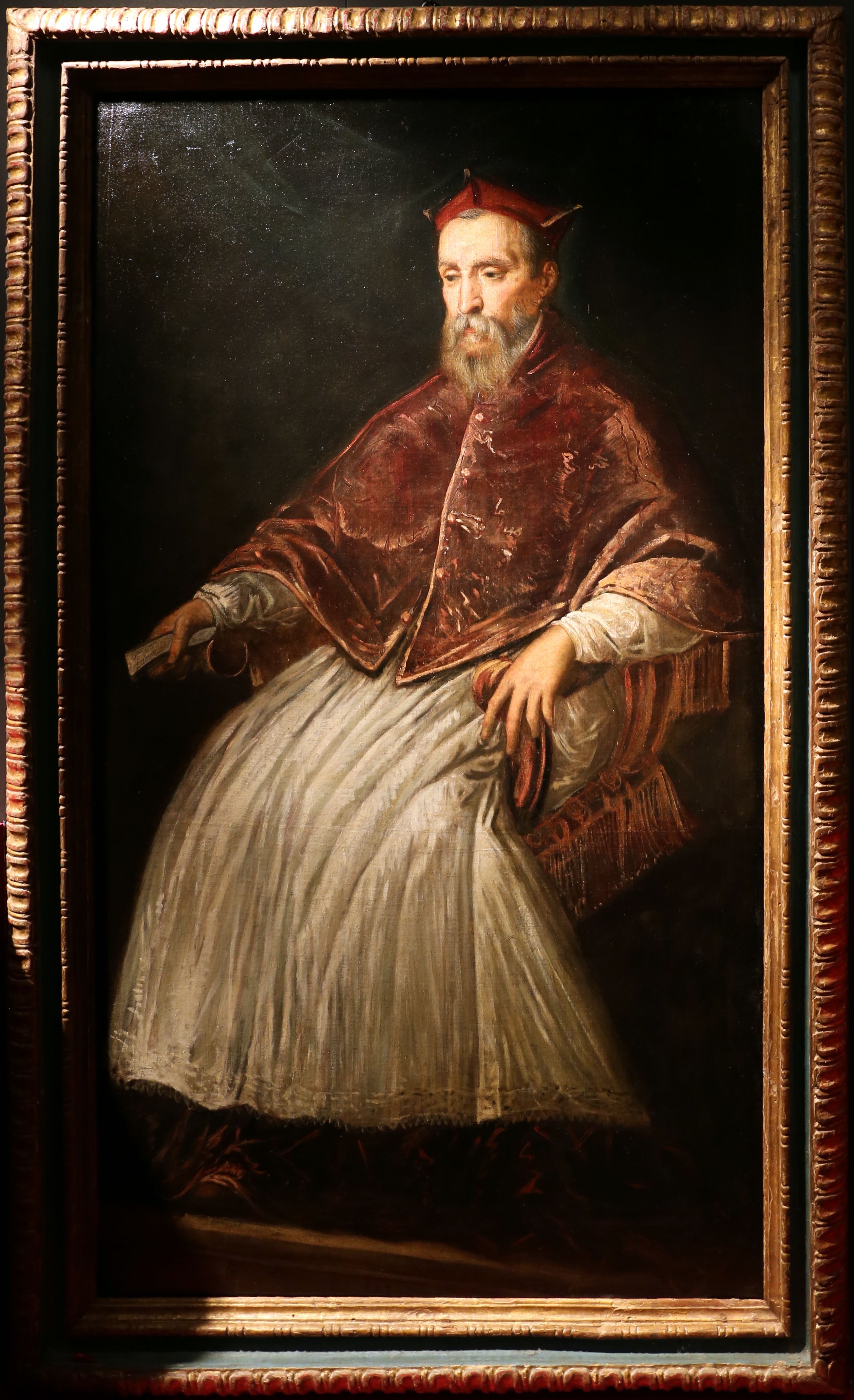
Upon its arrival between 1565 and 1566, Cardinal Marcantonio da Mula (known as Amulio), then Prefect of the Biblioteca Apostolica Vaticana, played a central role in its early reception. A major promoter of the understanding of American artefacts and images, he commissioned copies of several illustrations from the codex and circulated them within a wide network of contacts between Rome and Venice.
A document recently rediscovered in the Biblioteca Marciana in Venice and dated to around 1577, known as the Ragguaglio dell’Idolatria del Mondo, reproduces and translates into Spanish the Italian glosses of the codex. Remarkably, it preserves the same incorrect folio order—long attributed to a mistaken nineteenth-century restoration—demonstrating that the manuscript had already its erroneous configuration in the sixteenth century.
In this incorrect order, the codex appears to have drawn the attention of Roman intellectual circles. Its presence in the Biblioteca Apostolica Vaticana is indirectly attested by Michele Mercati in Degli obelischi di Roma (1589), where he refers to “two books that came from Mexico”.
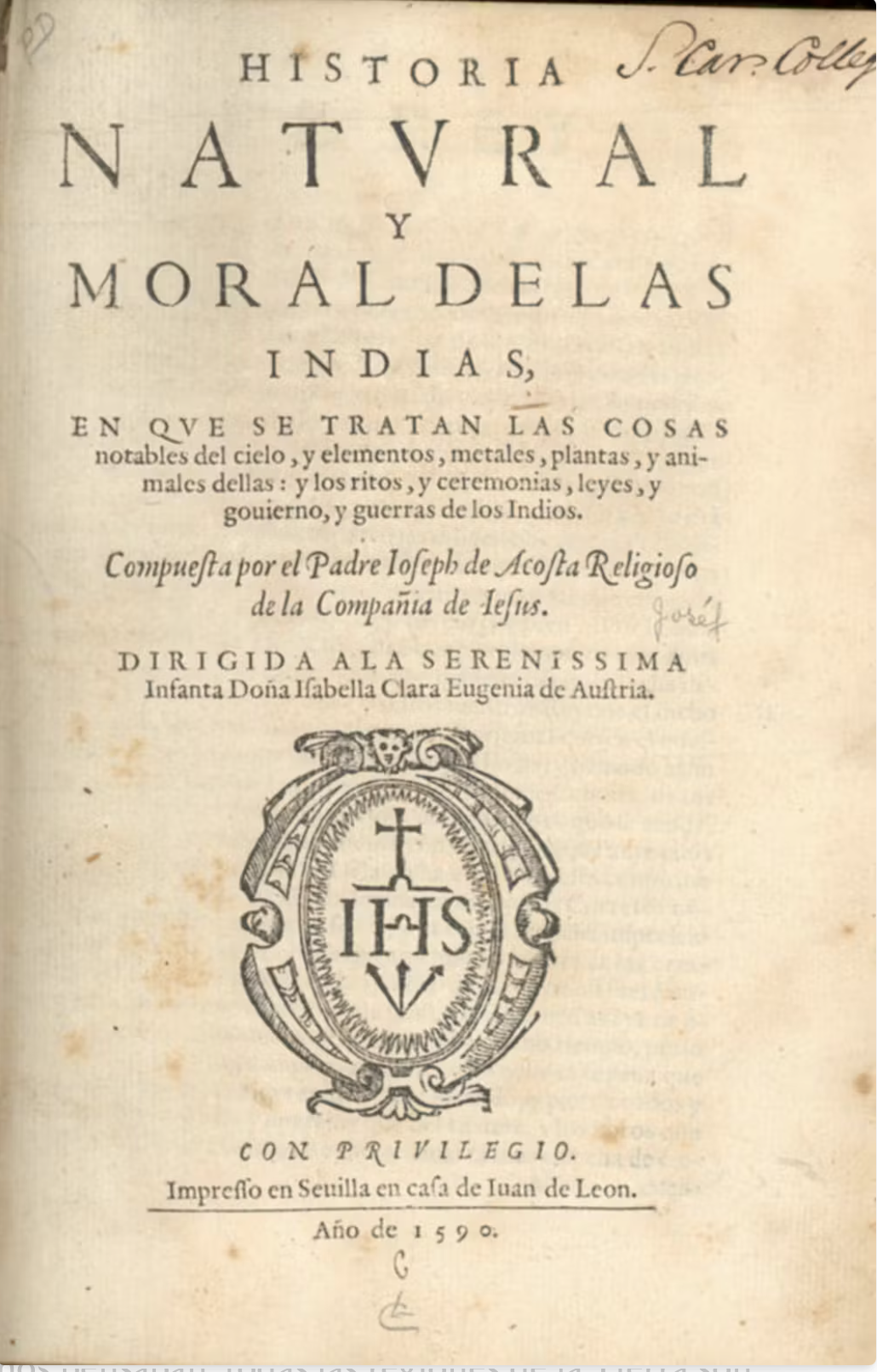
The Jesuit José de Acosta, in his Historia natural y moral de las Indias (1590), likewise seems to allude to similar pictographic manuscripts held in the Vatican. The first direct reference to the codex appears in the draft of the Rainaldi inventory (1596–1600).
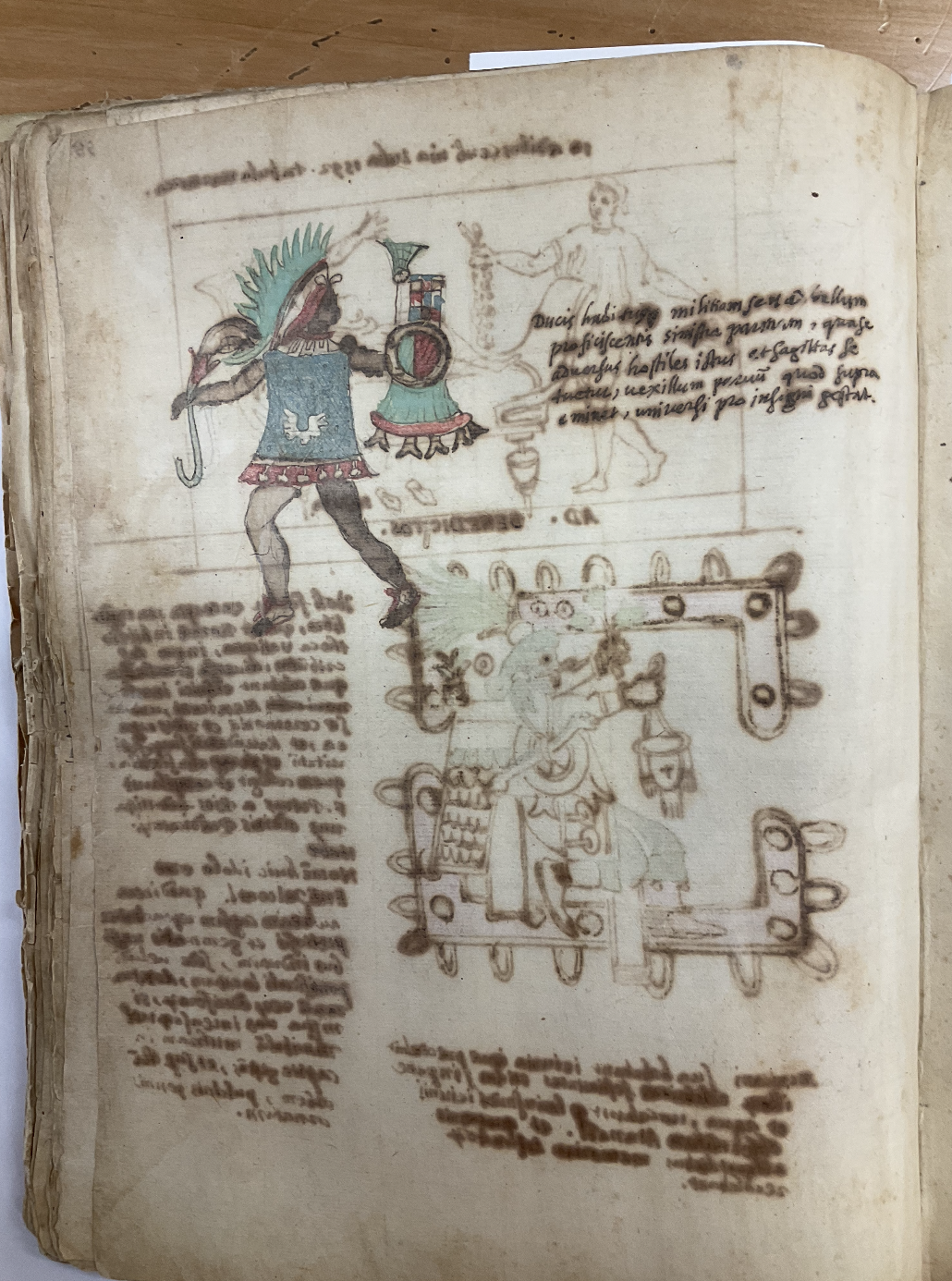
By the end of the 16th century, the manuscript was already appreciated for its antiquarian and exotic appeal, moving farther from the missionary objectives that had originally motivated its production. This change is exemplified, for instance, by Philips van Winghe, a Flemish antiquarian interested in the testimonial value of ancient objects from different sources, who copied the illustrations from the codex around 1592 and identified Pedro de los Ríos as its compiler. His drawings are now preserved in the Biblioteca Angelica in Rome (Ms. lat. 1564).


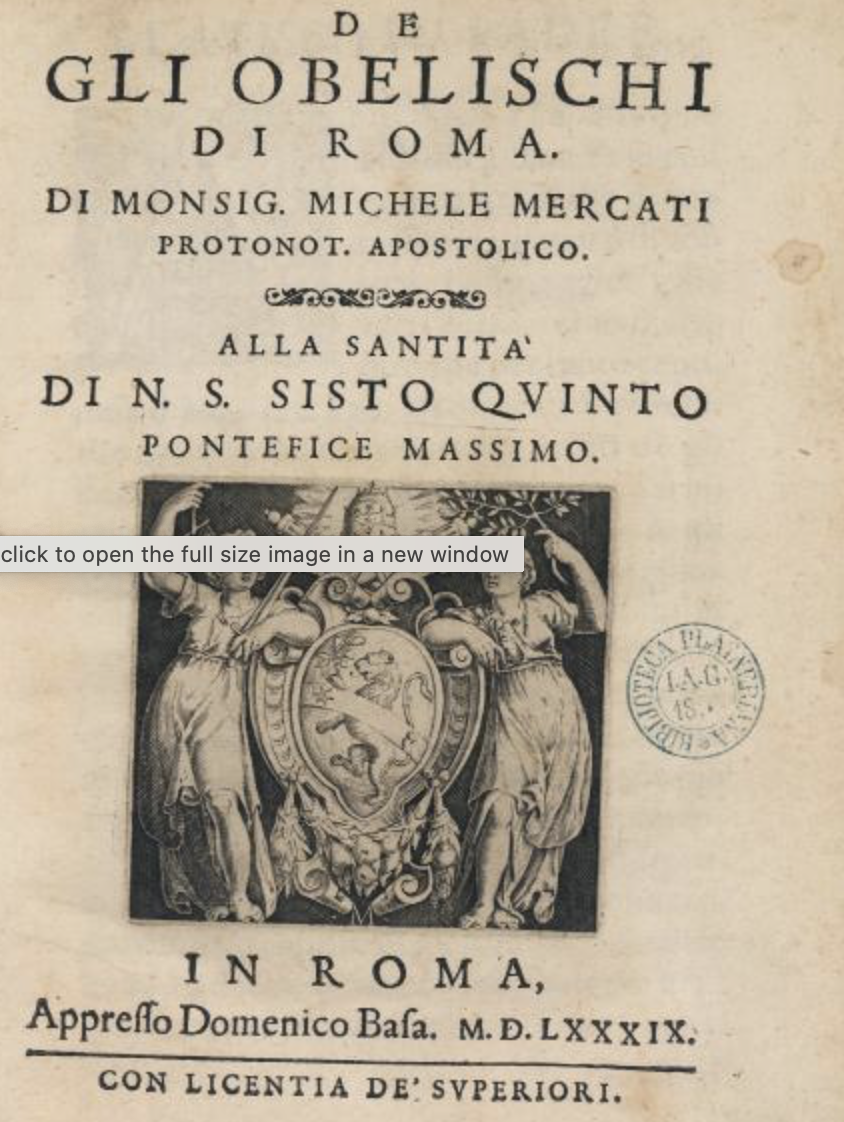



Frontispiece of Michele Mercati’s De gli Obelischi di Roma (1589)
Frontispiece of Michele Mercati’s De gli Obelischi di Roma (1589)

Frontispiece of José de Acosta’s Historia Natural y Moral de las Indias (1590)
Frontispiece of José de Acosta’s Historia Natural y Moral de las Indias (1590)

Philips van Winghe’s representation of an Aztec Warrior (Ms.Lat. 1564 courtesy of the Biblioteca Angelica of Rome) (1592)
Philips van Winghe’s representation of an Aztec Warrior (Ms.Lat. 1564 courtesy of the Biblioteca Angelica of Rome) (1592)
"…as can be seen in two books in the Vatican library copied from the originals arrived from Mexico”
.07
Rewriting the gods of the world
Global mythography and visual religion in early modern Europe
The most influential use of Codex Vaticanus A was made by the Padua antiquarian Lorenzo Pignoria in the Seconda Parte delle Imagini de gli Dei Indiani, appended to Vincenzo Cartari’s mythographic work in the 1615, 1624, and 1626 editions.
Cartari’s treatise was one of the most celebrated mythographic texts of the second half of the 16th century, gathering contemporary knowledge of the nature of Greco-Roman deities.
At the beginning of the 17th century and as evidence of a distinctly global intellectual sensibility, the publisher Cesare Malfatti commissioned Pignoria to produce a new edition, both updating information on ancient deities and adding a section dedicated to the “new” gods emerging not only from the Americas but also from Asia.
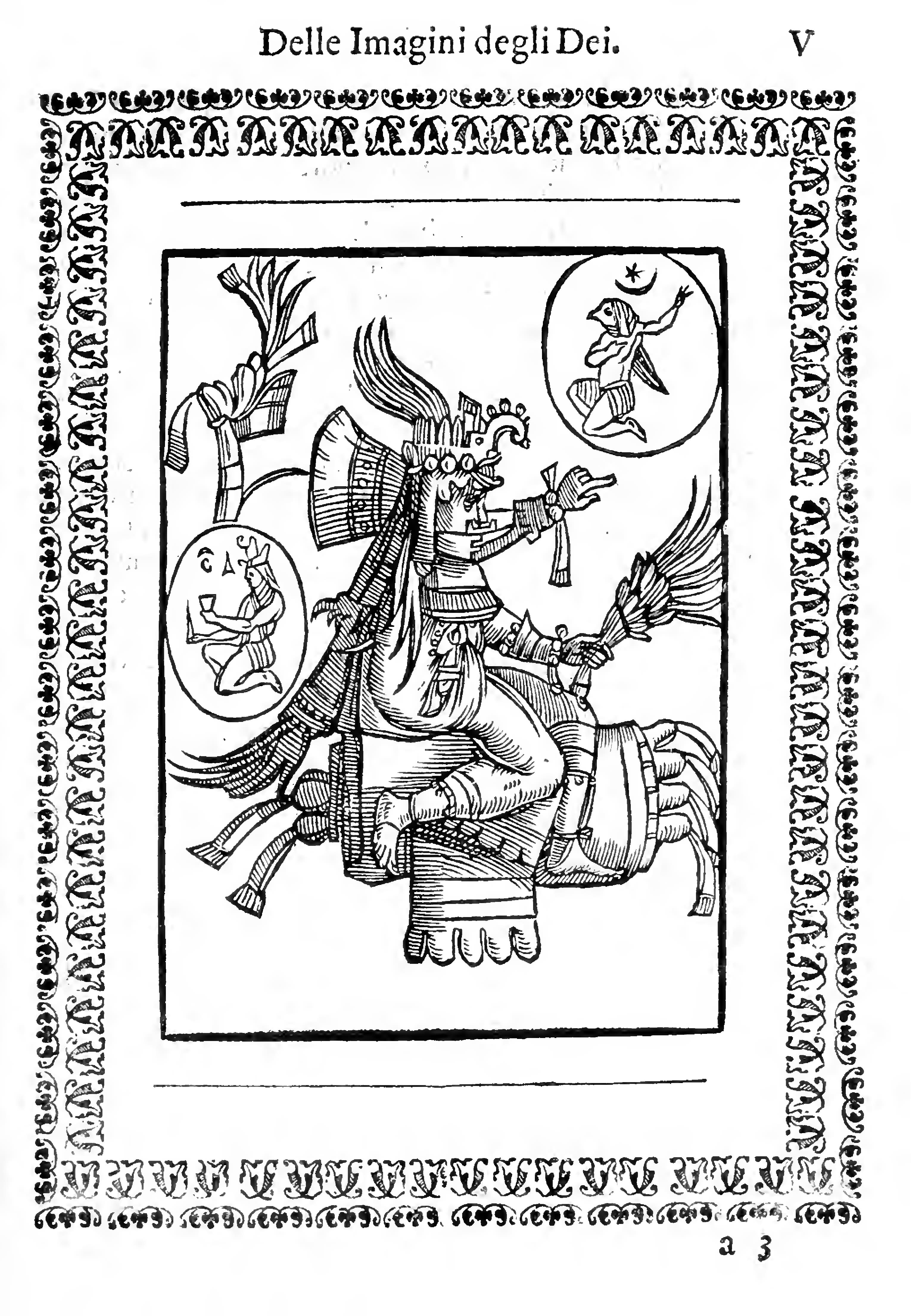
Through Senator Ottaviano Malipiero, who owned the copies made under the Cardinal Amulio, Pignoria obtained the illustrations corresponding to the first cosmological folios of the codex. He used these images to develop a form of “comparative mythology” pushing further the interpretive framework previously proposed by Dominican friars. Mesoamerican deities—such as Homoyoca, reimagined as a creator god, a Prima Causa—were incorporated into a Christian theological perspective.
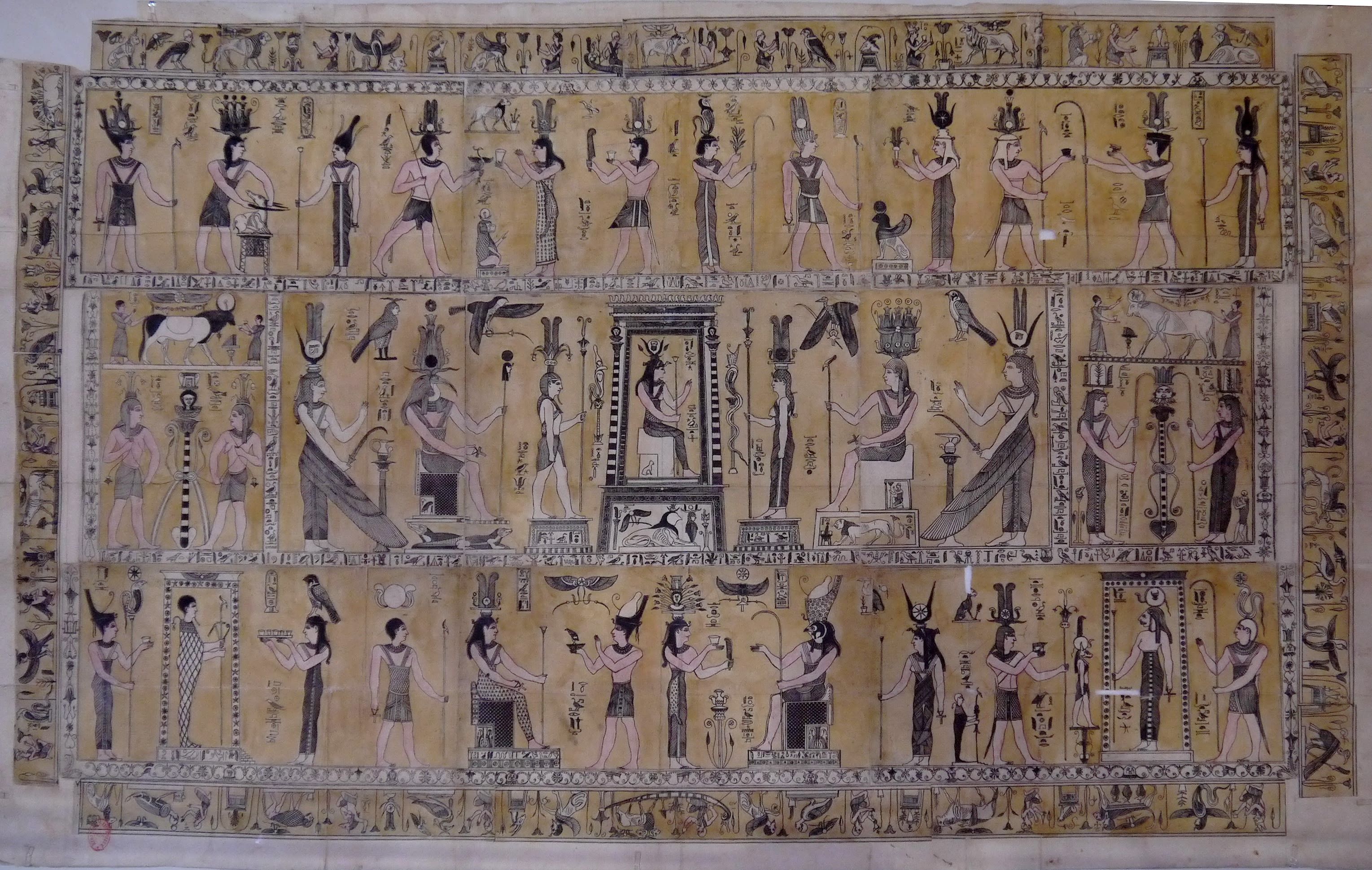
The most distinctive aspect of Pignoria’s work lies in his interpretation of Mexican (and Eastern) deities as peculiar manifestations of a universal idolatry originating in Egypt, expressed visually in forms believed to be essentially consistent across cultures. This new global and visual history of religion, influenced by a sort of Egyptomania, a rediscovery of ancient Egyptian culture that had gained importance in Rome and throughout Europe since the second half of the 16th century, was also driven by a growing antiquarian interest in ancient cultures, which were now being explored through a renewed focus on material production.
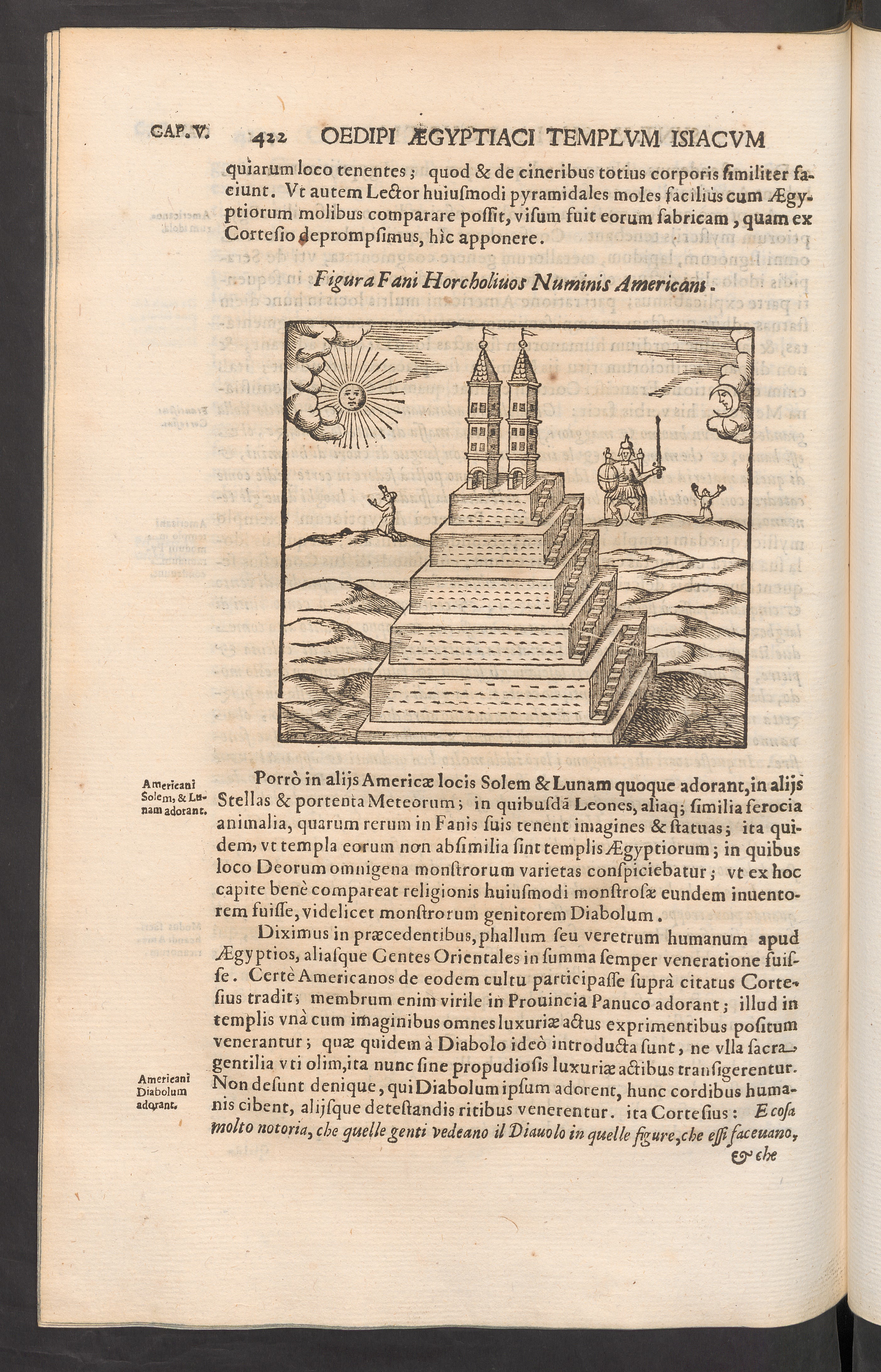
Pignoria's work also influenced numerous other contemporary reflections and interpretations, including that of the Jesuit Athanasius Kircher, thus helping to consolidate the role of Codex Vaticanus A as a fundamental reference point in the history of the circulation of indigenous objects and ideas in early modern Europe.

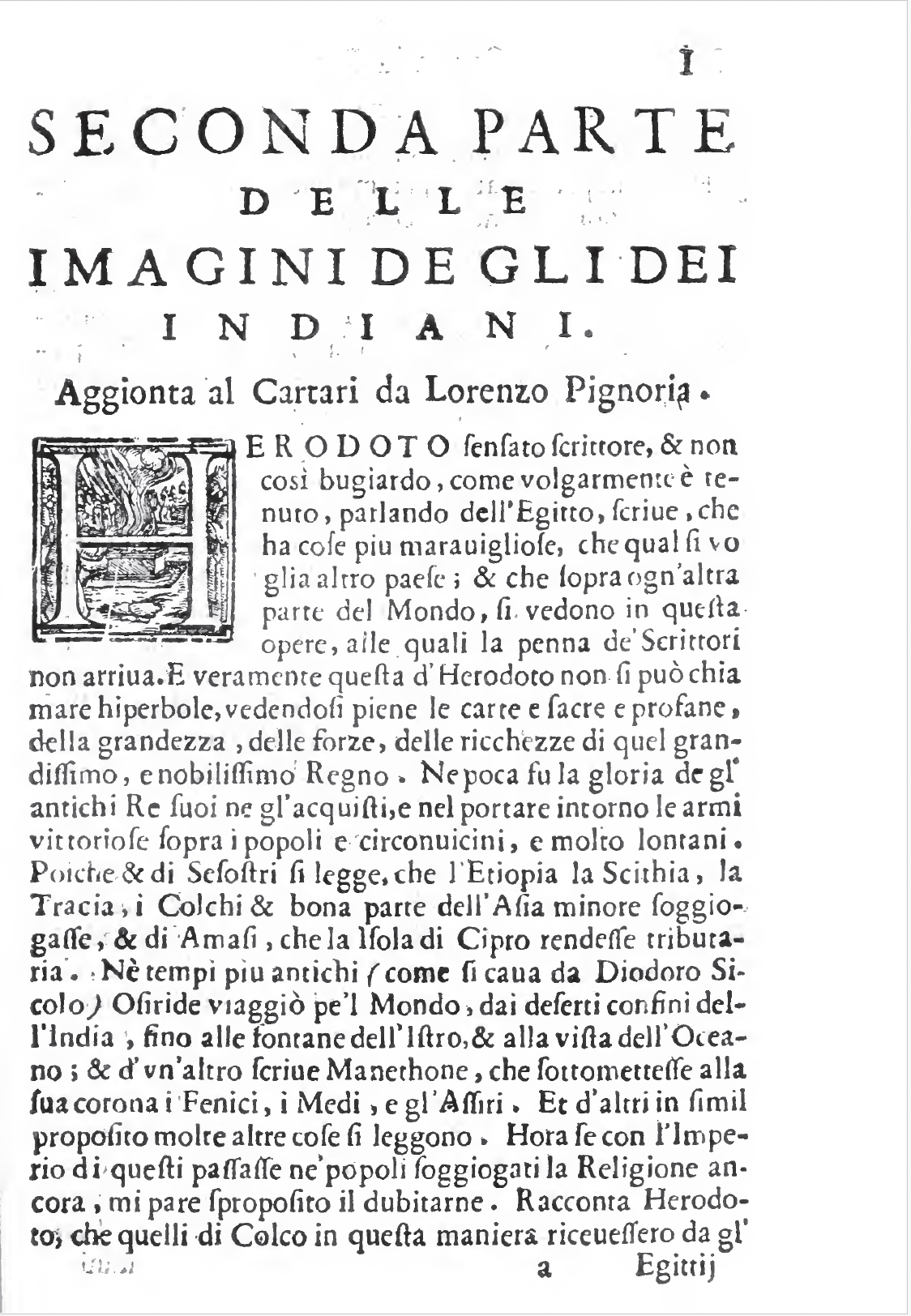





Frontispiece of Lorenzo Pignoria’s Seconda Parte delle Imagini de gli Dei Indiani
Frontispiece of Lorenzo Pignoria’s Seconda Parte delle Imagini de gli Dei Indiani

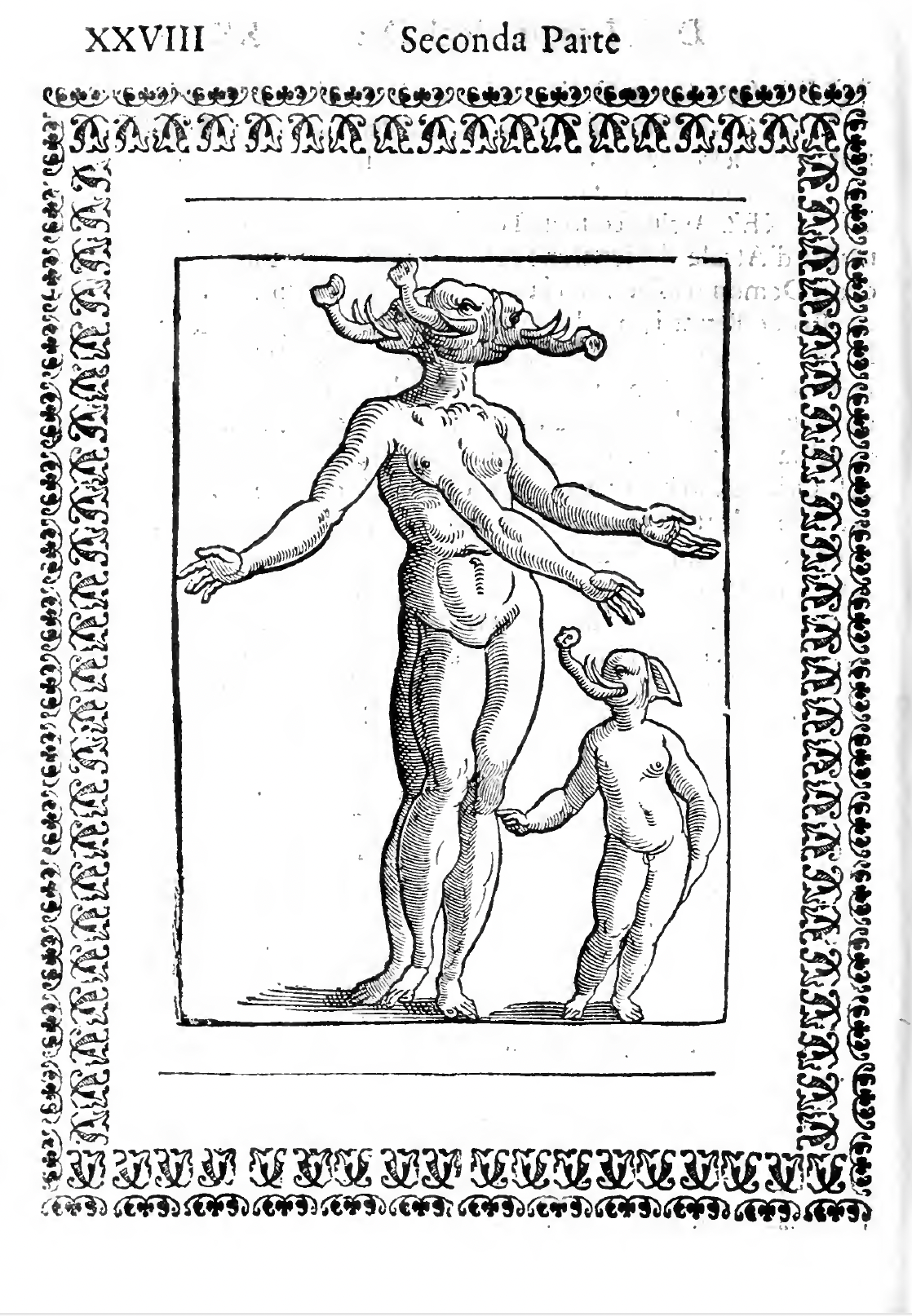
“Ganesh”, Lorenzo Pignoria, Seconda Parte delle Imagini de gli Dei Indiani, p. XXVIII
“Ganesh”, Lorenzo Pignoria, Seconda Parte delle Imagini de gli Dei Indiani, p. XXVIII

“Homoyoca”, Lorenzo Pignoria, Seconda Parte delle Imagini de gli Dei Indiani, p. V
“Homoyoca”, Lorenzo Pignoria, Seconda Parte delle Imagini de gli Dei Indiani, p. V

The reproduction of the Mensa Isiaca by Lorenzo Pignoria (1605)
The reproduction of the Mensa Isiaca by Lorenzo Pignoria (1605)

“Mexican Temple”, in Athanasius Kircher’s Oedipus Aegitiacus (1652), p. 422
“Mexican Temple”, in Athanasius Kircher’s Oedipus Aegitiacus (1652), p. 422
 Built with Shorthand