
Exploring Mesoamerican hybridity
The tlahmachayatl as a woven archive

Introduction
Tangible proofs of cultural blending
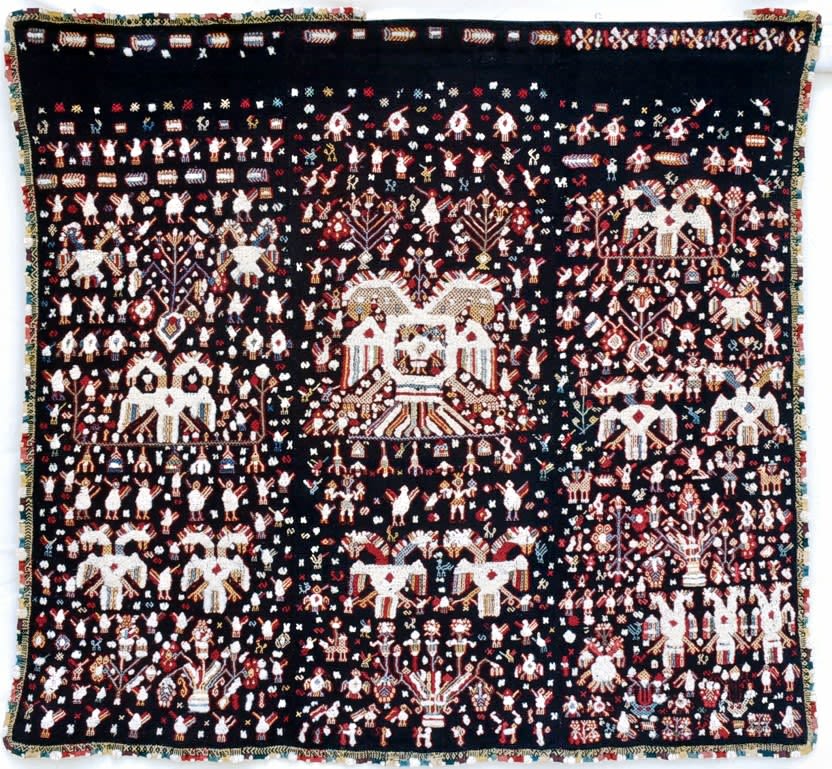
Wool, silk, cotton, and feathers are elegantly interwoven to give form to one of the rarest textiles in the world, now exhibited at the MUCIV - Museo delle Civiltà in Rome.
The tlahmachayatl is one of the very few colonial textiles characterized by a distinctive manufacturing technique that includes the use of twisted down combined with cotton, among other fibers.
The textile’s native name, tlahmachayatl, literally means “embroidered fabric” in Nahuatl. It is described in archival sources as a cloak (tilmahtli in Nahuatl), a garment that represents one of the most important status markers within the clothing repertoire of Mesoamerican warriors in pre-Hispanic times.
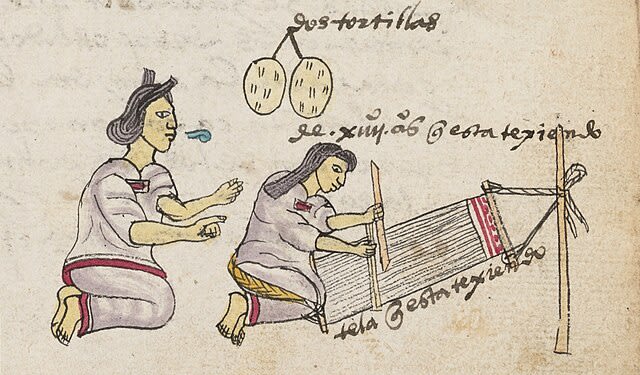
The textile consists of a plain weave base fabric of a dark purple tone, divided into three panels of equal dimensions. These are sewn together along their length using the same wool thread. The fabric is enriched with decorative motifs created by a supplementary polychrome weft made of silk, wool, and cotton twisted with white down, inserted into the base fabric using a backstrap loom. This device - typically fastened to the weaver’s body with a leather belt - has been documented since pre-Hispanic times and is still in use today in many Mesoamerican Indigenous communities.
The presence of wool and silk, which are presumably not indigenous weaving fibers, makes the textile’s materiality a hybrid complex of different cultural influences. Still the exceptional nature of the artifact lies essentially in the pre-Hispanic manufacturing technique of cotton twisted with down. Tracing its threads means immersing in a tale of exchange and cultural blending, making it one of the most evident material examples of cultural hybridity.
He who did not take a captive […] never did they place upon him an embroidered cape (tlahmachyoh tilmahtli) but only white was his small maguey fiber cape, white his small breech clout.

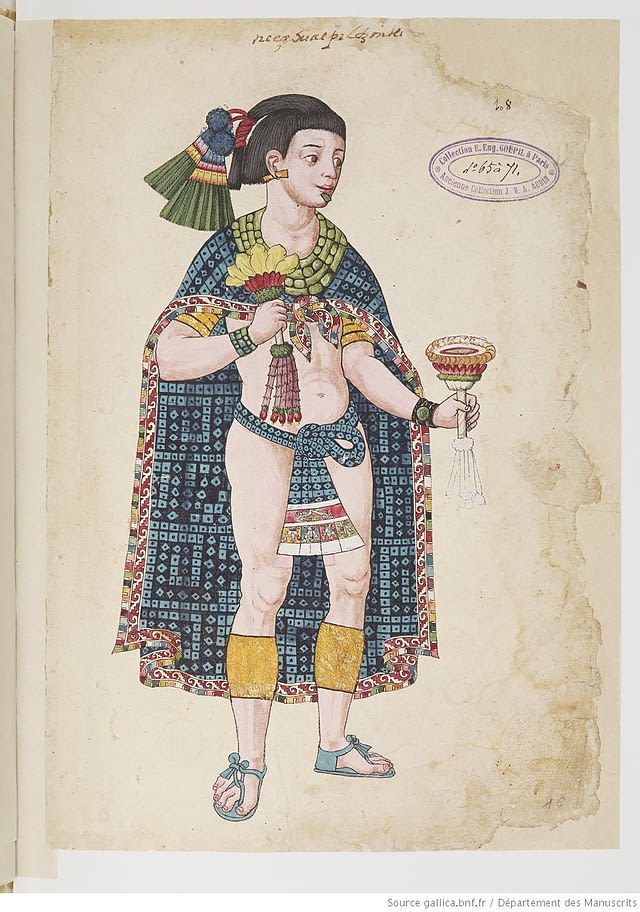
Nezahualpilli, Codex Ixtlilxochitl f.108r (Wikimedia Commons, public domain)
Nezahualpilli, Codex Ixtlilxochitl f.108r (Wikimedia Commons, public domain)

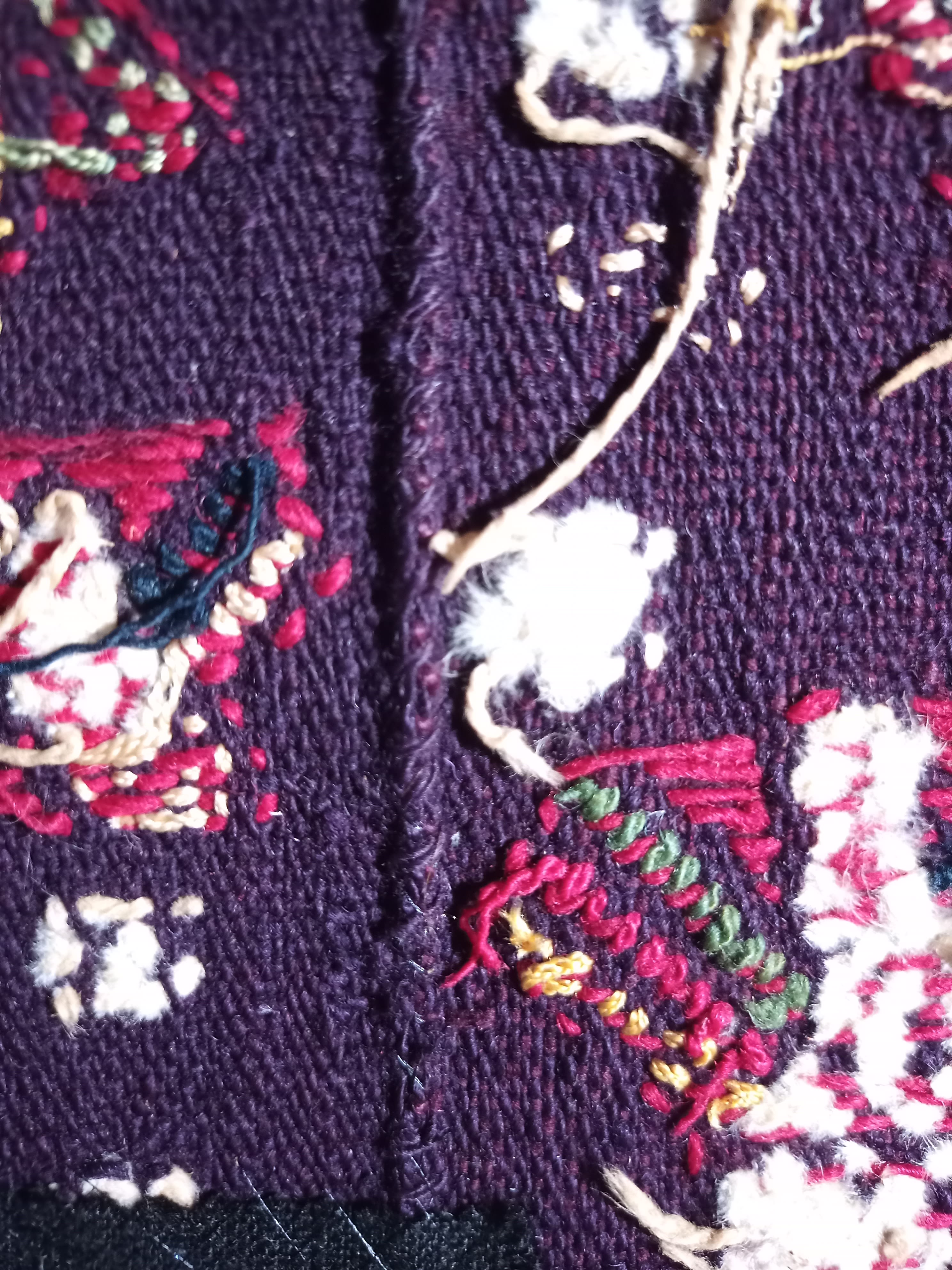
Tlahmachayatl. Detail of manufacture on the reverse side. MUCIV – Museo delle Civiltà – Roma.
Tlahmachayatl. Detail of manufacture on the reverse side. MUCIV – Museo delle Civiltà – Roma.

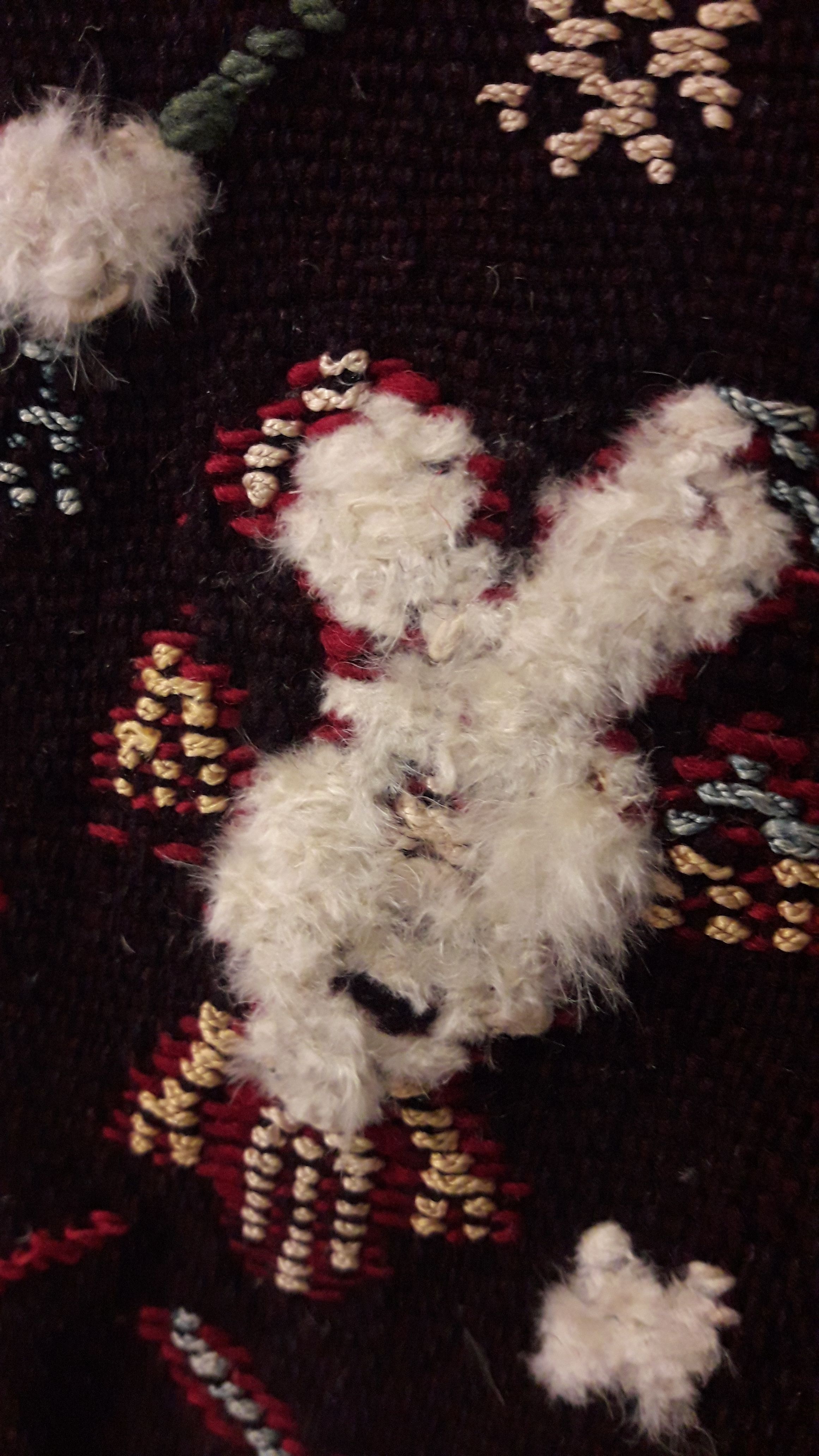
Tlahmachayatl. Detail of the feathered thread. MUCIV – Museo delle Civiltà – Roma.
Tlahmachayatl. Detail of the feathered thread. MUCIV – Museo delle Civiltà – Roma.
.01
A long journey
Collection itineraries of the tlahmachayatl
The Historical Archive of MUCIV - Museo delle Civiltà holds a rich set of documents related to this precious textile, which made it possible to reconstruct a significant part of its long journey to Italy.
Luigi Pigorini (1842-1925), archaeologist and founder of the Royal Prehistoric Ethnographic Museum (now MUCIV), acquired the tlahmachayatl in 1886 from the Zoological Institute of the Royal University of Rome, which had received it as a gift from Pope Pius IX (1792–1878).
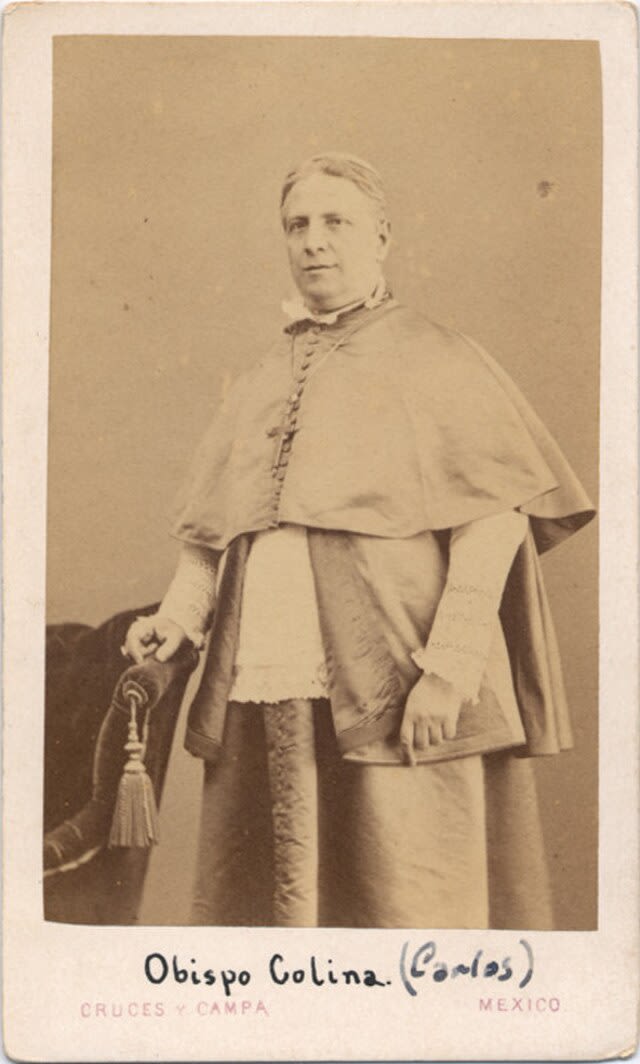
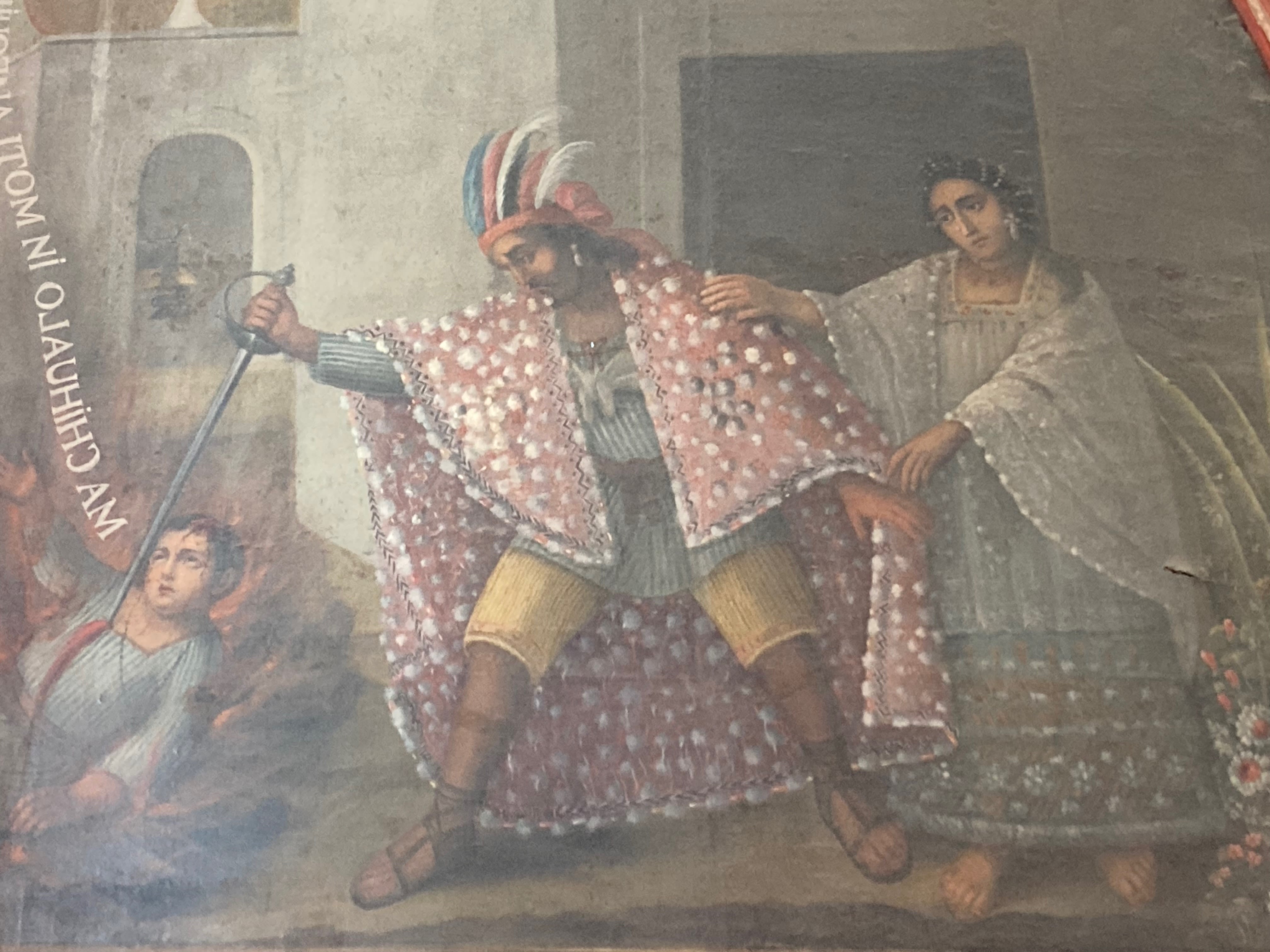
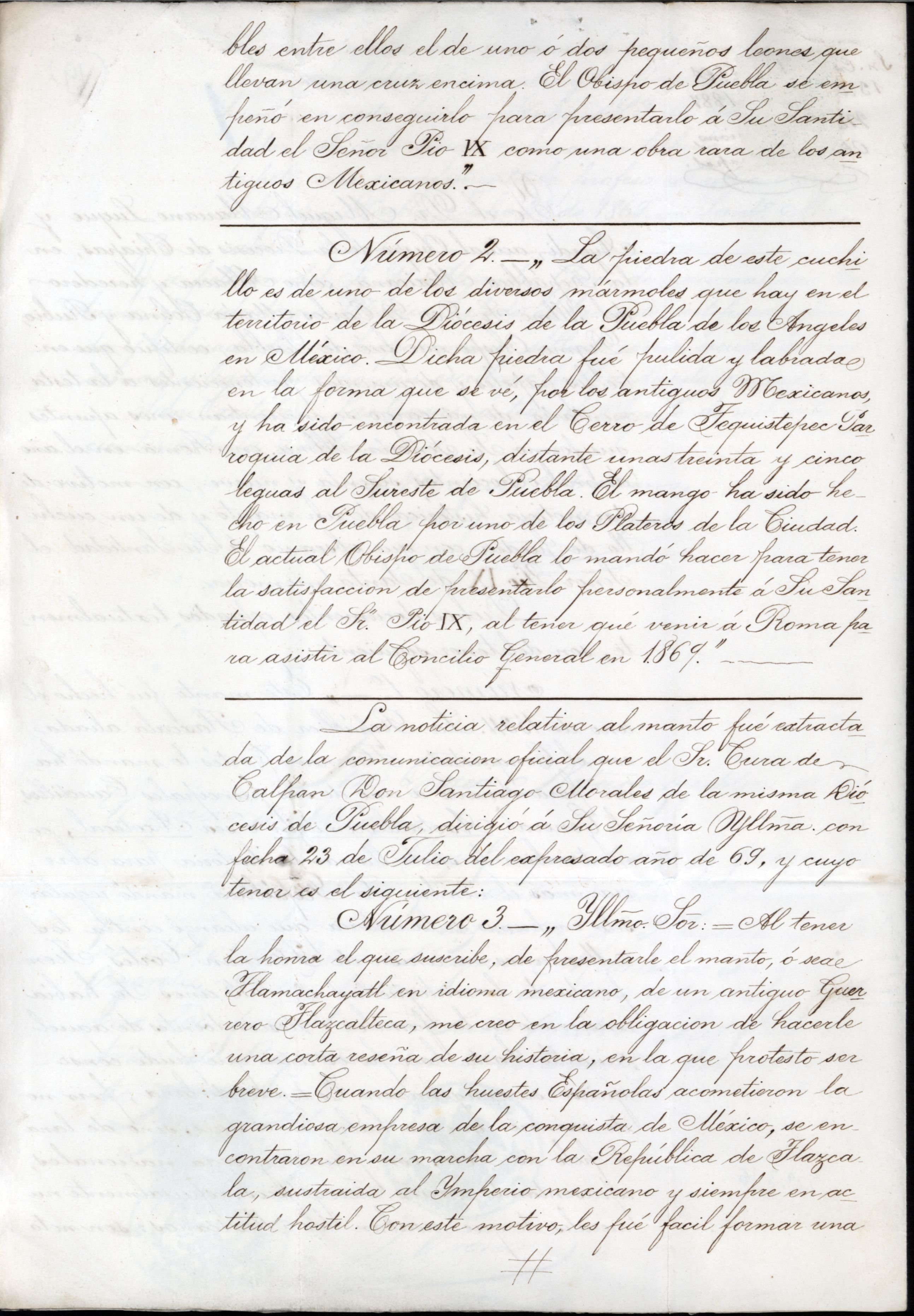
Its earliest mention appears in a handwritten document from 1869, authored by Carlos María Colina y Rubio, bishop of the Diocese of Tlaxcala (Puebla de Los Ángeles), and later added to his will. We read that the tilma was manufactured in 1534 to be gifted to Acxotecatl Cocomitzin, Lord of Atlihuetzia. Acxotecatl was one of the prominent military leaders of the “Republic of Tlaxcala”, proud ally of Hernán Cortés during the Conquest, and the cloak was intended as a symbolic reward for his loyalty to the Spanish crown.
According to the archival source, the mantle remained in the possession of Acxotecatl’s descendants for three centuries, before passing to Don Santiago Morales, “priest of Calpan” and later to Bishop Colina y Rubio, who considered it so valuable to be gifted to Pope Pius IX during his visit to Rome in 1869, adding the aforementioned handwritten description.
This fascinating account contains several details that still require verification. Its technical and stylistic features, especially when compared to later feathered textiles, suggest a much later date - between the 17th and 18th centuries - casting doubt on its attribution to Acxotecatl.
Nevertheless, even if some of the events described are partly fictional, they remain highly significant, as they reflect the great interest this garment aroused among the early figures who encountered it and sought to elevate its origin by linking its production to the period immediately following the Conquest. Perhaps, they recognized its exceptional nature and hybrid character, which today allows us to consider it as one of the outcomes of the processes of identity negotiation and knowledge exchange that shaped the cultural climate of New Spain.

The embroidery is made of feathers of local birds, since they abounded and are still found in the mountains, bonnets made of coarse silk but stronger than the fine one.
Their decorations are in their style and it is well known that if they imitated something from the Spaniards, they mixed their national habits and the flowers that abound so much in this country.

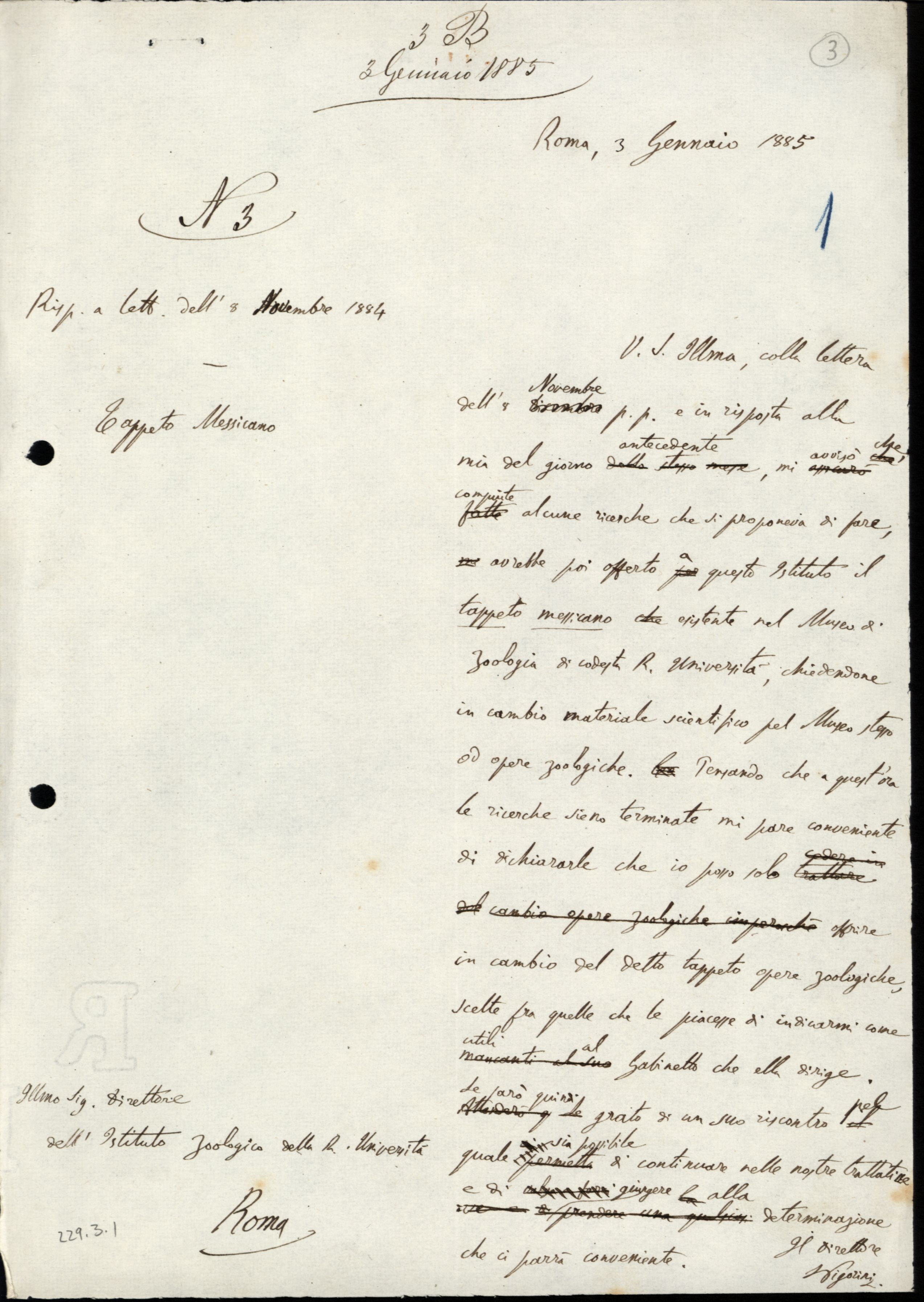






Letter from Luigi Pigorini addressed to the Zoological Cabinet of the Royal University of Rome, January 3, 1885. MUCIV – Museo delle Civiltà – Roma.
Letter from Luigi Pigorini addressed to the Zoological Cabinet of the Royal University of Rome, January 3, 1885. MUCIV – Museo delle Civiltà – Roma.

Portrait of Bishop Carlos Colina y Rubio (Wikimedia Commons, public domain)
Portrait of Bishop Carlos Colina y Rubio (Wikimedia Commons, public domain)

Atlihuetzia, Tlaxcala. Templo de la Purisima Concepción (© Davide Domenici)
Atlihuetzia, Tlaxcala. Templo de la Purisima Concepción (© Davide Domenici)

Letter from Don Santiago Morales to Bishop Carlos Colina y Rubio, July 23, 1869. MUCIV – Museo delle Civiltà – Roma.
Letter from Don Santiago Morales to Bishop Carlos Colina y Rubio, July 23, 1869. MUCIV – Museo delle Civiltà – Roma.

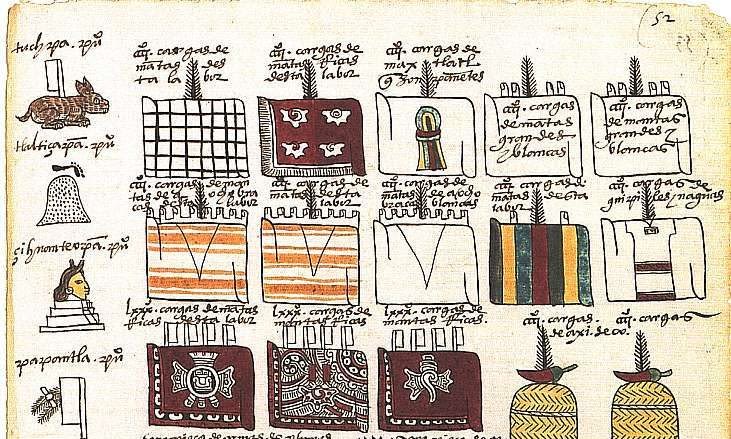
Codice Mendoza, fol. 52r. Detail of cloaks as luxury goods (Wikimedia Commons, public domain)
Codice Mendoza, fol. 52r. Detail of cloaks as luxury goods (Wikimedia Commons, public domain)

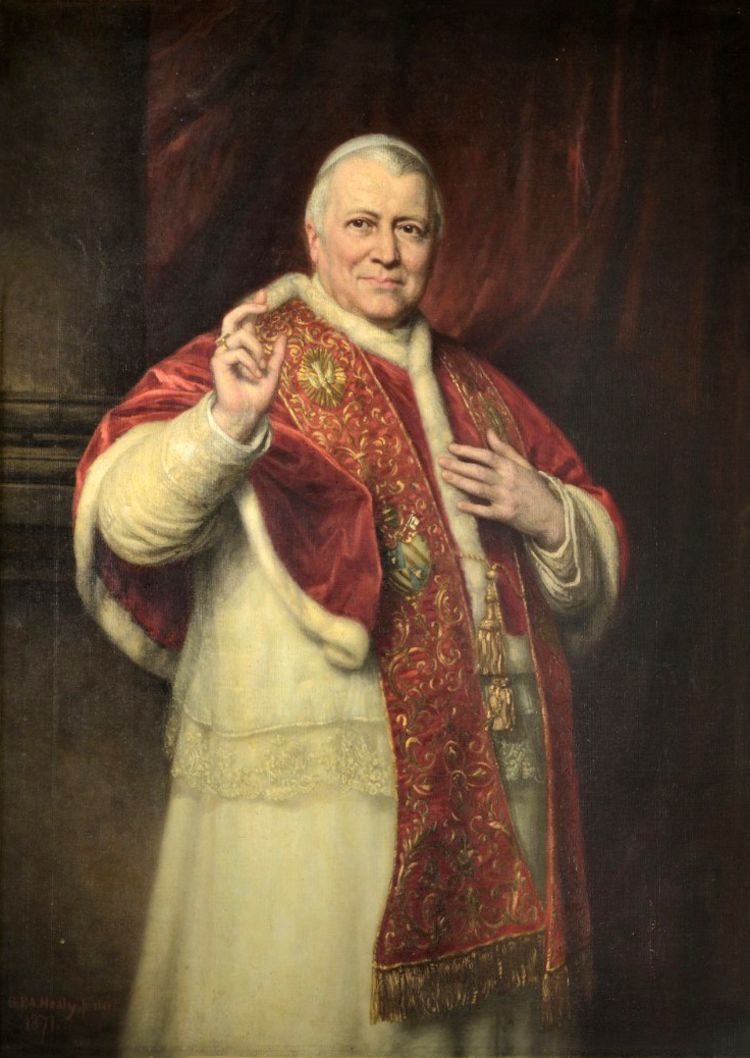
Portrait of Pope Pius IX (Wikimedia Commons, public domain)
Portrait of Pope Pius IX (Wikimedia Commons, public domain)

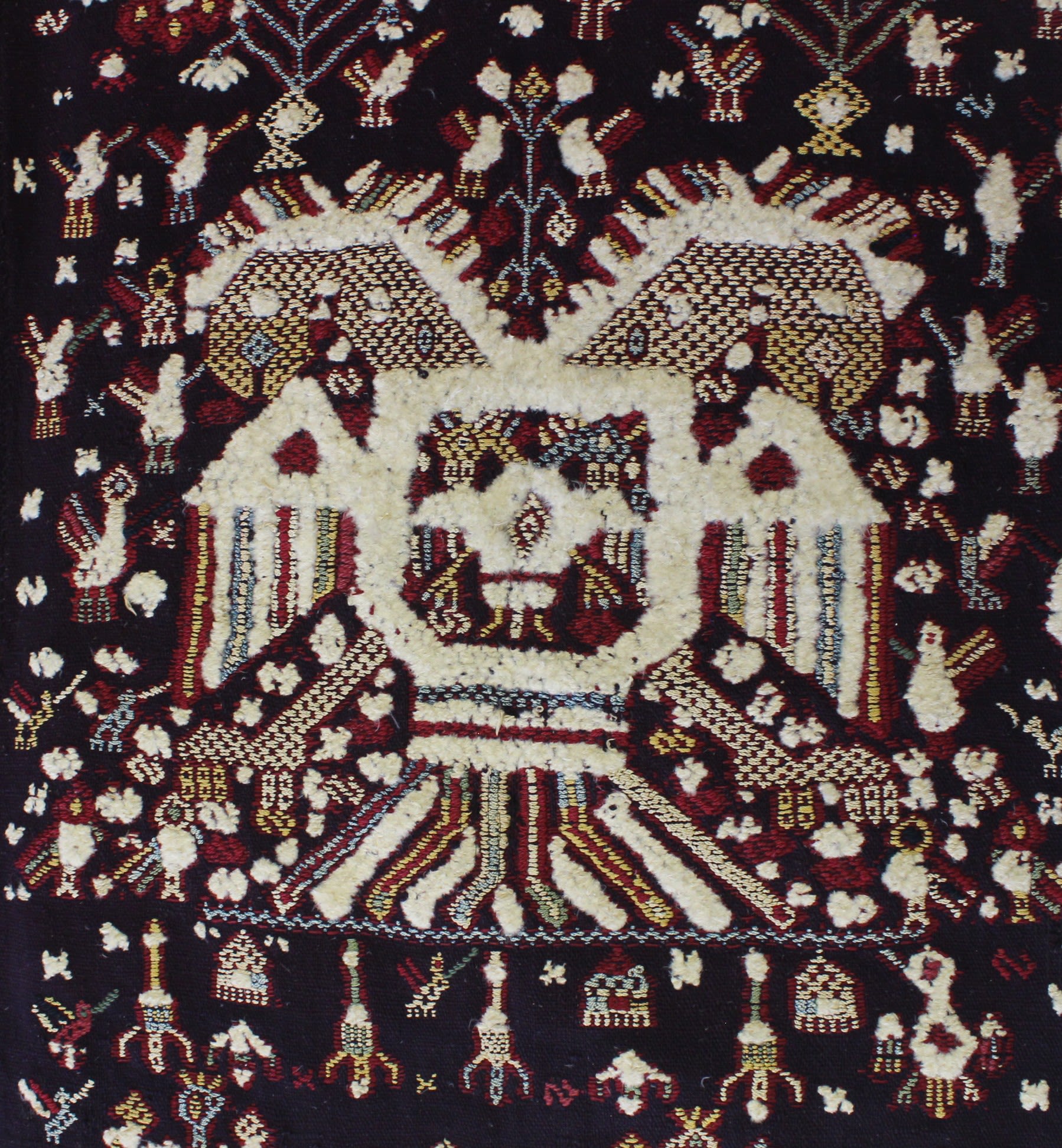
Tlahmachayatl. Detail of the double-headed eagle. MUCIV – Museo delle Civiltà – Roma.
Tlahmachayatl. Detail of the double-headed eagle. MUCIV – Museo delle Civiltà – Roma.

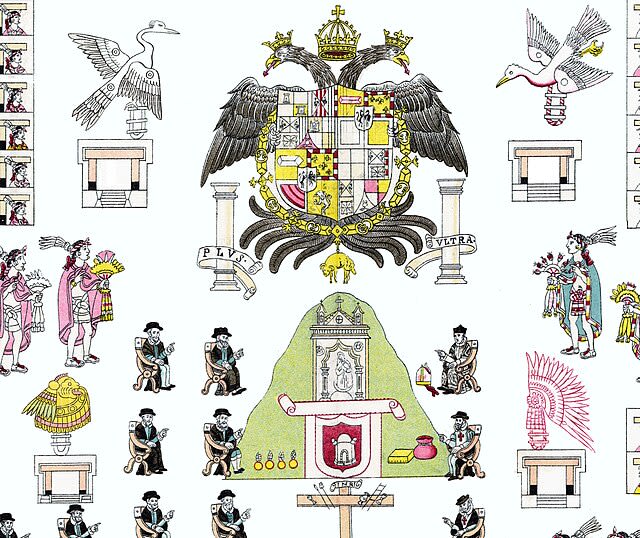
Lienzo de Tlaxcala (Wikimedia Commons, public domain)
Lienzo de Tlaxcala (Wikimedia Commons, public domain)

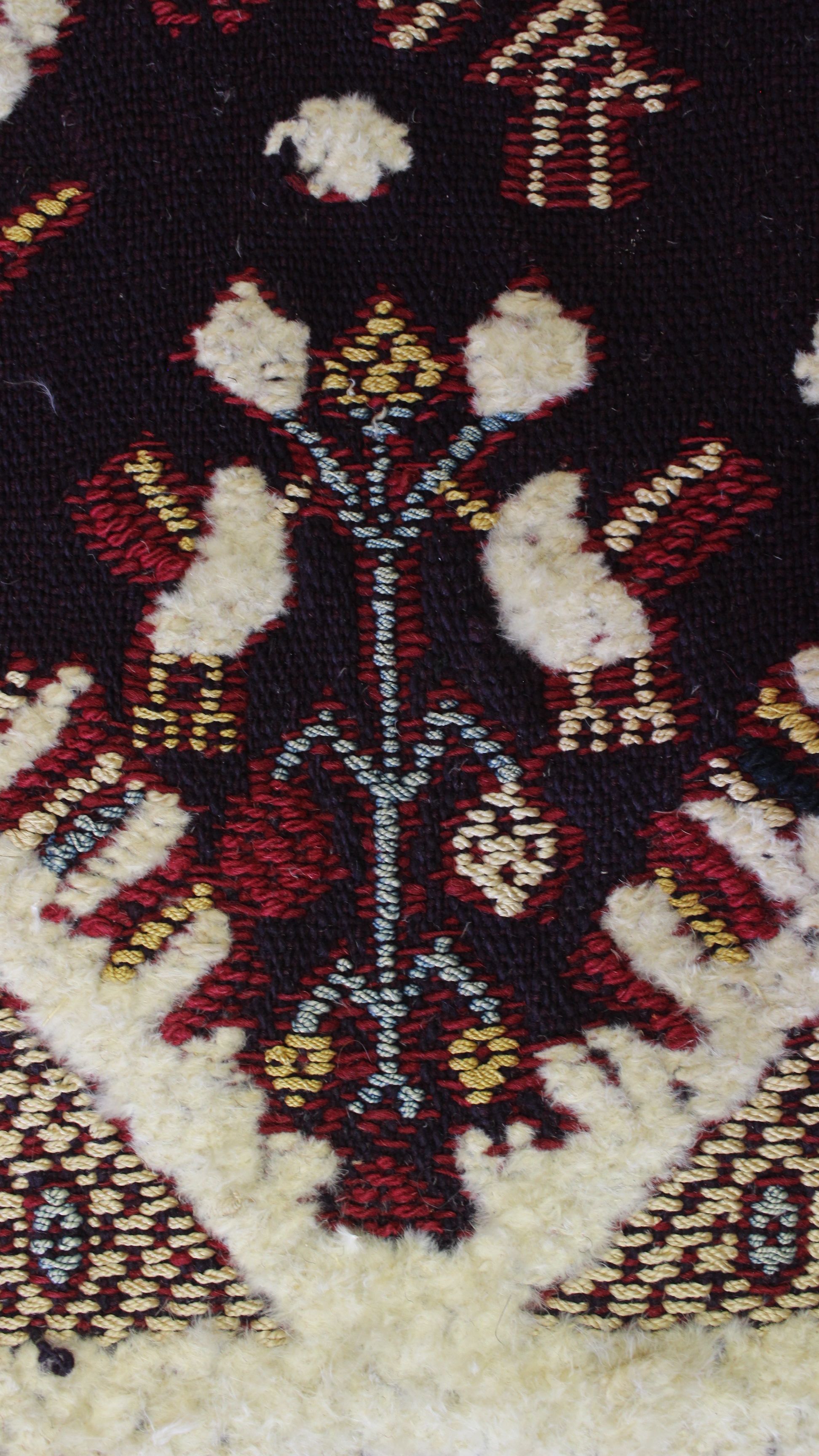
Tlahmachayatl. Detail of birds sipping nectar. MUCIV – Museo delle Civiltà – Roma.
Tlahmachayatl. Detail of birds sipping nectar. MUCIV – Museo delle Civiltà – Roma.

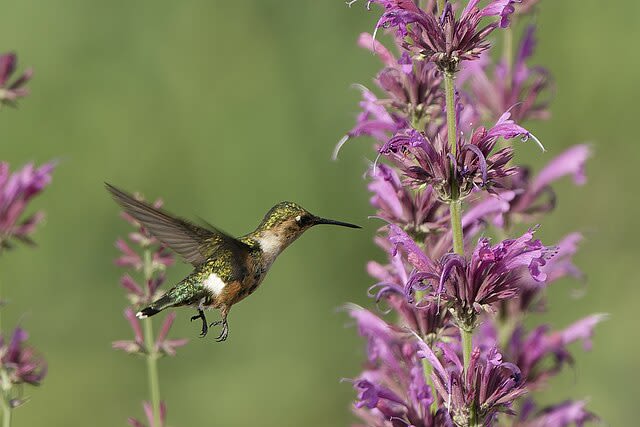
Hummingbird sipping nectar from flowers (Wikimedia Commons, public domain)
Hummingbird sipping nectar from flowers (Wikimedia Commons, public domain)

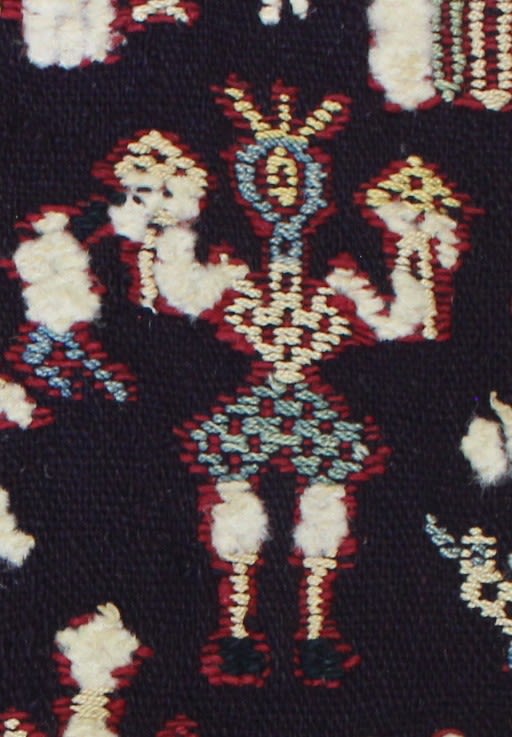
Tlahmachayatl. Detail of an anthropomorphic figure. MUCIV – Museo delle Civiltà – Roma.
Tlahmachayatl. Detail of an anthropomorphic figure. MUCIV – Museo delle Civiltà – Roma.

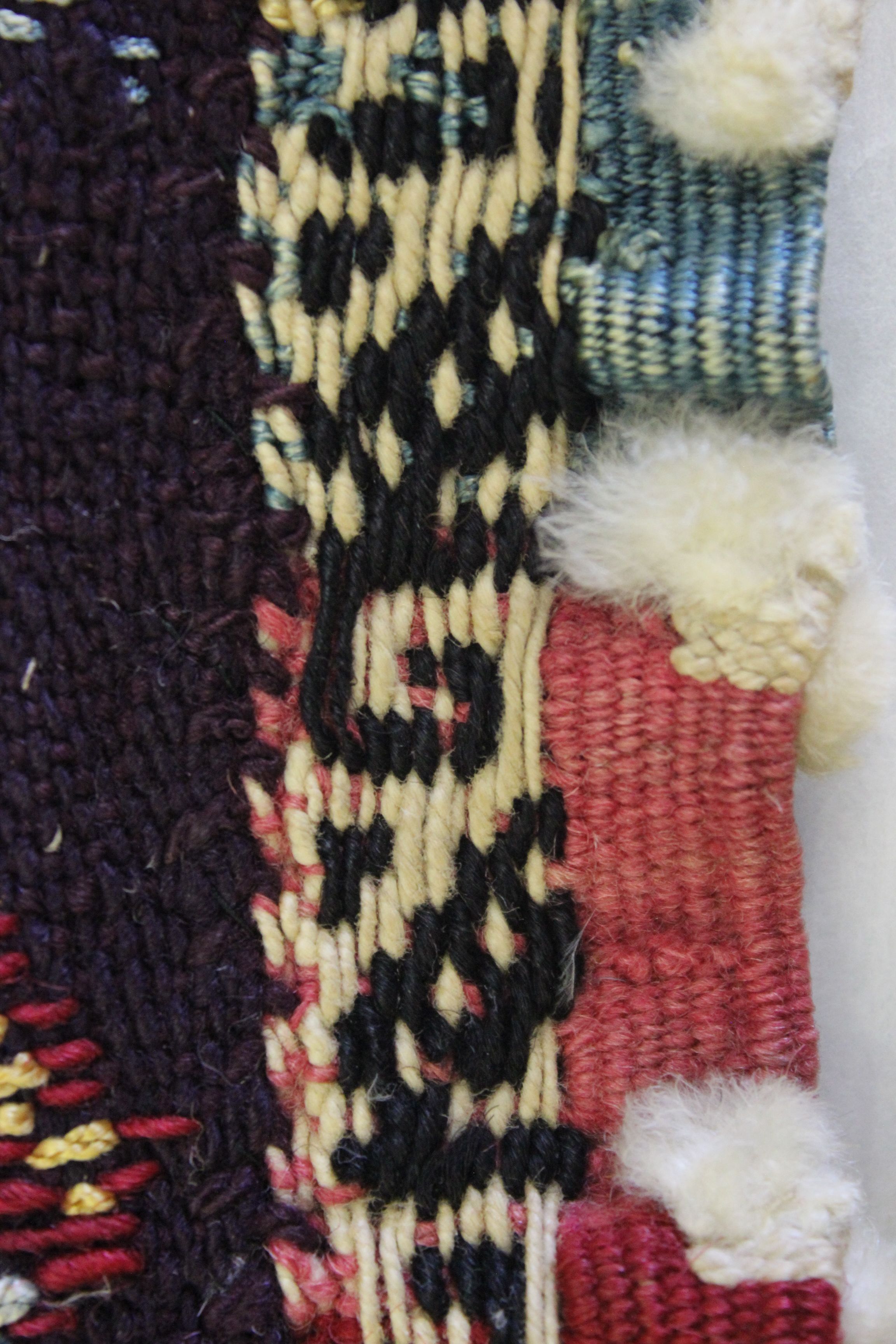
Tlahmachayatl. Detail of xicalcoliuhqui motif. MUCIV – Museo delle Civiltà – Roma.
Tlahmachayatl. Detail of xicalcoliuhqui motif. MUCIV – Museo delle Civiltà – Roma.
.02
Iconographic encounters
Visual codes across cultures
The tlahmachayatl unveils its richness and variety of elements across the three panels: the motif of the double-headed eagle appears in all three fabrics in an asymmetrical arrangement around the central figure, which is larger in scale. Although not entirely foreign to native iconography, this motif clearly reproduces the coat of arms of the Habsburgs. Other decorative elements - zoomorphic, anthropomorphic, and phytomorphic - are arranged in enclosed registers, forming a dense ensemble of ornaments that gradually taper if the gaze move from bottom to top.
Lush and abundant nature takes center stage in the overall decorative composition, where birds of various sizes and shapes approach the blossoms of polychrome plants with their beaks. Interestingly, most of the birds’ bodies are rendered with feathered threads, in a continuous symbolic interplay between materiality and iconography.
This blossoming landscape seems to evoke “paradisiacal” scenes typical of Mesoamerican oral tradition, where the intoxicating fragrance and vivid colors of flowers, the song of birds, and the fertile natural world welcome and delight the souls of warriors fallen in battle - often celebrated in colonial accounts such as the Cantares Mexicanos songs and Sahagún’s Florentine Codex.
The entire artifact is framed by a double border, divided into two concentric registers: the inner one features geometric decorative motifs, such as the stepped fret of pre-Hispanic origin (xicalcoliuhqui, ‘twisted gourd’ in nahuatl), a prerogative of the nobility; the outer register, by contrast, consists of a succession of polychrome rectangular panels interspersed with small modules of feathered cotton.
Tleon in quittoa a in quechol yuhuā Dios y huitzilini ylihuancano ye ontlachichina ma yahuia ye I yolcueponiya xochitla. Çan ye huitz in papalotl huia ye ompatlãtihuitz ye moçoçouhtihuitz xochiticpac nemia ye ontlachichina ma yuhuia ic y inlcueponia xochitla.
What says the God Swan, the hummingbird? He inhales! Let him be pleasured. A flower is opening its heart. He comes: the Butterfly comes flying, comes winging. He lights on a flower. He inhales! Let him be pleasured. A flower is opening its heart.
.03
Shining materiality
Watching fibers “come to life”
This textile represents an extraordinary example of Mesoamerican craftsmanship, thanks to its chromatic variety and luminous sheen, achieved exclusively through the use of natural dyes.
The down, derived from birds of the Anseriformes order, remains undyed, preserving its natural softness and texture. This choice, in contrast with the other five examples of feathered textiles from the same period, was perhaps intended to highlight the light feathered figures against the dark background.
The presence of wool and silk - fibers not native to the region - adds complexity to the textile’s materiality, creating a hybrid fabric that reflects the convergence of diverse cultural traditions.
What truly sets this artifact apart is the ingenious insertion of soft down between cotton fibers, accomplished by twisting two strands of cotton together. This spiraling motion traps the down, imparting volume, brilliance, and dynamic movement to the weave. Only five other known examples of this technique exist worldwide, all of Mesoamerican origin.
In pre-Hispanic societies, bird plumage was a highly prized material, reserved for the garments of Indigenous nobility. Feather art incorporated the visual and sensory qualities of plumage to create objects imbued with symbolic meaning and ritual function.
Tropical feathers, in particular, were associated with preciousness, elegance, and spiritual delicacy. Their iridescence allowed feathered objects to shimmer, shift in tone, and appear animated by light, air and solar energy (tonalli in nahuatl) - qualities that, in Mesoamerican cosmology, signified “coming to life”.
The artist, or weaver, was seen as one who could capture and crystallize this ephemeral vitality, embedding it into moving matter and making it endure. Silk, imported yet similarly radiant, was probably also perceived as a living material.
Even after the Conquest, amanteca artists continued to adapt feather art to Christian iconography, producing artworks that testify to their ingenuity, resilience, and deep cultural continuity.

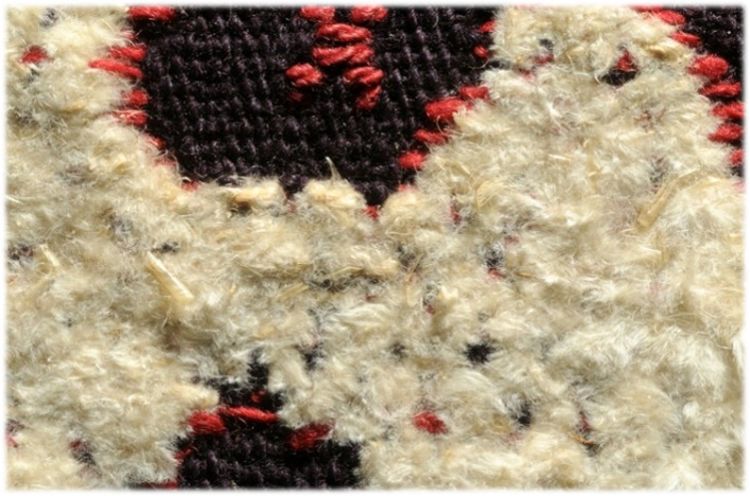
Tlahmachayatl. Detail of the feathered thread. MUCIV – Museo delle Civiltà – Roma.
Tlahmachayatl. Detail of the feathered thread. MUCIV – Museo delle Civiltà – Roma.

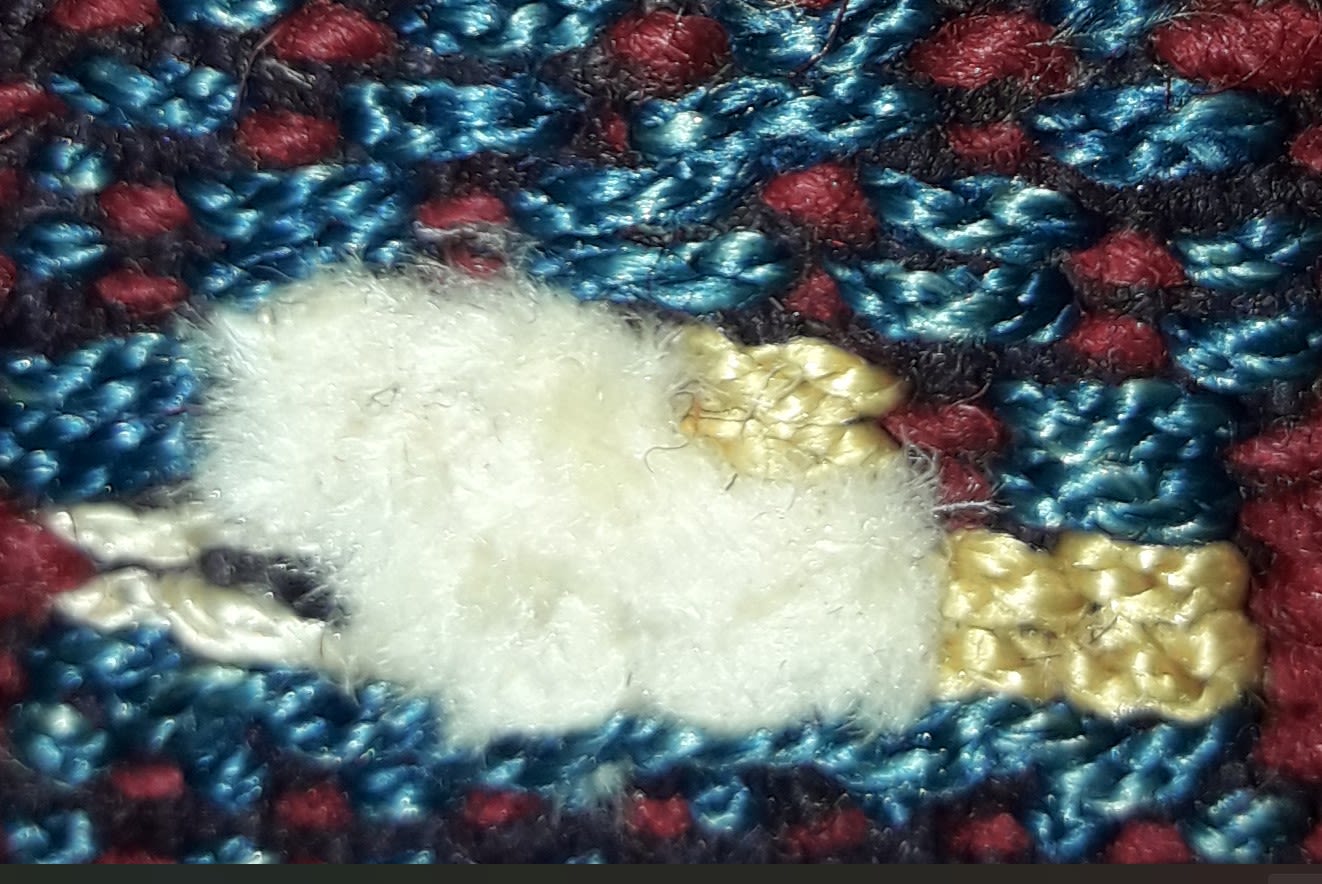
Tlahmachayatl. Detail of shiny silk and down. MUCIV – Museo delle Civiltà – Roma.
Tlahmachayatl. Detail of shiny silk and down. MUCIV – Museo delle Civiltà – Roma.


Northern Shoveler (Spatula clypeata) (Wikimedia Commons, public domain)
Northern Shoveler (Spatula clypeata) (Wikimedia Commons, public domain)

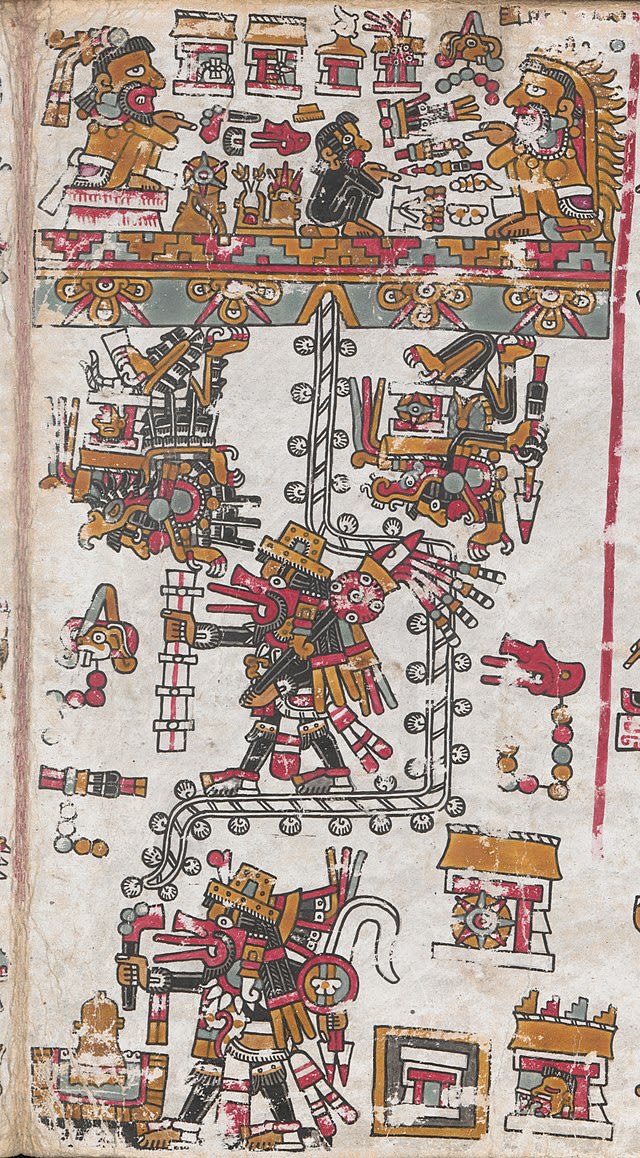
9 Wind descending along a thread adorned with feathers. Codex Vindobonensis, ANL/Vienna, Cod. Mexic. 1, fol. 48 https://viewer.onb.ac.at/117C476F/
9 Wind descending along a thread adorned with feathers. Codex Vindobonensis, ANL/Vienna, Cod. Mexic. 1, fol. 48 https://viewer.onb.ac.at/117C476F/
The feather seller [is] a bird owner. She raises the birds... She plucks feathers from her back and chest; she plucks soft feathers. She spins [the markers] split. She spins feathers, spins them in an even thread... She spins them freely, spins them firmly; she uses the spindle, she spins them loosely on the spindle, she spins them tight on the spindle.
.04
Under a new light
Scientific Insights into the Materiality of the tlahmachayatl
An interdisciplinary project of chemical analyses, launched in 2022, enabled a scientific investigation through the Italian mobile laboratory MOLAB of the National Research Council of Italy (CNR ISPC and CNR SCITEC) and the Centre SMAArt, University of Perugia. This was possible thanks to the support of E-RIHS.it (European Research Infrastructure for Heritage Science).
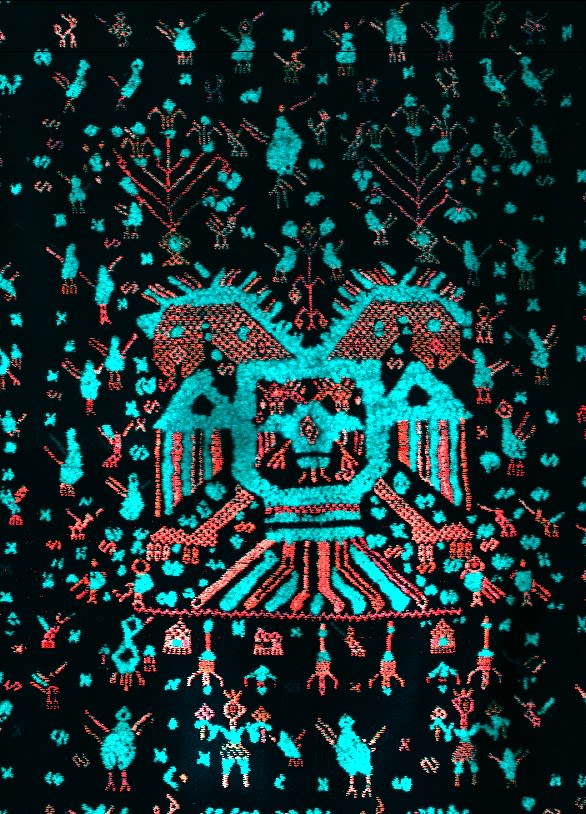
A non-invasive approach combining single-point techniques (XRF, FTIR, Raman, UV-VIS-NIR reflectance/fluorescence) and imaging methods (VIS-NIR-SWIR hyperspectral imaging) was applied to study the textile’s materiality. These analyses allowed the identification and mapping of organic fibres and down, their distribution across the garment, and the documentation of dyeing materials and techniques.
To integrate results, a few fibres were collected from the back and edges of the fabric, while the SERS (Surface-Enhanced Raman Spectroscopy) was used to investigate red and yellow dyes.
FT-IR and hyperspectral imaging confirmed the nature of the yarns previously identified by visual inspection.
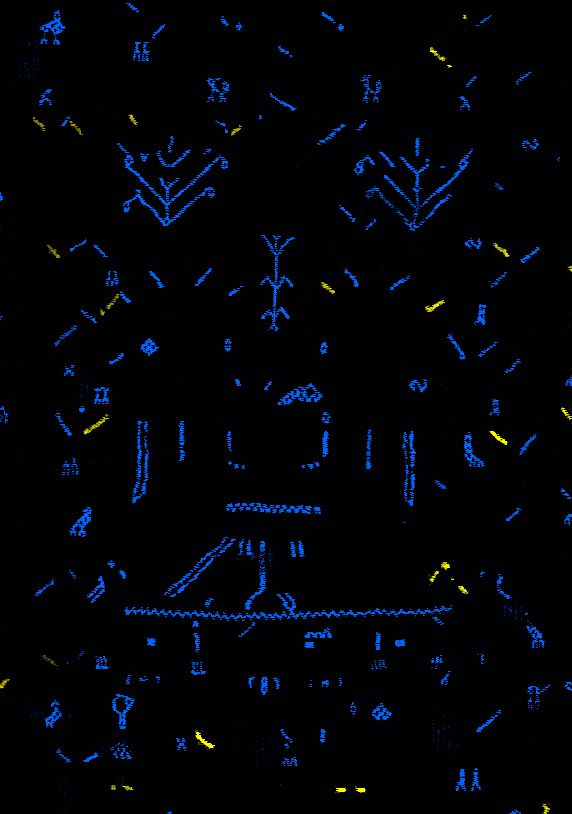
UV-VIS-NIR reflectance and Raman analyses revealed indigo on black wool and blue silk threads. Indigo was also detected in green decorations, mixed with a yellow organic dye to achieve the desired tone. The same dye was likely used for the yellow silk fibres. On the purple background, wool threads were dyed with a mixture of cochineal and blue dye. The red animal dye was, unsurprisingly, the most widely used for all red tonalities.
XRF analyses on all colours aimed to detect mordants. Although aluminium was slightly higher in yellow threads, no clear separation between mordanted and non-mordanted fibres was evident. A distinction was, however, observed between silk and wool based on sulphur content, consistent with their proteinaceous nature.
The findings reveal diverse textile traditions in the making of the tlahmachayatl, confirming the use of indigenous dyeing techniques and chromophores (indigo, cochineal, flavonoids, and mixtures) on non-native fibres such as wool and silk. This hybrid materiality reflects the adaptability and innovation of colonial textile artists, who merged local and imported practices with remarkable creativity.
I dye. I make something cochineal-colored. I apply cochineal. I paint things with colors. I apply colors. I blend colors. I thicken colors. I make something chili-red. I become chili-red. I bring out color. […] It is very good, firm, vivid, a real chili-red, very much like blood, like fresh blood.

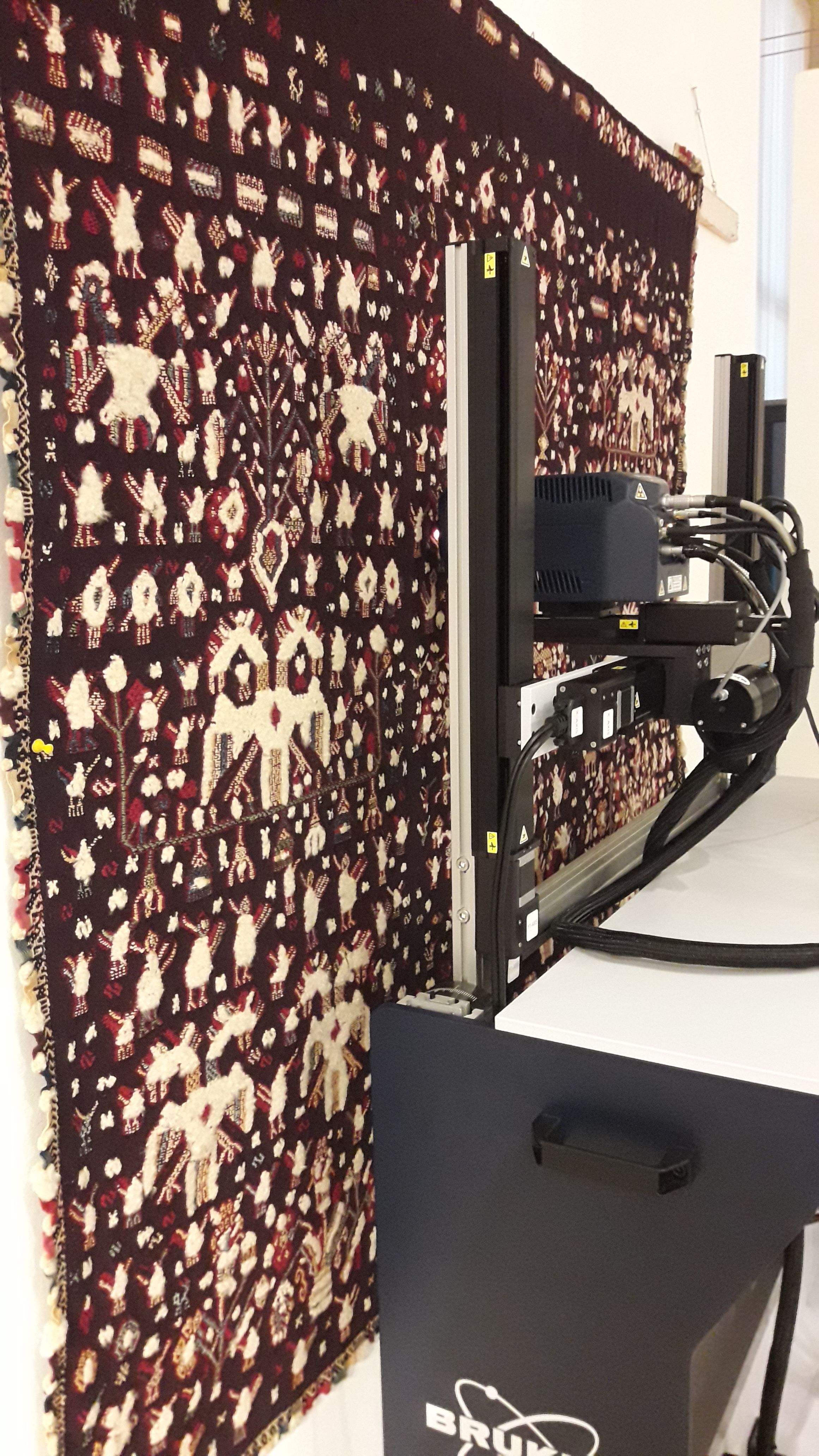





VIS-NIR-SWIR Hyperspectral Scanner. MUCIV – Museo delle Civiltà – Roma.
VIS-NIR-SWIR Hyperspectral Scanner. MUCIV – Museo delle Civiltà – Roma.

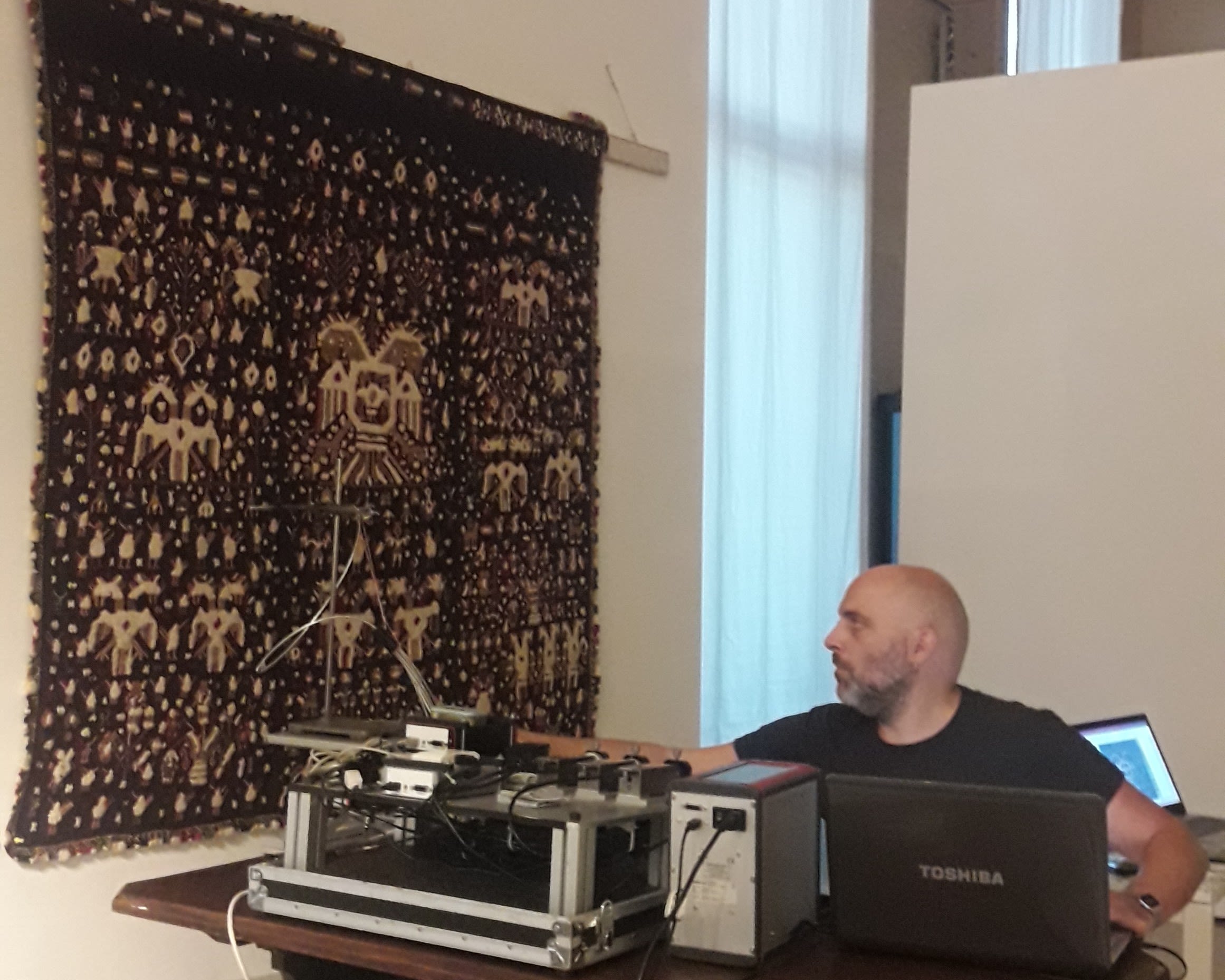
MOLAB team conducting FTIR analysis on-site. MUCIV – Museo delle Civiltà – Roma.
MOLAB team conducting FTIR analysis on-site. MUCIV – Museo delle Civiltà – Roma.

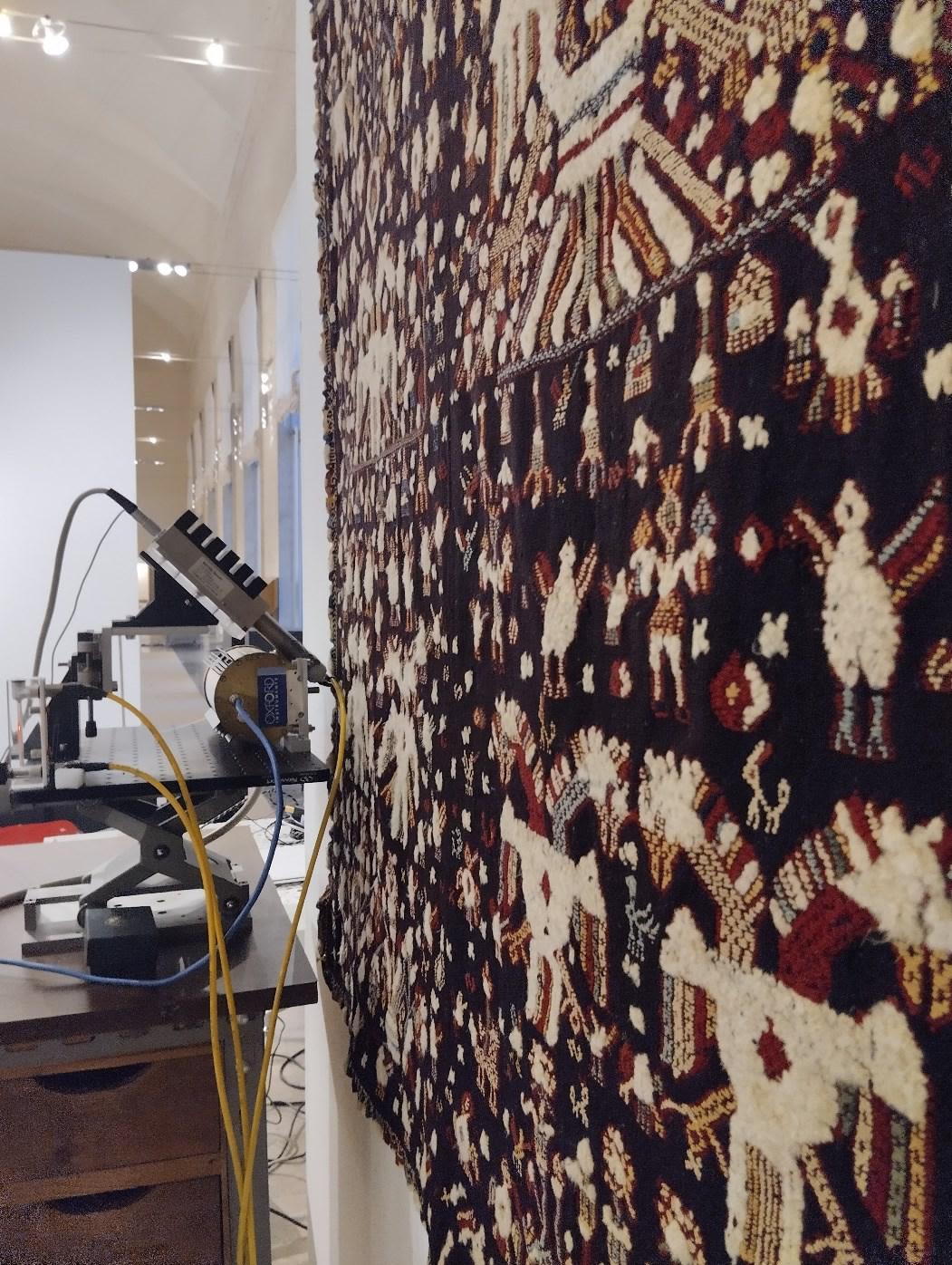
MOLAB operator carrying out UV-VIS-NIR Reflectance & Fluorescence analysis. MUCIV – Museo delle Civiltà – Roma.
MOLAB operator carrying out UV-VIS-NIR Reflectance & Fluorescence analysis. MUCIV – Museo delle Civiltà – Roma.

Low Energy XRF spectrometer. MUCIV – Museo delle Civiltà – Roma.
Low Energy XRF spectrometer. MUCIV – Museo delle Civiltà – Roma.

SWIR Hyperspectral map highlighting the organic fibres and down distribution (wool: black; silk: red; down: cyan;) (©MOLAB)
SWIR Hyperspectral map highlighting the organic fibres and down distribution (wool: black; silk: red; down: cyan;) (©MOLAB)

SWIR Hyperspectral map highlighting the distribution of indigo (yellow: black wool; blue: blue silk and green silk/wool); (©MOLAB)
SWIR Hyperspectral map highlighting the distribution of indigo (yellow: black wool; blue: blue silk and green silk/wool); (©MOLAB)
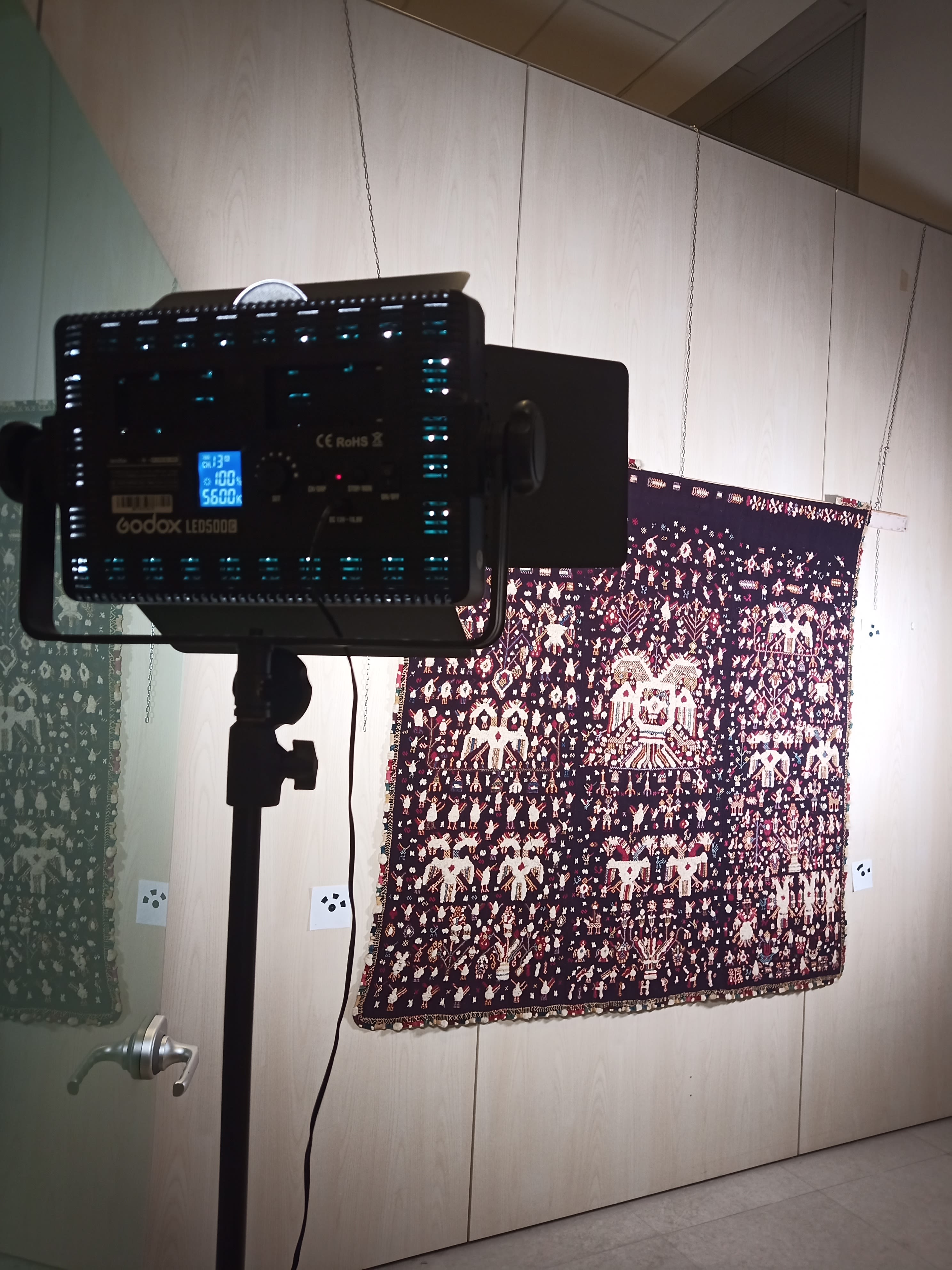
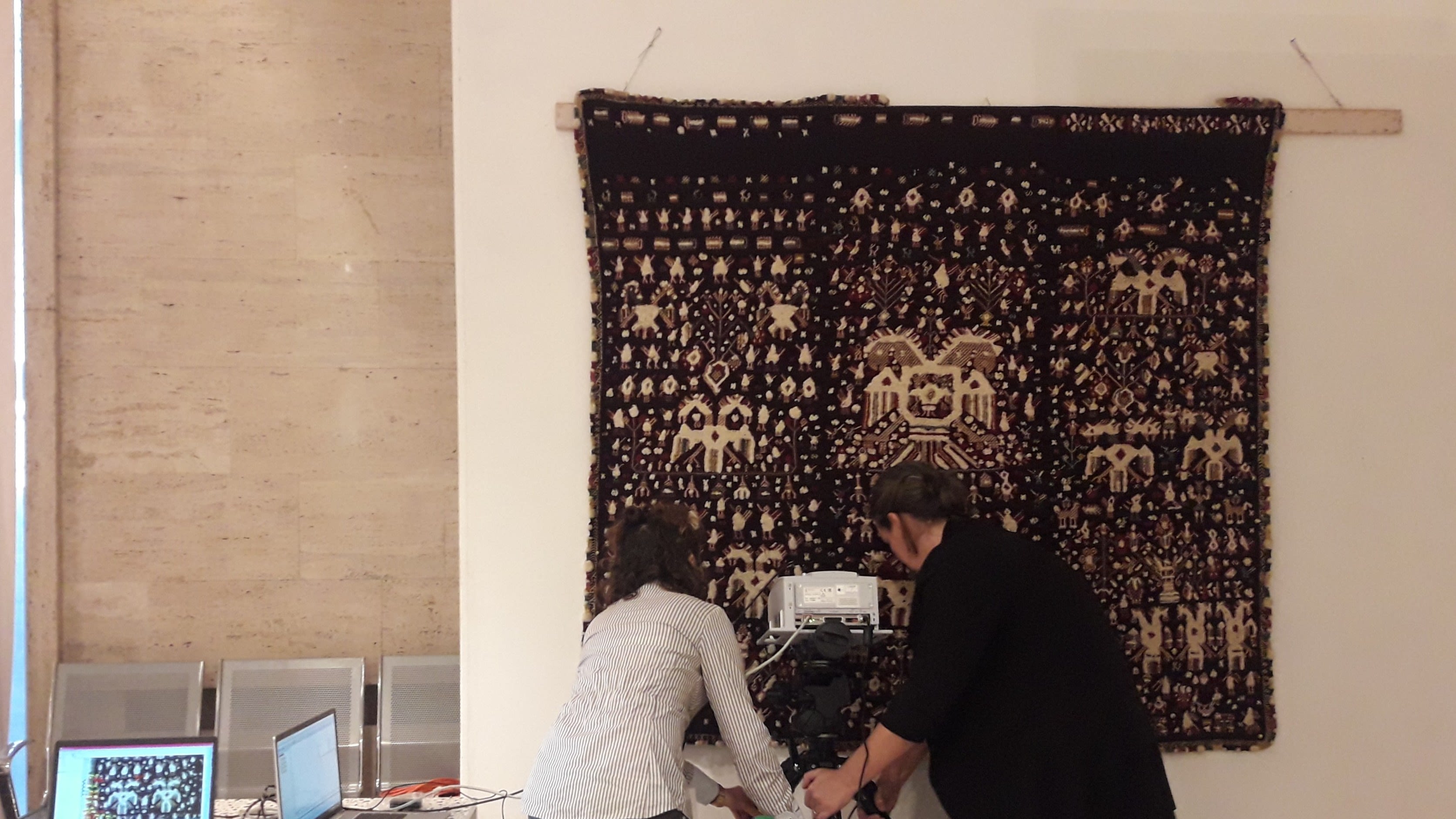
Data acquisition setup for the construction of the 3D model of the tlahmachayatl by CNR ISPC. MUCIV – Museo delle Civiltà – Roma.
Data acquisition setup for the construction of the 3D model of the tlahmachayatl by CNR ISPC. MUCIV – Museo delle Civiltà – Roma.
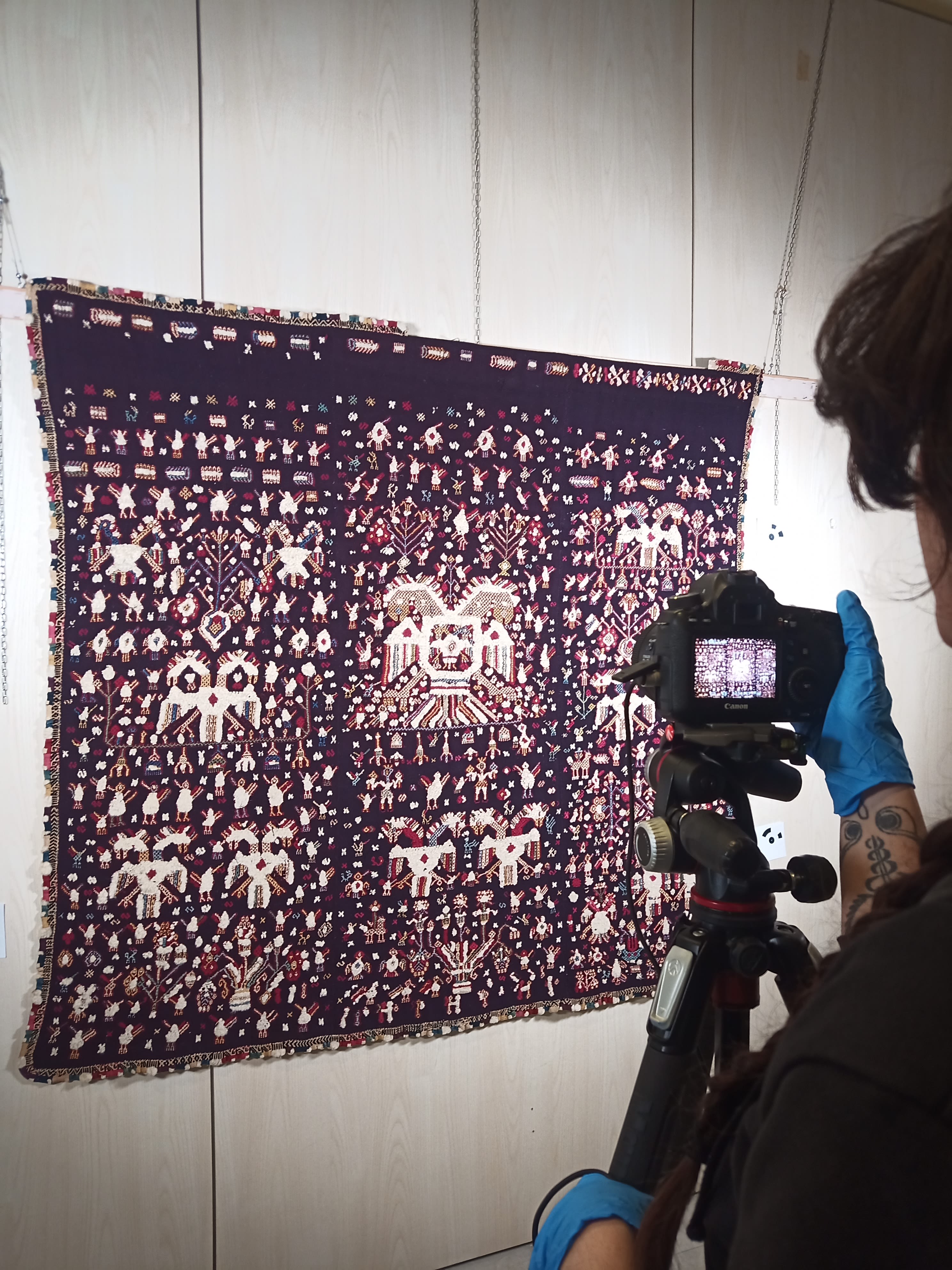
Operator capturing images of the tlahmachayatl by CNR ISPC. MUCIV – Museo delle Civiltà – Roma.
Operator capturing images of the tlahmachayatl by CNR ISPC. MUCIV – Museo delle Civiltà – Roma.
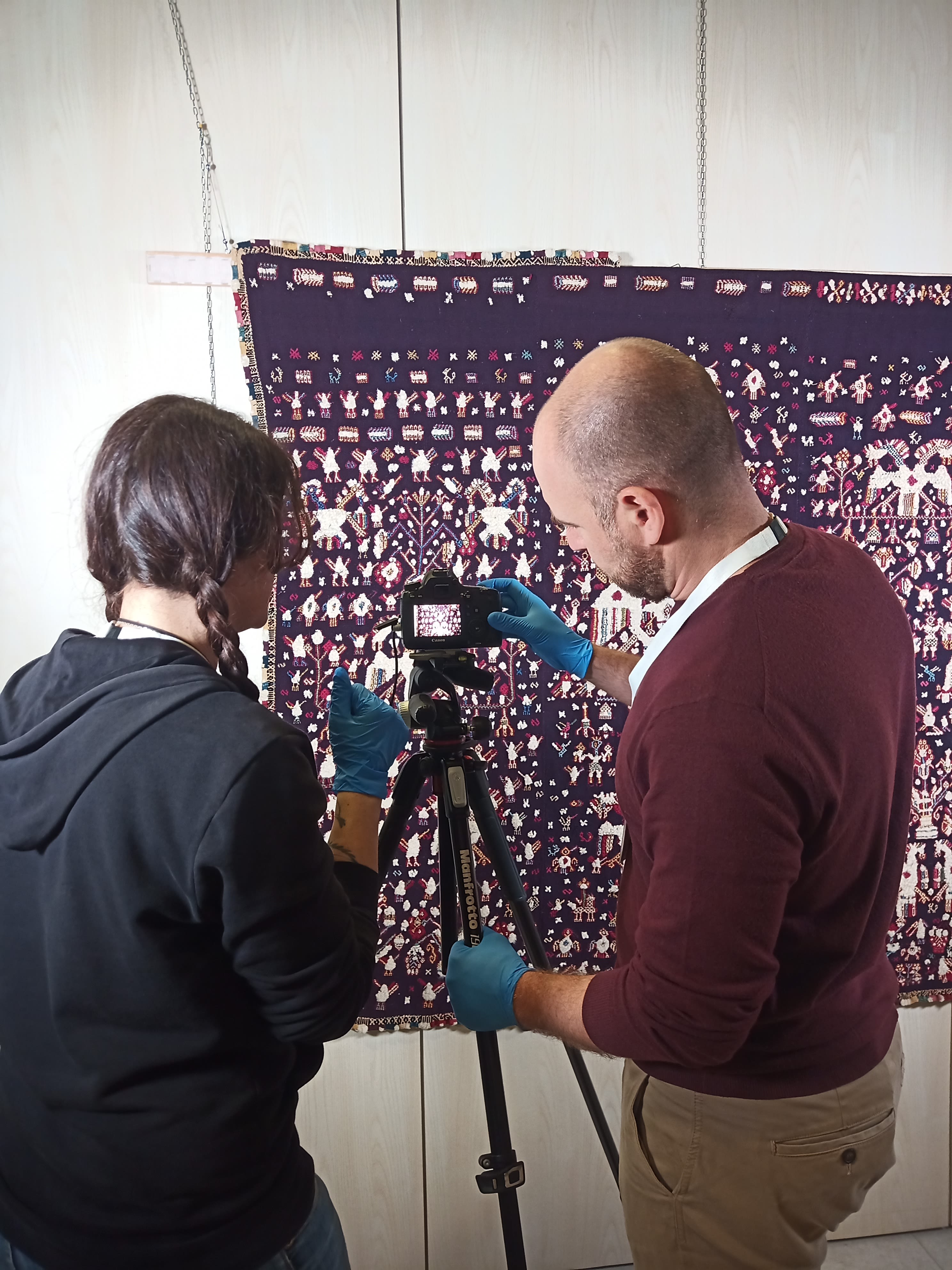
Operators reviewing the photographic acquisitions of the tlahmachayatl by CNR ISPC. MUCIV – Museo delle Civiltà – Roma.
Operators reviewing the photographic acquisitions of the tlahmachayatl by CNR ISPC. MUCIV – Museo delle Civiltà – Roma.

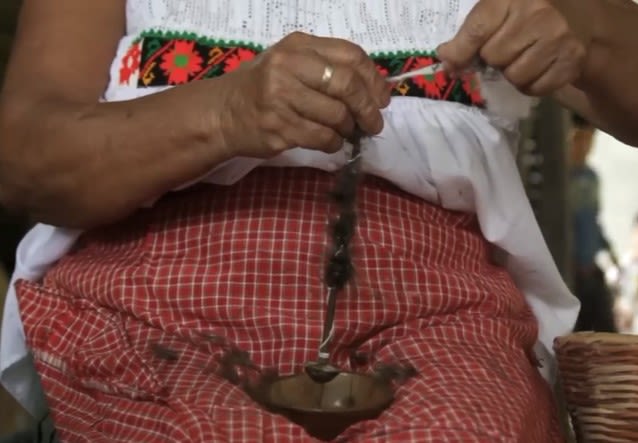
Video frame from the INAH film on feather spinners from Chicontepec, Veracruz, Mexico (©INAH).
Video frame from the INAH film on feather spinners from Chicontepec, Veracruz, Mexico (©INAH).

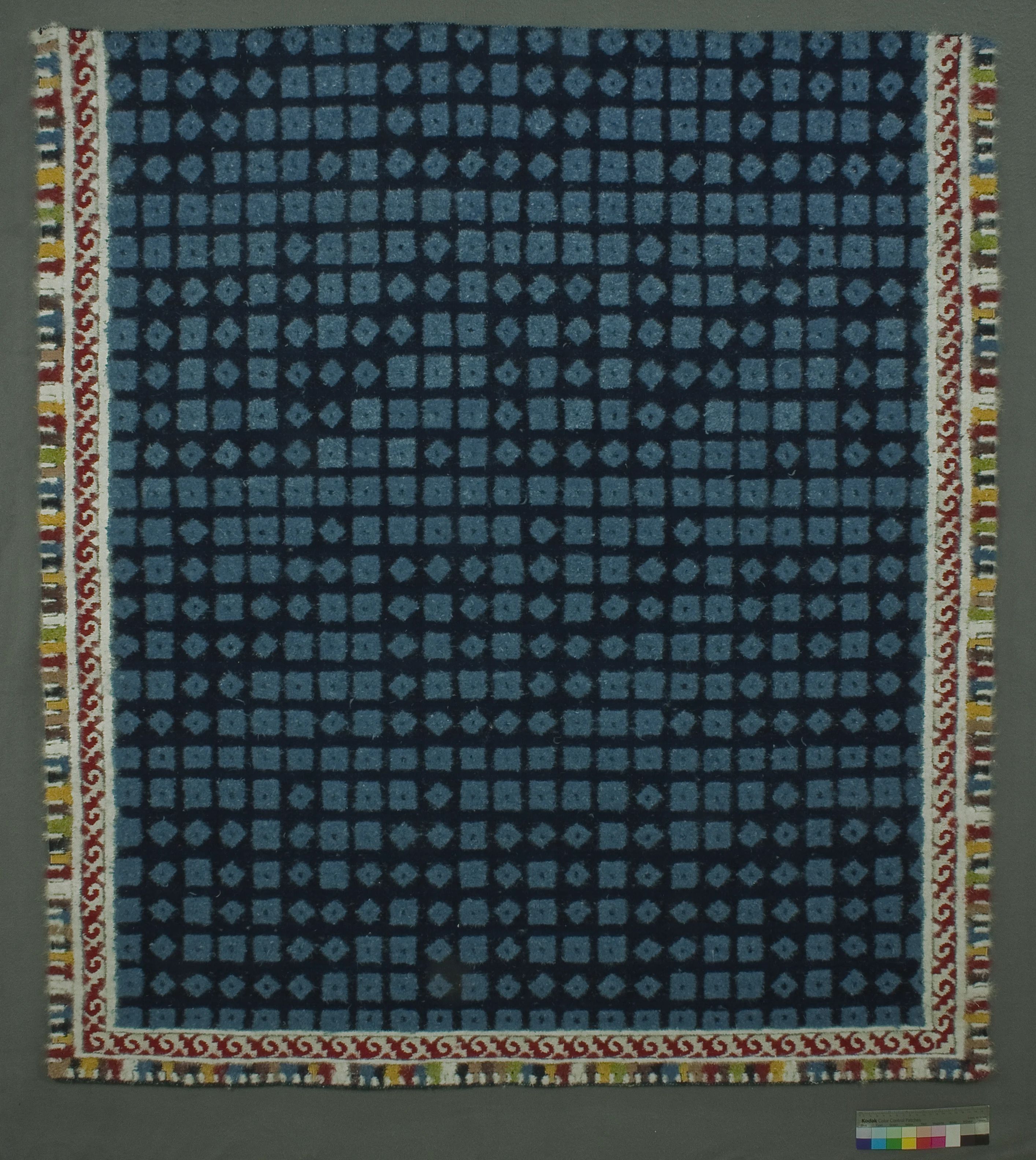
Román Gutiérrez, Tilma, 2008. Teotitlán del Valle, Oaxaca (©Col. Museo Textil de Oaxaca / Fundación Alfredo Harp Helú Oaxaca, Mexico)
Román Gutiérrez, Tilma, 2008. Teotitlán del Valle, Oaxaca (©Col. Museo Textil de Oaxaca / Fundación Alfredo Harp Helú Oaxaca, Mexico)
.05
A (virtual) way back home
The tlahmachayatl in the digital era
Today, the tlahmachayatl continues to captivate with its fascinating composite nature, a living testimony of spontaneous material and iconographic syncretism, where ancient knowledge intertwines with new forms on the fertile ground of creativity.
Thanks to the digitization campaign recently undertaken in collaboration with CNR ISPC as part of the KNOT project, a 3D model of the tlahmachayatl has been acquired and made accessible through this platform. This allowed for global dissemination without subjecting the artifact to the risks of a transatlantic journey that could compromise its integrity. This initiative has opened a new chapter in the social life of this precious textile, projecting it into the contemporary world and enabling its restitution as a sort of “homecoming”—even if only in virtual form.
In some present-day Indigenous communities of Mexico, ancient textile traditions continue to thrive, preserving techniques that date back to the pre-Hispanic era. One remarkable example is found in Chicontepec de Tejeda, a Nahua municipality located in the state of Veracruz. Here, in the village of Ayacaxtle - part of the Chicontepec region - local weavers maintain the practice of spinning turkey down, a delicate and labor-intensive fiber, by intertwining it with cotton yarns. The twisted feather technique has been revived by Román Gutiérrez in Teotitlán del Valle. This traditional method involves tightly twisting duck down together with two strands of cotton. Using a spinning wheel, the two cotton threads are combined with the down to create a two-ply feathered yarn, resulting in a richly textured and distinctive fiber.
The digital model of the mantle will enable awareness of this textile to reach the original places where feather weavers live today, such as Ayacaxtle or Teotitlán, offering historical depth to local knowledge and practices, and inspiring the creativity of today’s artisans working at the loom.
Of down interwoven with cotton itself, they made blankets, bedspreads, tapestries, tunics, and other pieces as soft as they were beautiful. I have seen some striking blankets of this kind that are still preserved by certain noblemen today, and they often wear them during extraordinary festivities.


 Built with Shorthand